Achallader Castle: A Sixteenth-Century Tower House in Scotland
Site at a Glance
- Popularity
- Medium
- Country
- United Kingdom
- Primary era
- Early Modern
- Eras represented
- Early Modern
- Civilizations
- Kingdom of Scotland
- Site type
- Military
- Remains
- Castle
On this page6 sections
History
Achallader Castle is a ruined tower house, a fortified residence built as a tower, at the northern end of Loch Tulla near Bridge of Orchy in Argyll and Bute, United Kingdom. Built in the sixteenth century and enlarged by local clans over the following decades, it later became a setting for negotiations between Highland chiefs. The name comes from Scottish Gaelic and means “field with hard water”; Caisteal Achaladair is its Gaelic form, and Achaladair Castle is another name.
Clans and Campbell ownership
The Fletchers, also known as Mac an Fhleister, are traditionally credited with being the first to establish a household on the Braes of Glenorchy. The MacGregors held authority in the area during the fifteenth century. Both were Highland clans, kinship groups commonly led by chiefs.
Sir Duncan Campbell of Glen Orchy acquired the castle and its surrounding lands in 1587. A tradition about the transfer tells that an English servant or soldier allowed his horse to graze in the Fletchers’ corn. The Fletchers warned him in Gaelic, but he did not understand and failed to move the animal, so they shot him. Known as Black Duncan, Campbell is said to have feared that the Fletcher chief would be hanged and urged him to flee to France. Before leaving, the chief entrusted his property to Campbell, hoping to prevent its forfeiture to the Crown until he returned. The Fletchers never regained their lands.
Destruction and Highland negotiations
In 1603, the MacGregors burned the castle. In the summer of 1683, a commission for the settlement of the Highlands, led by Sir William Drummond of Cromlix, stayed there and welcomed Alasdair MacIain MacDonald, the twelfth Chief of Glencoe. MacIain was later killed in the Glencoe Massacre of 1692, in which members of his clan were killed.
In 1689, after victory at Killiecrankie and a repulse at Dunkeld, the MacIains pulled down what they could of the castle. It was not rebuilt. In June 1691, John Campbell, Earl of Breadalbane, met Highland chiefs among the ruins, acting with authority from King William. He used threats, promises of bribes, and deception to persuade most clans, but not the MacIains, to sign a treaty. Secret provisions gave the chiefs the right to seek release from their oaths to the exiled James VII of Scotland and James II of England, the two titles of the same king. Campbell later denied those provisions, and the promised bribes were never paid.
The castle and its burial ground received protection as a scheduled monument on 7 December 1978. In Scotland, this status gives legal protection to a historic or archaeological site.
Remains
Surviving structure
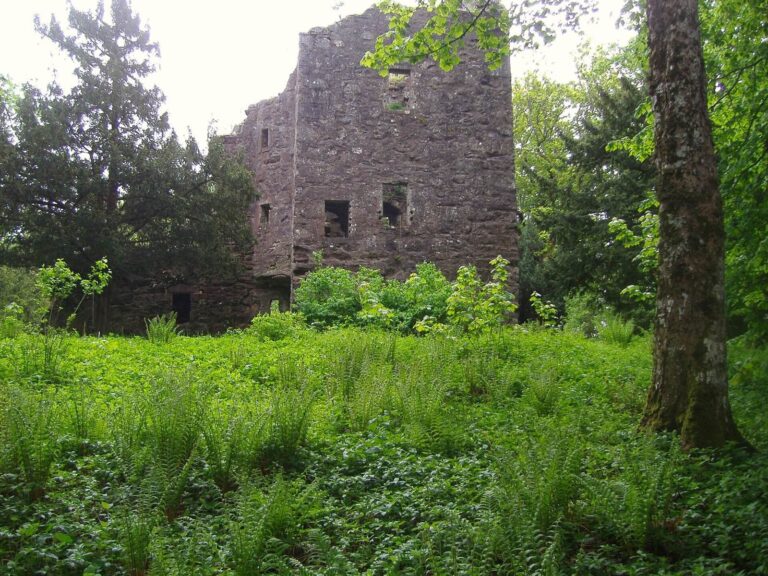
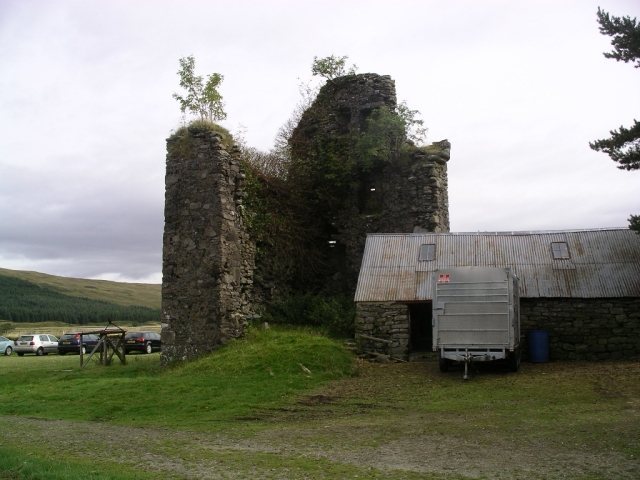
The ruin lies beneath Beinn Achaladair, about 5.5 kilometres north of Bridge of Orchy. The main house once had three storeys and a garret, a room beneath the roof, and its defences included shot-holes, narrow openings through which defenders could fire. Two walls remain and shelter farm buildings at Achallader Farm. One wall retains a trace of corbelling, masonry projecting outward to support a structure above.
Burial ground
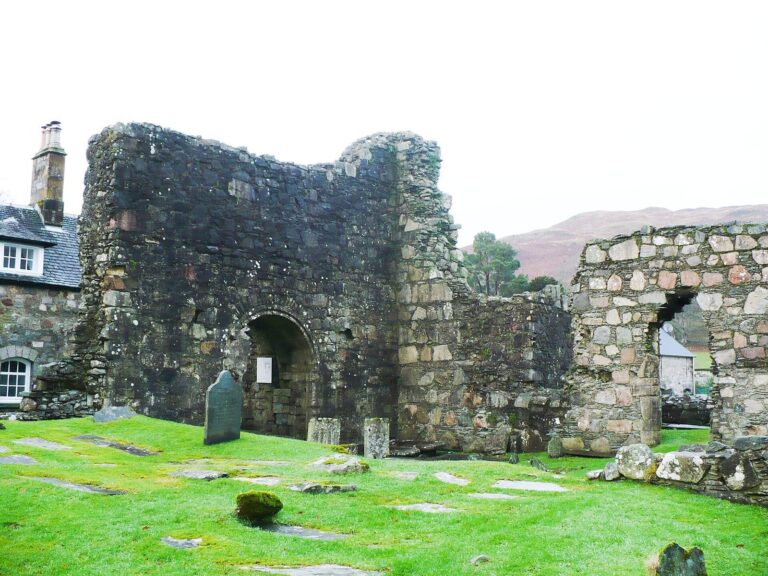
A burial ground is associated with the castle.