Cesena Cathedral: The Episcopal Church of Cesena, Italy


Site at a Glance
- Rating
- 4.4
- Popularity
- Low
- Country
- Italy
- Primary era
- Medieval
- Eras represented
- Medieval, Early Modern, Modern
- Civilizations
- Papal States
- Site type
- Religious
- Remains
- Cathedral
On this page19 sections
History
Cesena Cathedral, dedicated to Saint John the Baptist, is the principal Catholic church in Cesena, Italy, and the episcopal seat of the Diocese of Cesena-Sarsina. Its rebuilding began in 1385 and was completed around 1405 in a German Gothic hall-church design. The cathedral has served as the religious centre of the city through successive periods of Malatesta rule, Renaissance patronage, Baroque renewal, and modern restoration.
Relocation and medieval rebuilding
Before the Malatesta lordship shaped the city’s later medieval development, the cathedral stood within the elevated citadel called the Murata, in the area now occupied by Cesena’s Sferisterio. In 1378, Galeotto I Malatesta ordered a new cathedral in the Croce di Marmo district. The chosen site was occupied by the former church of Saint Anthony the Abbot, near the meeting point of the Via Emilia and the ancient Salt Road leading to Cervia.
Pope Urban VI authorized the rebuilding through a papal bull. Work began under Andrea Malatesta, who financed the project, and continued for approximately two decades. The design was attributed to a master from Unterwalden in Switzerland, conventionally known as Maestro Underwalden. His plan followed the Hallenkirche, or hall-church, arrangement, in which the nave and side aisles are close to the same height and create a more unified interior space than a church with a much taller central nave.
Bishops, tower, and Renaissance patronage
The cathedral acquired its bell tower between 1443 and 1456. It was designed by Maso di Pietro di Lugano at the request of Bishop Antonio Malatesta da Fossombrone, who held the see of Cesena from 1435 to 1475. Antonio Malatesta also commissioned the adjacent Bishop’s Palace. His successor, Bishop Giovanni Venturelli, completed that building during his episcopate from 1475 to 1486.
After Antonio Malatesta’s death, Ottaviano di Antonio di Duccio created his funerary arch. The cathedral then entered a period of artistic prosperity associated with sculptors such as Giovanni Battista and Lorenzo Bregno da Osteno. Around the beginning of the sixteenth century, the upper part of the facade was completed according to a design attributed to the Venetian architect Mauro Codussi.
At the end of the sixteenth century, Bishop Camillo Gualandi reorganized the cathedral’s overall arrangement. He also gave the title “Madonna del Popolo” to Bartolomeo Ramenghi’s small painting, formally acknowledging a devotion that had already developed among the people of Cesena.
Baroque renewal and modern restoration
The seventeenth century brought a succession of Baroque alterations. The image of the Madonna del Popolo was placed in its chapel in 1683. The chapel acquired its present form between 1746 and 1748, following a design by Pietro Carlo Borboni, and Corrado Giaquinto painted its frescoes between 1750 and 1751.
Between 1886 and 1892, architect Francesco Gualandi gave the cathedral a new Neo-Gothic appearance. Neo-Gothic was a nineteenth-century revival of medieval Gothic forms. A restoration campaign carried out from 1957 to 1960 removed the internal Neo-Gothic vaults and nineteenth-century altars, installed a new ceiling and crypt, and walled up the facade windows. These changes returned the church to an appearance considered close to its original form.
In July 1960, Pope John XXIII granted Cesena Cathedral the title of minor basilica. This is a papal honorific for churches of particular historical, devotional, or pastoral importance, rather than a description of a specific architectural plan. The cathedral became the episcopal seat of the Diocese of Cesena-Sarsina in 1986; before then, it belonged to the Diocese of Cesena.
Papal visits and twentieth-century memory
The cathedral’s later history includes papal visits by Pope Pius VI in 1782, Pope John Paul II on 8 May 1986, and Pope Francis on 1 October 2017. Inscriptions within the church also recall a miraculous episode associated with Bishop Beniamino Socche during the Second World War, the global conflict fought from 1939 to 1945.
Remains
Exterior and bell tower
Facade
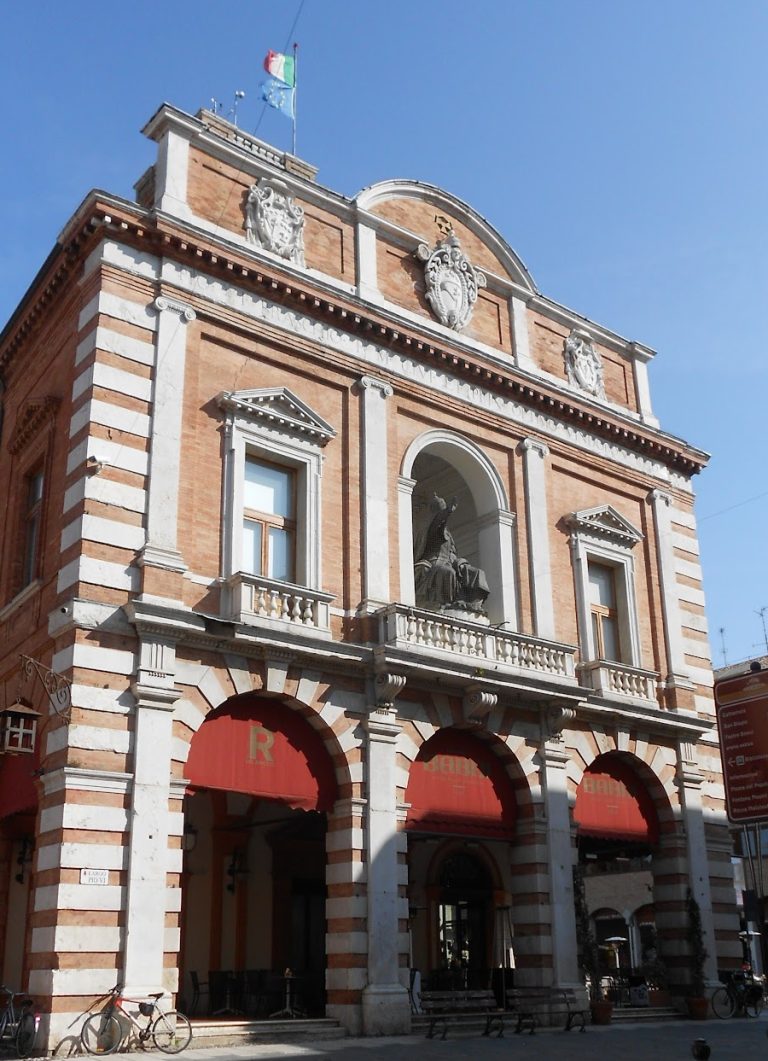
Cesena Cathedral is built of brick, and its exterior has a restrained Romanesque character, a medieval architectural language associated with robust masonry and round arches. Eight pilasters divide the otherwise flat facade. Its upper section, attributed to Mauro Codussi, reflects Venetian Renaissance influence. It includes a triangular pediment, two semicircular tympana, two small pilasters, and a central pair of pilasters decorated with a frieze of seraphim.
To the right of the portal, an inscription commemorates the plenary indulgence granted to Cesena by Pope Pius VI on 9 July 1793. A niche holds Vincenzo Gottardi’s Madonna and Child, made in 1510. To the left of the cathedral stands a bronze statue of Saint John the Baptist made by Leonardo Lucchi in the 1980s.
Portal and bronze door
The stone portal is splayed and round-arched. Tradition says that it came from the former church of Saint Lawrence and was installed here at Antonio Malatesta’s direction, although it may instead have been made for the cathedral itself. The present bronze door was created in 2000 by the Cesena sculptor Ilario Fioravanti.
Fioravanti’s door illustrates the virtues and life of Saint John the Baptist. The arch contains the Madonna del Popolo with Saints Maurus and Vicinius. The lower section shows the Four Evangelists and the glorification of Christ, while the door leaves present episodes from the saint’s life, including his encounter with Christ. The inner sides of the handles depict Saints Francis of Assisi, Clare, Ambrose, and Charles.
Bell tower
The bell tower rises at the rear left side of the cathedral. Constructed between 1443 and 1456, it received a bell chamber in 1741 and its original cupola in 1753. The tower reaches a height of 72 metres.
Naves and liturgical furnishings
Central nave and counterfacade
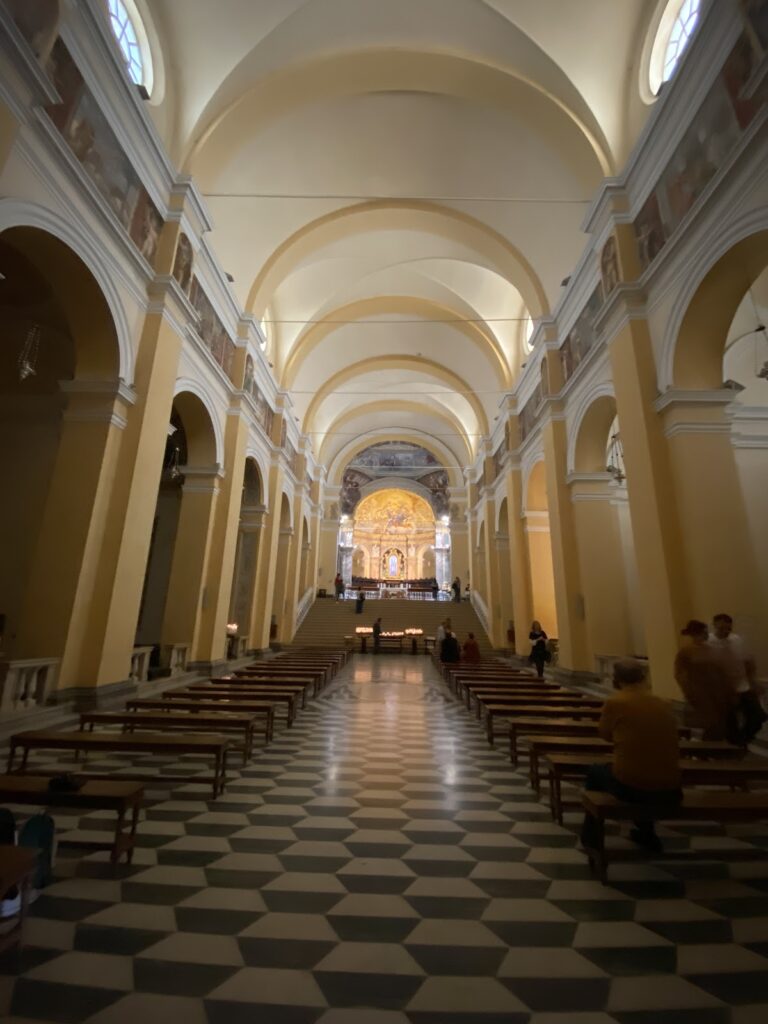
The interior has three naves. The central nave is covered by a timber truss roof, while the side naves have groin-vaulted ceilings. A groin vault is formed by the intersection of two barrel vaults. On the counterfacade, the interior wall opposite the main altar, Girolamo Cialdieri’s 1625 painting shows the Blessed Virgin and Child with angels, Saints Maurus and Severus, the city of Cesena, and the martyrs Eugarius, Firmius, Genesius, and Concordia. The painting came from the destroyed church of Saint Severus.
Above Cialdieri’s painting is a 1650 memorial plaque with an oval image of the Virgin and Child. It commemorates Pier Giacomo Beccarini, a benefactor of the Confraternity of the Madonna del Popolo. Below are a copper urn containing the remains of Saint Maurus, dated 1645, and a sixteenth-century sculpture of Saint Anthony the Abbot from the Bregno workshop.
Right nave
The right nave contains the fifteenth-century wooden Crucifix known as the Saint Zeno Crucifix and the 1467 funerary ark of Bishop Antonio Malatesta da Fossombrone. Ottaviano di Antonio di Duccio carved the ark in Istrian stone. The Corpus Christi Altar occupies the fourth bay. Corpus Christi is the Christian feast and devotional concept centred on the Eucharist, the sacramental presence of Christ in consecrated bread and wine.
Near the presbytery, the area around the main altar reserved for the clergy, a painting of Saint Jerome by Livio Modigliani hangs above a side door. The nave also contains a commemorative antependium for Bishop Augusto Gianfranceschi. An antependium is a decorative hanging or facing attached to the front of an altar. The remains of the Chapel of Saint Tobias now house the Cathedral Museum.
Apse and left nave
The apse contains two large paintings by Giuseppe Milani, made in 1782 in honour of Pope Pius VI. They represent the Birth and the Martyrdom of Saint John the Baptist. Nicola Sebastio’s stained-glass windows, made in 1981, depict the Magnificat, the Baptism of Christ, and the Martyrdom of Saint John the Baptist.
A niche opening into the left nave contains a fragment of Antonio Aleotti’s 1509 fresco of the Holy Trinity adored by Saint Francis and Canon Cesare Isolani. It stands with the sarcophagus of Saint Severus, dated 1644 to 1645. On the wall nearby is a sundial by Marinace Vescovo, dated 1022 and brought from the old cathedral.
The left nave also contains Vincenzo Gottardi’s 1490 relief of Saint Severus venerated by Carlo and Camillo Verardi. The work shows the co-patron, the two commissioners, two angels, and a crowd of worshippers. A side door bears a painting of the Madonna and Child with Saint Anthony of Padua. Near this area is the entrance to the sacristies. One sacristy has cabinets by Fabio Urbino and a fifteenth-century coffered ceiling, while the other contains a Renaissance lavabo, a basin used for ritual handwashing.
Chapels and sacramental spaces
Chapel of the Madonna del Popolo
The Chapel of the Madonna del Popolo opens from the nave opposite the Corpus Christi Altar. It has a square plan, Corinthian columns at its corners, and polychrome marble. Corrado Giaquinto’s frescoes fill the hemispherical dome and pendentives. The dome shows the Genealogy of the Virgin, with the Virgin, the infant Jesus, and figures from the Old Testament in Paradise. The pendentives, curved triangular surfaces supporting a dome over a square space, contain the prophets Baruch, Ezekiel, Isaiah, and Jeremiah.
The chapel’s altar was designed in 1882 by Francesco Vespignani and Filippo Viti. Its altarpiece contains Bartolomeo Ramenghi’s Madonna del Popolo, painted in 1520. Bishop Camillo Gualandi and the Capuchin Father Girolamo da Forlì gave the image that title in 1599 because of its popular devotion. Pietro Martinetti created the stuccoes, Giovanni Fabbri produced the marble work between 1753 and 1759, and Antonio Trentanove made the stucco angels on the side doors between 1795 and 1796.
Inscriptions in the chapel commemorate the visits of Pope Pius VI in 1782, Pope John Paul II in 1986, and Pope Francis in 2017. They also recall the miraculous episode associated with Bishop Beniamino Socche during the Second World War.
Baptistery and crypt
The baptistery contains sixteenth-century frescoes of Saint Vincent Ferrer and Saint Roch, together with a baptismal font dated 1541. The crypt contains the remains of Saint Maurus, identified as a bishop and the patron saint of Cesena.
Corpus Christi Altar
The Corpus Christi Altar is also known as the Altar of Saint John the Baptist, the Prepositure, or the Body of Christ. Carlo Verardi, the cathedral’s first archdeacon, commissioned it in 1487 and shared its patronage with his nephews, the sons of his brother Ptolemy. Giovanni Battista Bregno carved its marble sculptures between 1494 and 1505 for a payment of 300 gold ducats. Giacomo Bianchi and Rocco Poltri made the architectural framework between 1523 and 1525.
At the centre, Christ holds a chalice that receives blood from his side. He is flanked by Saint John the Baptist and Saint John the Evangelist. The kneeling patrons are Carlo Verardi and his nephew Camillo, a papal knight who died either in 1505 or 1511. Angels occupy the surrounding panels. Floral candelabra, dolphins, ears of grain, cornucopias, monstrous figures, and birds, including a phoenix, enrich the frame. These elements were produced by collaborators of Bregno. The large shell was added in the early twentieth century by the Cesena sculptor Paolo Grilli.
Organ
The organ stands on a gallery at the rear of the right nave. The Fratelli Ruffatti firm of Padua built it in 1962, reusing as much material as possible from the former 1898 Laudani and Giudici organ. That earlier instrument had been damaged by wartime events and had stood in the gallery above the entrance. Ruffatti revised the organ in 1985 and expanded its tonal resources.
The instrument has 2,121 pipes, two 61-note keyboards, a 32-note concave-radial pedalboard, and 34 stops. Of these, 26 are real stops and eight are transmitted, derived, or extended stops. Its electronic multiplex transmission uses a single coaxial cable and enables the organist to store 64 different stop combinations.