Saint-Lucien Abbey of Beauvais: A Benedictine Monastic Foundation in France
Site at a Glance
- Rating
- 3.8
- Popularity
- Very Low
- Country
- France
- Primary era
- Medieval
- Eras represented
- Medieval
- Civilizations
- French
- Site type
- Military
- Remains
- Wall
On this page14 sections
History
Saint-Lucien Abbey of Beauvais was a Benedictine abbey in Beauvais, France, founded around 580 at the burial place of Lucien of Beauvais. Established outside the city under the authority of the bishop of Beauvais, it became a regional pilgrimage center and later developed extensive possessions, dependent priories, and close institutional ties with the diocese.
Foundation and early pilgrimage
Evrost, abbot of Saint-Fuscien and a native of the Beauvaisis, received permission from Dodon, bishop of Beauvais, to build a church at Lucien’s tomb. The foundation was associated with an apparition of the martyr. A charter attributed to Chilperic I later confirmed the foundation, although its authenticity has been rejected.
Around 585, Evrost sent monks from Saint-Fuscien to establish the new community with the bishop’s approval. They probably followed the Benedictine Rule, the monastic code associated with Benedict of Nursia that organized communal prayer, work, discipline, and monastic government. Lucien’s tomb lay beneath the high altar of the abbey church, and the site attracted pilgrims seeking cures, especially for madness and epilepsy. Worshippers also brought offerings in gratitude for miracles.
The abbey suffered during the conflicts among the sons of Louis the Pious, when part of its land was confiscated. Norman attacks devastated Beauvais and the abbey in 861, and further attacks on the city in 883 probably caused additional damage. Bishop Odo obtained land donations from Charles II the Bald to support restoration and the continuation of the monastic community.
Growth and ecclesiastical influence
In the 920s, Bishop Bovon, formerly a monk of Saint-Lucien, secured the church of Saint-Just-de-Marais and its tithes for the abbey. These possessions had previously depended on Fouquenies. The monastery maintained close relations with the bishops of Beauvais. Each new bishop spent the night before his formal entry and investiture at Lucien’s tomb, and many bishops were buried at the abbey.
Around 1002, fragments believed to be Lucien’s clothing were miraculously rediscovered and displayed as relics. In 1035, the bishop granted the abbey the lordship of Warluis and the church of Bonnières, followed by numerous other properties around Beauvais. A new stone abbey church was built at the end of the eleventh or the beginning of the twelfth century and formally dedicated in 1109.
From the late eleventh to the early twelfth century, Saint-Lucien expanded its possessions and influence. Its dependent houses included Saint-Martin d’Auchy, founded in 1096 and made an independent abbey in 1130, as well as Saint-Maxien at Montmille and priories at Senarpont, Pernois, Flixecourt, Notre-Dame-sur-le-Mont at Picquigny, Lesseville, La Chaussée d’Eu, and Weedon in England. In 1167, the former collegiate church of Milly-sur-Thérain was placed under the abbey.
In 1157, Abbot Pierre II obtained episcopal confirmation of the abbey’s possessions and rights. Saint-Lucien founded the settlement of Grandvilliers in 1212. On 21 July 1260, Pope Alexander IV authorized the abbots to use the mitre, ring, and crozier, the ceremonial headdress, ring, and staff that represented episcopal authority.
In 1261, Lucien’s relics were transferred to newly sculpted reliquaries in a ceremony attended by several bishops and Louis IX of France. The tomb beneath the high altar and the relics of Lucien and his companions remained central to the abbey’s religious identity.
War, rebuilding, and commendatory rule
During Edward III of England’s campaign of 1346, English troops stayed at the abbey during the night of 20 to 21 August, shortly before the Battle of Crécy. They set the buildings on fire when they departed. The costs of supporting the community and rebuilding the abbey led to permission for the abbot to reduce the number of monks to 36.
By the end of the fourteenth century, successive abbots had rebuilt the church and regular buildings. Renewed fighting in the early fifteenth century reduced the abbey’s revenues, and the community responded by fortifying the complex with an enclosing wall. During the siege of Beauvais in 1472, troops serving Charles the Bold, Duke of Burgundy, occupied the abbey after storming its enclosure. Charles established his camp there, while forces in the Beauvais area were commanded by Philippe de Crèvecœur d’Esquerdes. The Burgundians left on 22 July, causing relatively little damage to the buildings but severely damaging the furnishings. The abbey had been defended by monks led by Florimond de Villers, the abbot’s brother.
In 1492, Antoine Du Bois became the first abbot of Saint-Lucien appointed by the king rather than elected by the monks. This introduced the commendatory system, under which an abbot could hold the title and revenues of an abbey without necessarily residing there or directly governing its monks. Du Bois retained the abbey benefice after becoming bishop of Béziers in 1507.
Du Bois added a carved wooden rood screen, choir stalls, and new windows to the church. He also arranged an abbatial residence between the church and the Luchy turret and built a country residence at Saint-Félix. His successor, Cardinal Odet de Coligny, was also archbishop of Toulouse, bishop of Beauvais, and commendatory abbot of fifteen other abbeys. He leased Saint-Lucien’s properties to a general farmer and placed its temporal administration in the hands of a council.
After converting to Protestantism in 1560, Coligny plundered and sold the abbey’s goods. He also removed the church’s tomb slabs to pave his château at Bresles. He was excommunicated in 1563 and deprived of his benefices in 1569.
Reform and the late ancien régime
At the beginning of the seventeenth century, the community consisted of 16 monks under Prior Nicolas Patin, a doctor of theology who worked to restore discipline. Pierre de Bérulle held the abbacy for several months in 1629 and appointed Yvon Mullot as his successor. Mullot continued the return to strict observance for 32 years.
Saint-Lucien joined the Congregation of Saint-Maur in October 1665. This reform movement within French Benedictine monasticism promoted stricter observance, scholarly work, and systematic management of monastic archives and histories. The community’s 13 monks had adopted a new chapter regulation supporting the affiliation on 4 April 1665.
Richelieu and Mazarin held the abbacy from 1630 to 1642 and from 1642 to 1661 respectively, and their appointments chiefly benefited the holders. During Jacques-Bénigne Bossuet’s tenure, a detailed inventory and plan of the abbey’s property and revenues were prepared. Bossuet arranged repairs to farms and churches, improved worship in the abbey’s 20 parishes, renewed the church vault, built a three-storey conventual building and a new porter’s house, organized the archives, commissioned a new collection of charters, and supported the writing of an institutional history in 1681.
In 1700, the abbey’s annual revenues exceeded 40,000 livres. They were divided approximately equally among the commendatory abbot, the community, and maintenance and repairs. During the controversy over the papal bull Unigenitus, the monks sided with the Jansenists, a rigorist Catholic movement that emphasized human sinfulness, divine grace, and strict moral discipline. They published a strongly critical text on 8 October 1718 and accepted the bull’s clauses only under pressure from the bishop of Beauvais.
Dissolution and later transformation
After the last abbot died in 1787, the office remained vacant and administration passed to the general steward of the clergy of France. An inventory made in 1790 recorded revenues of more than 53,000 livres, a library of 3,057 manuscripts, and a community of 10 monks.
The abbey was dissolved on 20 December 1790, and the monks dispersed. Its nationalized property failed to sell on 5 January 1791 but was purchased on 19 January by Michel de Boislisle, a merchant from Beauvais, for 181,000 livres. The church began to be demolished in 1791, while the remaining conventual buildings were demolished in 1810. The relics of Lucien and his companions were transferred to Beauvais Cathedral before being destroyed in 1793.
In 1819, the property was divided among several private owners. The grounds were leased in 1855 by the agricultural institute of Beauvais for an educational farm. They were later acquired by the Congregation of the Brothers of the Holy Spirit and, after 1905, by a farmer. An artificial-silk spinning mill occupied the grounds from 1926 to 1931. Military forces used the former abbey site during the Second World War, after which it remained derelict until a housing company acquired it in 1960 and built residential blocks.
The surviving remains became municipal property and received heritage protection in stages. The principal entrance gate was classified as a historic monument in 1930, the surviving enclosure tower was listed in 1935, and the remaining preserved grounds, including fragments of the enclosure wall, were listed in 1965.
Remains
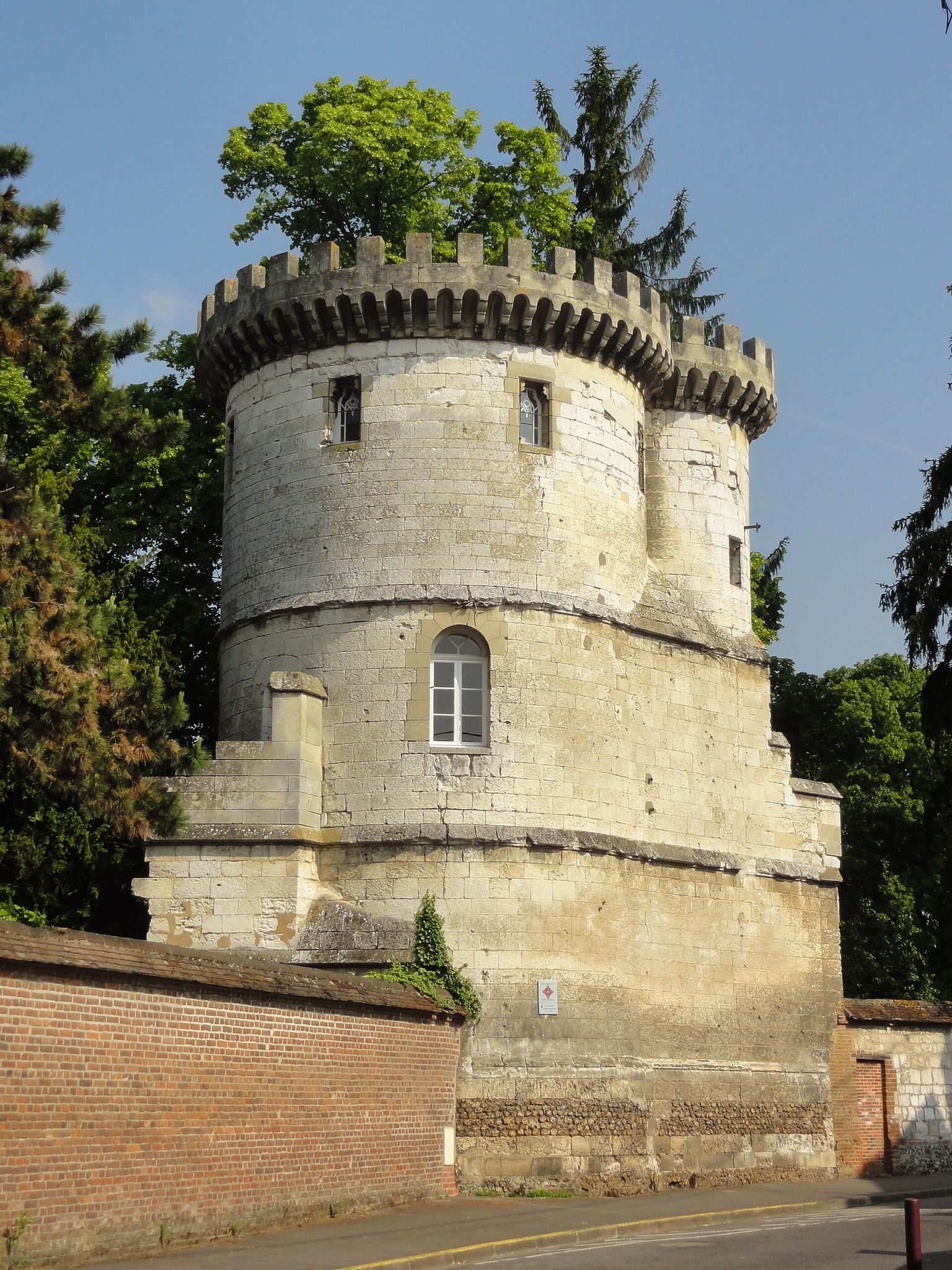
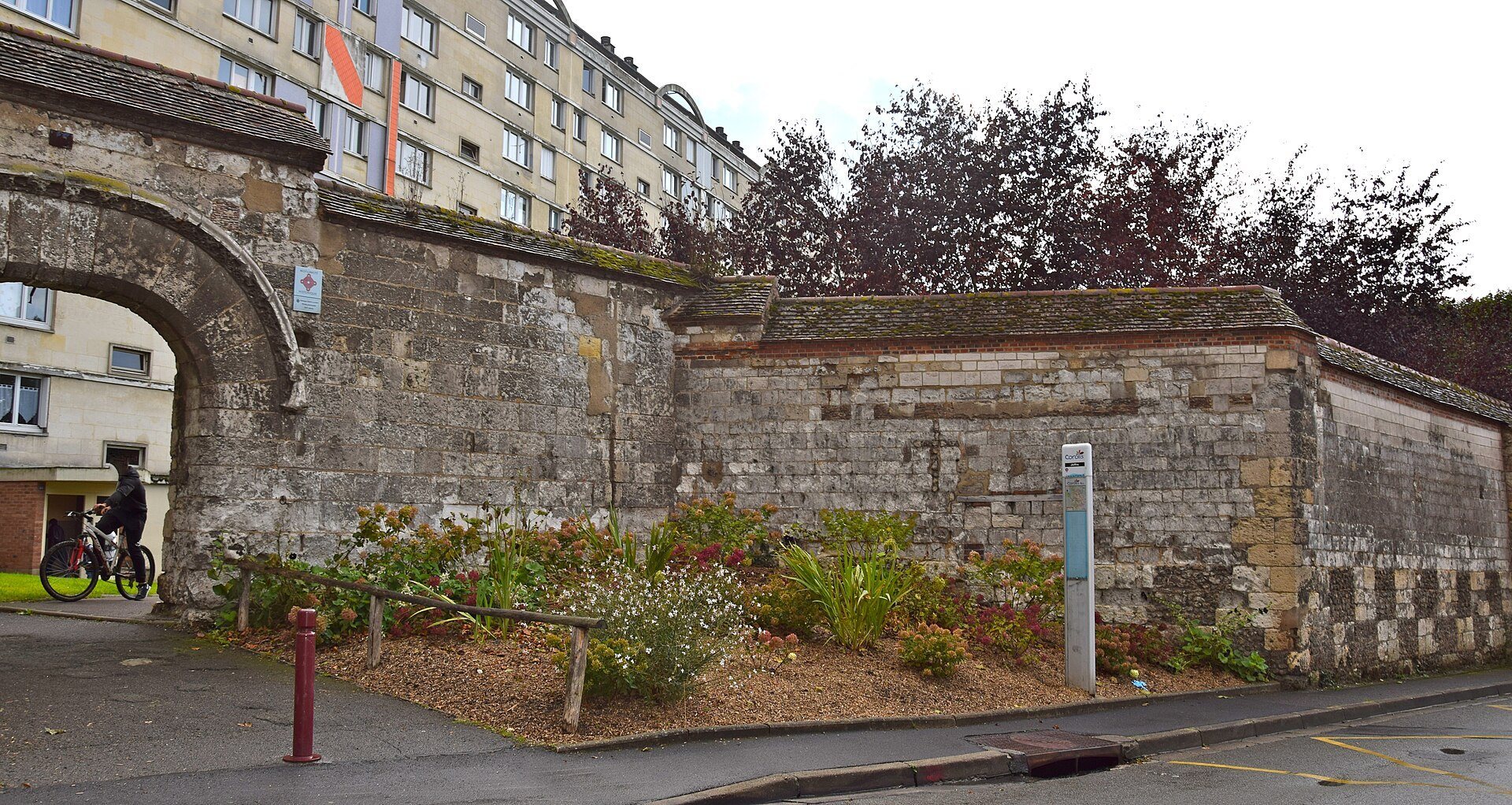
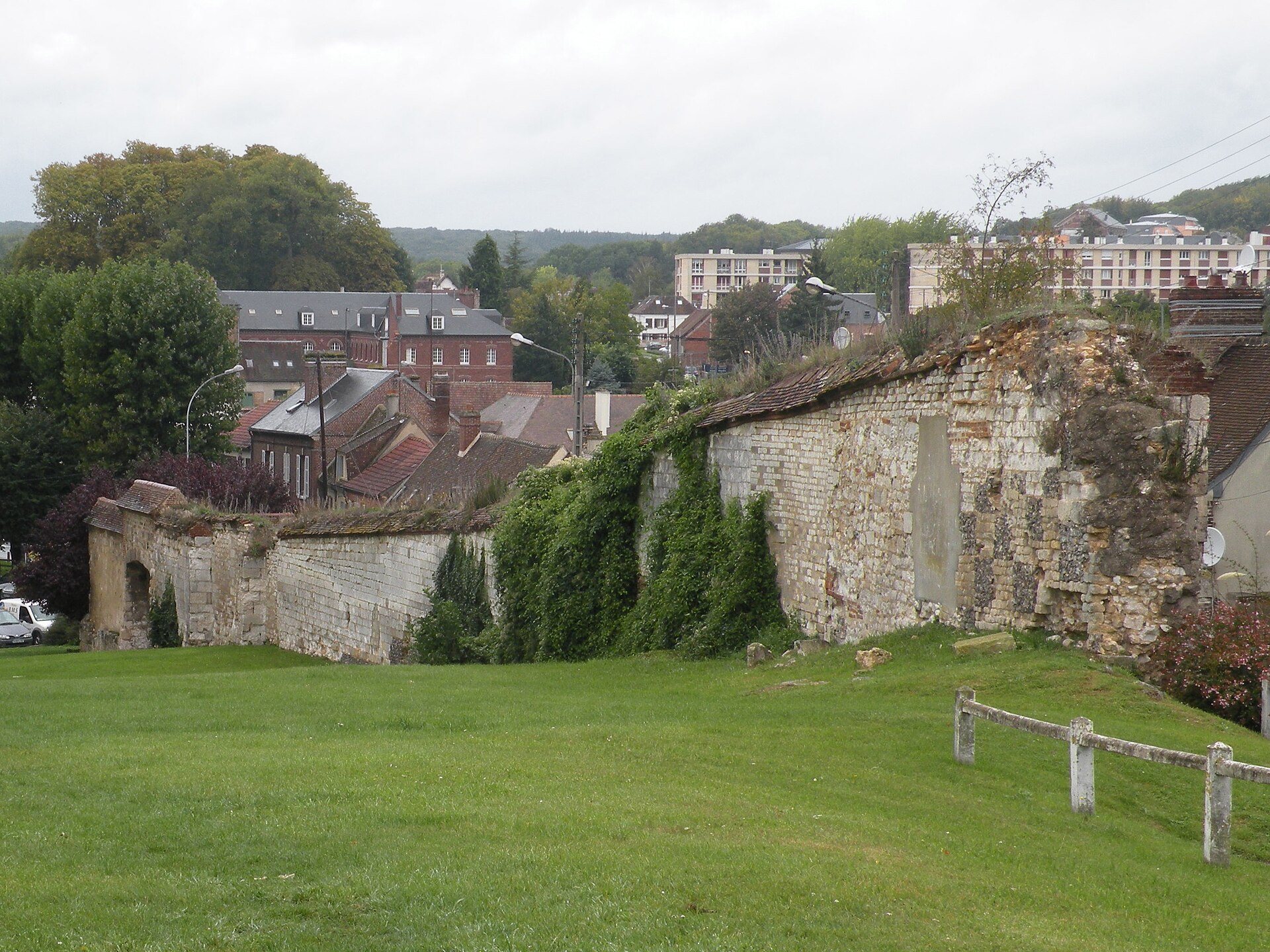
The surviving site is a fragment of the former abbey complex along the Rue de l’Abbaye and Rue Louis Prache. Its preserved fabric centers on the principal entrance gate, a section of the enclosure wall, and an early fifteenth-century corner tower. Most of the abbey buildings were demolished during the nineteenth century, while several objects and architectural elements are preserved elsewhere.
Enclosure and entrance
Principal entrance gate
The principal entrance gate is one of the surviving elements of the abbey’s boundary. It belonged to the complex that enclosed the church, regular buildings, residences, farms, and other properties. The gate was classified as a historic monument in 1930.
Enclosure wall and corner tower
An enclosing fortification wall was built around the abbey in the early fifteenth century, when declining revenues and renewed warfare led the community to strengthen the complex. A fragment of this wall survives, together with a corner tower at the southeast angle dating from the same period. The tower was listed as a historic monument in 1935, while the preserved grounds and remaining wall fragments received protection in 1965.
Former church and associated objects
Abbey church
The first church, founded at Lucien’s burial place in the late sixth century, was partly built of wood. A stone church replaced it at the end of the eleventh or the beginning of the twelfth century and was dedicated in 1109. Lucien’s tomb lay beneath its high altar, and the church contained the saint’s relics and those of his companions. Antoine Du Bois later added a carved wooden rood screen, choir stalls, and new stained-glass windows. Bossuet renewed the church vault. The building began to be demolished in 1791.
Surviving furnishings and sculpture
A carved oak pulpit from the late seventeenth century, purchased in 1805, survives in Beauvais Cathedral. Its panels depict Lucien and his companions Maxien and Julien, and it was classified as a historic monument in 1840.
The recumbent effigy of Florimond de Villers-Saint-Paul, who was buried in the abbey church in 1473, was purchased in 1842 and is preserved in the Church of Sainte-Maure-et-Sainte-Brigide at Nogent-sur-Oise. The sculpture, known as a gisant, represents the deceased as a recumbent figure on a tomb and has been classified as a historic monument since 1984. Part of the abbey’s choir stalls is displayed at the Cluny Museum in Paris in a form reassembled during the twentieth century.
Monastic buildings
Between 1391 and 1413, the abbey acquired a new refectory with a rib-vaulted ceiling and a new entrance building. The wider complex included regular buildings, an abbatial residence, a porter’s house, farms, and churches belonging to the abbey. Bossuet later oversaw the construction of a three-storey conventual building and another porter’s house. These buildings formed part of the former monastic complex but were demolished, leaving the surviving boundary structures and the preserved objects now held elsewhere.