Abae: An Ancient Greek Oracle Town in Phocis
Site at a Glance
- Popularity
- Medium
- Country
- Greece
- Primary era
- Classical
- Eras represented
- Bronze Age, Iron Age, Classical
- Civilizations
- Ancient Greek, Mycenaean, Roman
- Site type
- City
On this page11 sections
History
Abae was an ancient Greek town in northeastern Phocis, Greece, near the Opuntian Locrians. Occupation extended from the Early Bronze Age into the Roman period, and the town became known for its oracle of Apollo, where people sought divine guidance.
Origins and the oracle
Local tradition traced Abae’s name and foundation to Abas, a mythical king of Argos said to be the son of Lynceus and Hypermnestra and grandson of Danaus. Aristotle offered a different origin, associating the town’s foundation with Thracians. He also said that Thracians from Abae migrated to Euboea and gave its inhabitants the name Abantes.
Abae’s oracle attracted visitors from beyond Phocis. Croesus, the last king of Lydia, and Mardonius, a Persian military commander, were said to have consulted it. The Thebans also sought its guidance before the Battle of Leuctra in 371 BCE, fought between Thebes and Sparta. The sanctuary at Kalapodi was used for religious practices from early Mycenaean times, a Late Bronze Age culture of mainland Greece, through the Roman period. This long sequence has been interpreted as evidence of continuity between Mycenaean and Classical Greek religion.
Persian and Theban destruction
Before the Persian invasion, Abae’s temple held treasuries and offerings dedicated to the gods, including shields and statues given by the Phocians. In 480 BCE, the forces of Xerxes I, king of the Persian Empire, captured the town and destroyed the temple. The Greeks pledged not to rebuild temples destroyed by the Persians, preserving their ruin as a memorial of the devastation.
During the Third Sacred War, a fourth-century BCE conflict over control of the sanctuary at Delphi, Theban forces destroyed Abae’s temple and captured the town. In 346 BCE, Philip II of Macedon spared Abae because it had not taken part in the attack on Delphi’s sanctuary, unlike other Phocian cities.
Hellenistic and Roman periods
During the Hellenistic period, which followed Alexander the Great’s conquests, nearby Hyampolis surpassed Abae in importance. In 208 BCE, Philip V of Macedon attacked the town, but its oracle remained exempt from taxation. The Romans later confirmed Abae’s sacred privileges, and under Roman rule it was an autonomous sacred city.
By the second century CE, when the Greek travel writer Pausanias saw it, the sanctuary was in a dilapidated state. The Roman emperor Hadrian arranged some restoration and built a smaller temple beside the earlier sanctuary.
Identification and excavation
In the nineteenth century, William Martin Leake identified fortified remains near modern Exarchos as Abae. That identification has been questioned, and the remains have also been considered more likely to belong to the Sanctuary of Artemis at Hyampolis. Leake and V. W. Yorke had earlier proposed that a sanctuary southwest of the town might be Abae’s Apollo sanctuary; later archaeological work identified the sanctuary at Kalapodi with the oracle.
The British School at Athens excavated at the site in 1894. The German Archaeological Institute’s Athens department investigated the Apollo sanctuary at Kalapodi from 1972 to 1982, with further excavations from 2004 to 2013. This work supported the identification of Kalapodi with Abae’s oracle and the interpretation of long-term religious continuity there.
Remains
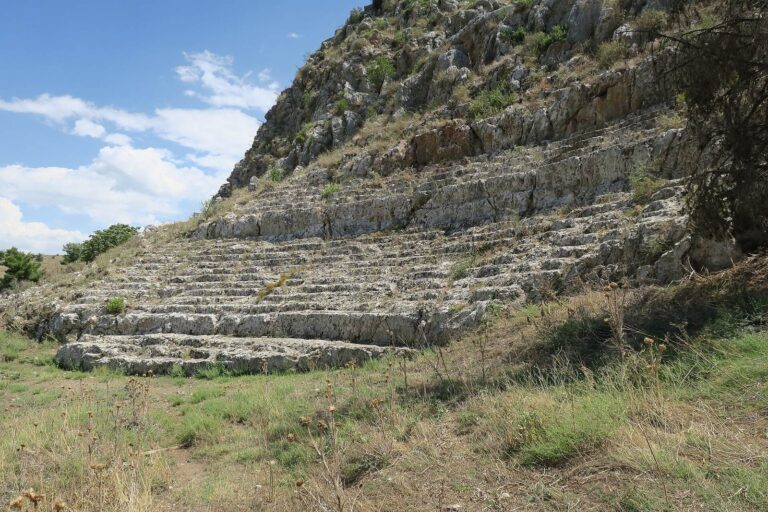
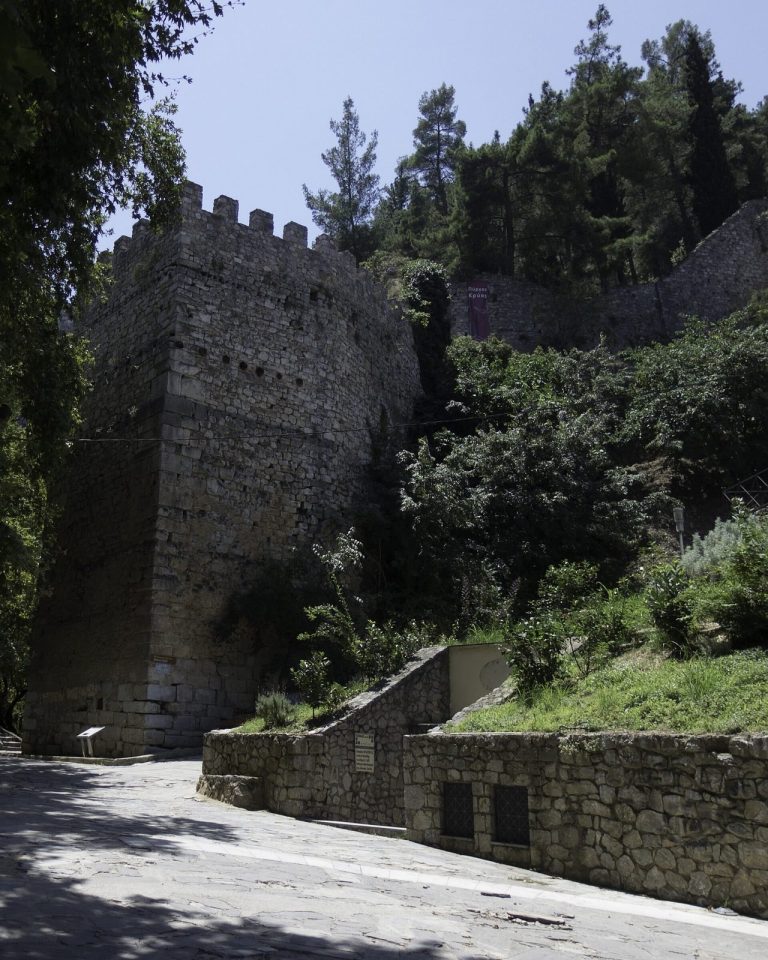
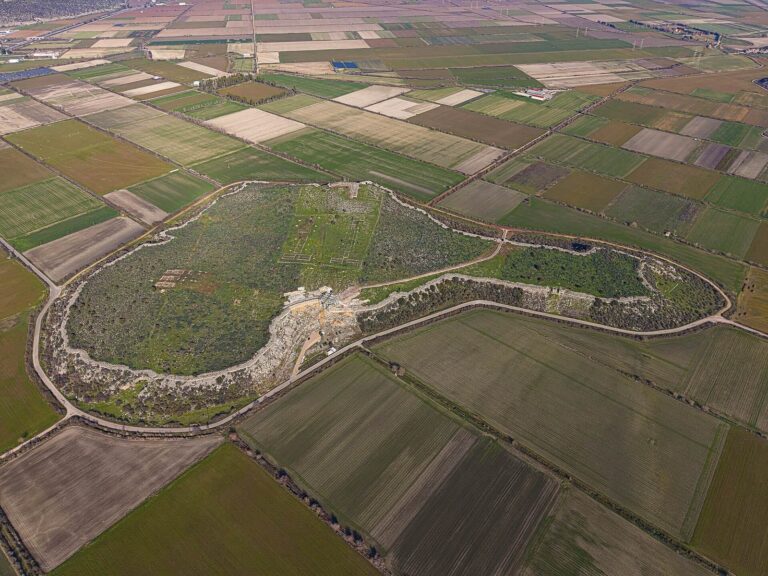
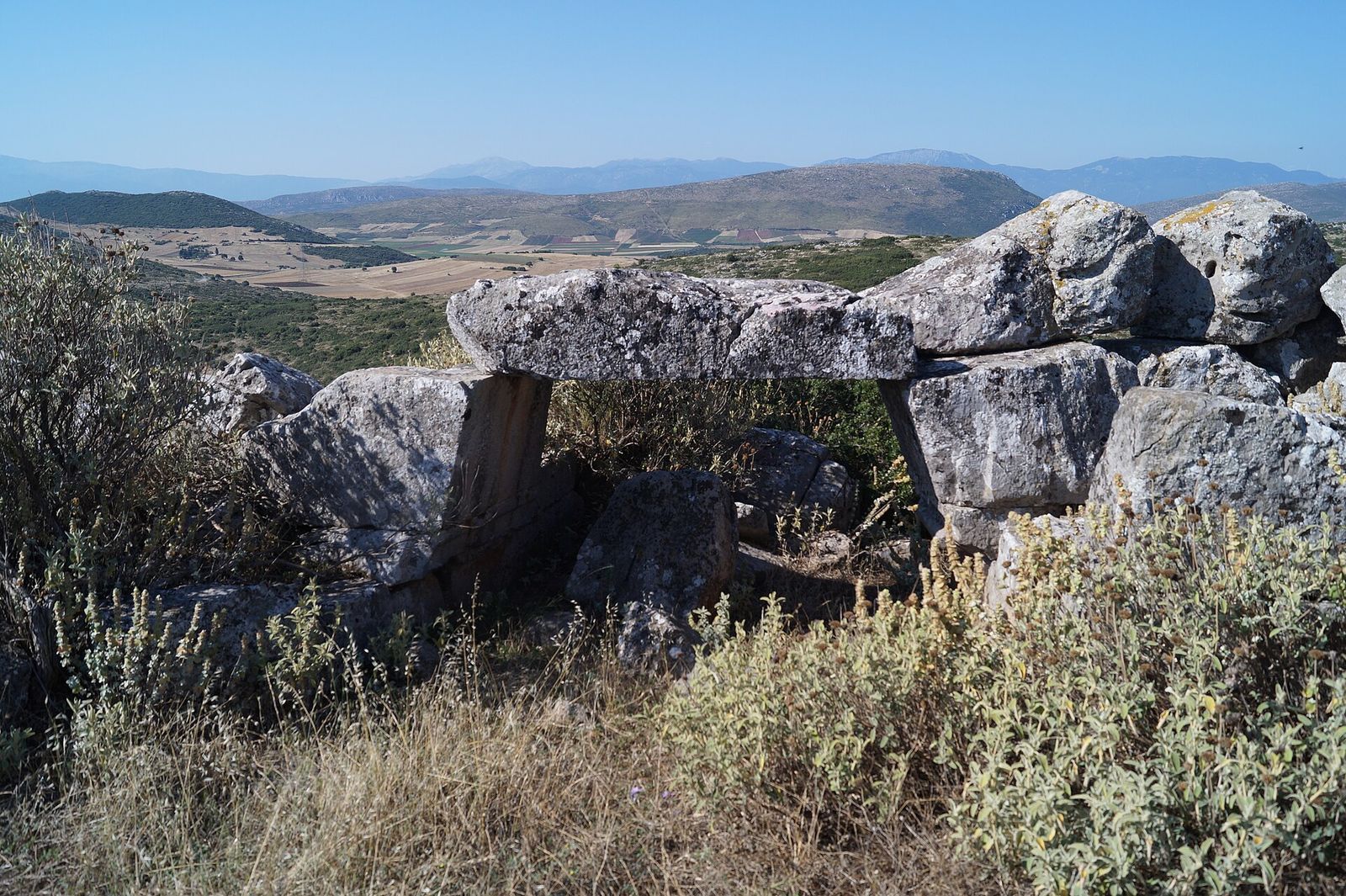
The remains associated with Abae form a fortified settlement on a rocky hill, with walls built in polygonal masonry, irregular stones fitted together. The hilltop center and defenses extend across the surrounding terrain, while sanctuary remains lie southwest of the town and at Kalapodi to the north.
Town and defenses
The site lies near modern Exarchos, about 2.5 km west of the village and 10 km southwest of Atalanti. The hill, called Kastro, reaches 431 m and rises about 160 m above the plain in an eastern side valley of the Assos River. The route from Orchomenos to Opus passed through Abae, while Hyampolis lay about 2.5 km to its west. The acropolis, the fortified upper part of the town, occupied the summit. Its wall enclosed most of the hilltop, leaving the steepest eastern section outside. Another wall ran south from east of the acropolis for about 100 m, then west roughly parallel to its wall before turning north to meet the western side. The outer town wall enclosed a northern mountain saddle and part of the fertile plain, where remains of ancient buildings have been found. Projecting sections marked its southern side, and a well-preserved southeastern gate was strengthened by a tower. The walls date to the sixth and fifth centuries BCE. They are 2 to 2.5 m thick and survive to heights of 1 to 3 m, with large stones forming the faces and rubble and smaller stones packed within.
Sanctuaries and burial ground
Southwestern sanctuary and cemetery
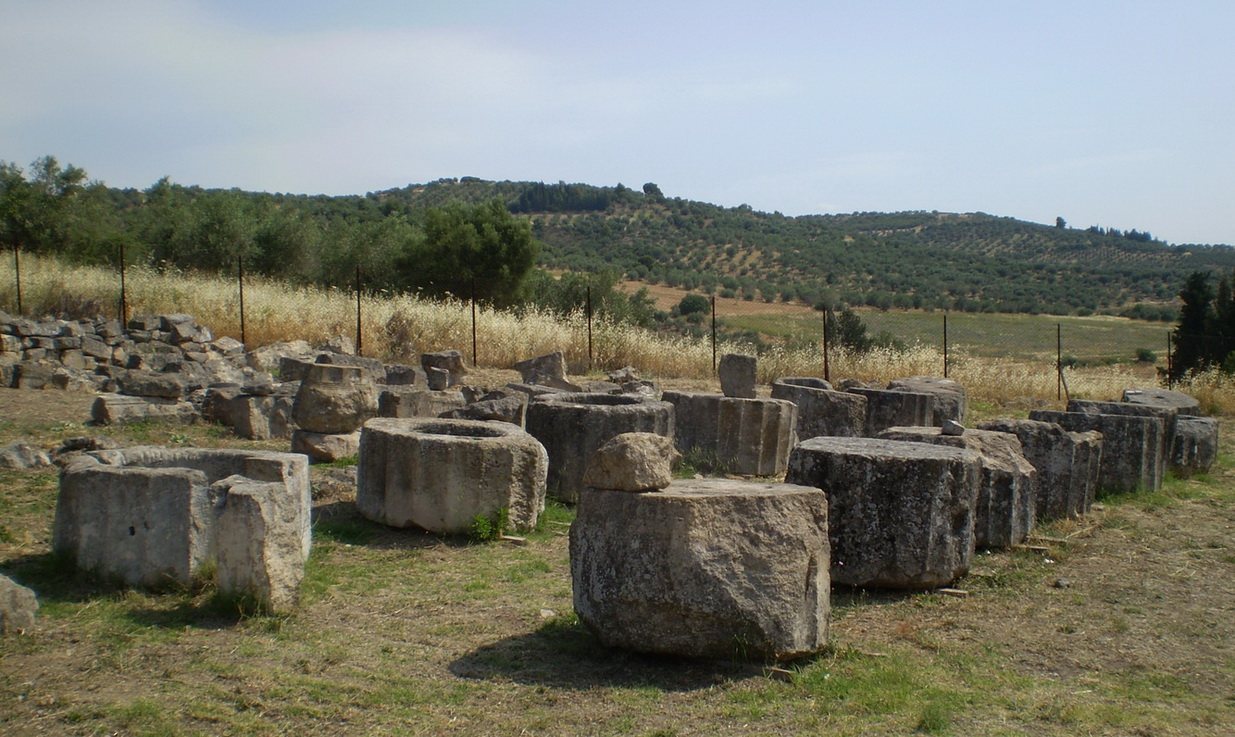
A sanctuary dating to the fourth century BCE stood on a low hill about 700 m southwest of the town. It included a covered walkway, or stoa, about 30 m long and two small temples. A cemetery lay on the mountain slope west of the sanctuary. Finds from it include bronze objects from the Hellenistic and Roman periods, imported pottery from Corinth and Attica, and fired-clay objects.
Apollo sanctuary at Kalapodi
About 6.5 km north of the town, the Apollo sanctuary at Kalapodi has yielded remains of six temples. It is identified with Abae’s oracle sanctuary.
Hadrian’s temple
Hadrian’s smaller temple stood beside the ruins of the earlier sanctuary. It contained ancient bronze statues of Apollo, Leto, and Artemis, dedicated by the people of Abae. The statues may have been saved from the earlier temple. Leto was Apollo and Artemis’s mother, and Artemis was a goddess associated with hunting and wilderness.