Malmesbury Abbey: An Anglo-Saxon Monastery and Norman Parish Church


Site at a Glance
- Rating
- 4.7
- Popularity
- Low
- Country
- United Kingdom
- Primary era
- Medieval
- External website
- Open
- Eras represented
- Medieval
- Civilizations
- Norman
- Site type
- Religious
- Remains
- Church
On this page18 sections
History
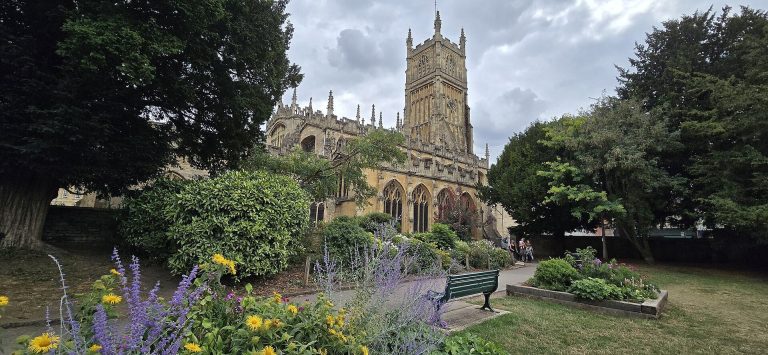
Malmesbury Abbey is a former Benedictine abbey in the United Kingdom, founded by the Anglo-Saxon churchman Aldhelm around 676 and substantially rebuilt in the Norman, or Romanesque, period. It is now an active parish church in the Church of England and the Diocese of Bristol, but before 1539 it was a Roman Catholic monastic institution. Less than half of the medieval church survives after the collapse of its towers, although the remaining nave continues in use.
Early foundation and Anglo-Saxon development
In the later seventh century, the Irish hermit Máel Dub established a hermitage at the site and taught local children. Toward the end of his life, the surrounding area was conquered by the Saxons. Around 676, Aldhelm, a scholar, poet, churchman, and nephew of King Ine of Wessex, founded a Benedictine monastery there. Benedictine monks followed the Rule of Saint Benedict, a medieval framework governing prayer, work, discipline, and communal life.
The settlement grew alongside the abbey. Alfred the Great later made Malmesbury a fortified burh, an Anglo-Saxon defended settlement, assessed at 12 hides, a unit used for land assessment and taxation. The abbey maintained a continuous history from the seventh century until the Dissolution of the Monasteries, a process through which Henry VIII’s government closed England’s monasteries and transferred or sold their property during the 1530s and 1540s.
Royal connections and intellectual life
King Æthelstan died at Gloucester in October 939 and was buried at Malmesbury in 941. Æthelstan, a tenth-century Anglo-Saxon king commonly regarded as the first ruler of a united England, was buried there rather than at the New Minster in Winchester. This choice has been interpreted as evidence that he remained an outsider to the West Saxon court. A mint was established at the abbey around the same period.
Under figures including Aldhelm, the Christian philosopher John Scotus Eriugena, Alfred of Malmesbury, and Aelfric of Eynsham, the abbey became a major centre of learning. Its library was reputed to be the second largest in Europe in the eleventh century. The monk Eilmer of Malmesbury also attempted human flight in the early eleventh century, attaching wings to his body and launching himself from a tower. He flew more than 200 yards, then landed and broke both legs. He later thought that a tail on his glider might have carried him farther.
William of Malmesbury, the twelfth-century historian, was a monk of the abbey. The institution’s Anglo-Saxon charters, legal documents recording grants, privileges, or land transactions, remain important evidence for the history of Wessex and the West Saxon church from the seventh century. They were altered and supplemented by forgeries and additions made by monastic scribes. In 2009, historian Michael Wood proposed that the Anglo-Saxon epic poem Beowulf may have been transcribed at Malmesbury.
Medieval rebuilding and monastic expansion
The current abbey church was substantially completed by 1180. From 1260, Abbot William of Colerne began constructing a kitchen, two stone halls, a water supply, the Chapel of the Virgin, and the Chapel of Saint Aldhelm. Kings Henry II and Edward I visited the abbey in the twelfth and thirteenth centuries.
Æthelstan was originally buried in the tower beneath the altar of Saint Mary. William of Malmesbury wrote that his body was disinterred in the eleventh century and reburied in the abbot’s garden to protect it from Norman desecration. Máel Dub’s remains were removed from the church of Saint Peter and Saint Paul by the Norman abbot Warin of Lyre and reburied in a distant corner of Saint Michael’s Church.
Collapse, Dissolution, and parish use
Around 1500, a storm brought down the central tower and its 431-foot, or 131-metre, spire. The collapse destroyed the choir, transepts, and much of the eastern end. Around 1550, the west tower also fell, bringing down the three westernmost bays of the nave. Together, these disasters destroyed more than half of the original church.
At the Dissolution in 1539, the abbey had an annual income of £803 and owned approximately 23,000 acres, or 93 square kilometres, in the twenty parishes of the Malmesbury Hundred. Abbot Richard Selwin of Frampton and 21 monks surrendered the abbey and received lifelong pensions. The dissolved abbey and its lands were sold to William Stumpe, a wealthy cloth merchant. He returned the church to the town for use as a parish church and installed up to 20 looms in the surviving abbey buildings for cloth production. The cloisters and other monastic buildings were later demolished.
Malmesbury’s parish church had been Saint Paul’s from 1301 until the mid-sixteenth century. In August 1541, Thomas Cranmer, then Archbishop of Canterbury, licensed the former abbey church to replace Saint Paul’s as the town’s parish church. The chapelries of Corston and Rodbourne became a separate parish in 1837, while Saint Mary Westport was united with the abbey church.
Conflict, preservation, and continuing use
During the English Civil War, a conflict between supporters of King Charles I and Parliament, Malmesbury may have changed hands as many as seven times during severe fighting. Bullet and shot damage from the conflict remains visible on the south, west, and east sides of the church.
The earliest organ obtained by the parish arrived in 1846 from Saint Benet Fink in Threadneedle Street, London. Abraham Jordan had made it in 1714. Henry Willis supplied a new organ in 1938, and that instrument was replaced in 1984 by one built by E. J. Johnson of Cambridge. In 1949, the church became a Grade I listed building. Historic England placed it on the Heritage at Risk Register in 2022 because leaking roofs over the nave and aisles required repair.
The church and churchyard retain burials or commemorations associated with Máel Dub, Aldhelm, Æthelwine and Ælfwine, the sons of Æthelweard, King Æthelstan, Daniel, Bishop of Winchester, and the writer and philosopher Roger Scruton. Hannah Twynnoy is buried in the churchyard. She is said to have been killed by a tiger on 23 October 1703 after teasing it in a menagerie at the White Lion public house where she worked.
Remains
The surviving church is a Norman Romanesque building with later Gothic additions. Its Romanesque core contains six bays of the nave, while the surviving part of the building remains physically connected to ruined sections of the former abbey. The present church has a truncated western extent and an opening toward the destroyed crossing, preserving the effects of the two tower collapses in its layout.
Entrance and upper rooms
South porch
The mid-twelfth-century south porch is now the church’s only entrance. Reliefs of the Twelve Apostles, six on each side, decorate it, and a lunette above the doorway contains finer twelfth-century sculpture. Traces of paint and gilding remain on the porch walls. Its deeply moulded portal has unusual profiles, formed as continuous bands rather than divided by capitals into columns and archivolts.
Parvise
A parvise, a room built above a porch, survives above the south entrance. It contains examples of books from the former abbey library, linking this upper room with the intellectual history of the monastic community.
Nave and surviving medieval structure
Nave arcades and vaults
The lower arcade of the six-bay nave rests on round columns. Above it are a Romanesque triforium, an upper passage or gallery level, and a further window level beneath Gothic vaults with an elaborate network of ribs. The surviving nave remains in active use as the parish church.
Elevated room over the south aisle
An unusual attic or elevated room projects over the south aisle. It probably enabled monks seeking greater seclusion to hear services.
Former crossing and western end
The former central tower and spire collapsed around 1500, leaving an opening toward the destroyed crossing. An arch behind the altar has been blocked where the crossing formerly extended. The west tower fell around 1550, and the collapse carried away the three westernmost nave bays, creating the church’s present shortened form.
Memorials, burials, and churchyard remains
Æthelstan’s commemorative tomb
An empty fifteenth-century tomb commemorating King Æthelstan survives in a side aisle. It relates to the earlier burial beneath the altar of Saint Mary and to the later tradition that his body was moved to the abbot’s garden.
Hannah Twynnoy’s grave
A stone in the churchyard marks Hannah Twynnoy’s grave and bears a poetic epitaph. The burial preserves the memory of her reported death in 1703.
Organ
The current organ, installed in 1984, has 30 stops, two 58-key manuals, and a 30-key pedalboard. Some stops were retained from the earlier Henry Willis instrument installed in 1938.