Acey Abbey: A Cistercian Monastery in France


Site at a Glance
- Rating
- 4.7
- Popularity
- Low
- Country
- France
- Primary era
- Medieval
- External website
- Open
- Eras represented
- Medieval, Early Modern, Modern
- Civilizations
- French, Holy Roman Empire
- Site type
- Religious
- Remains
- Monastery
On this page14 sections
History
Acey Abbey is a Cistercian monastery in France, near Vitreux in the Jura, founded in 1136 in the Ognon valley. Its community came from Cherlieu Abbey, placing Acey within the institutional lineage of Clairvaux. Cistercians followed a monastic reform that emphasized communal discipline, manual work, and an austere religious life. The abbey stood near the boundary between the County of Burgundy and the Duchy of Burgundy, a position that later exposed it to political and military conflict.
Origins and foundation
The site had an earlier hermitage linked to the monastery of Condat, later known as Saint-Claude. Neighboring lords gave property to the hermitage, but it disappeared during the Norman invasions. Baume-les-Messieurs Abbey acquired its possessions toward the end of the eleventh century. Pope Urban II confirmed that claim in 1090, followed by the archbishop of Besançon in 1111.
Two hermits, Constantin and Robert, later settled at the first priory. Robert was a priest, and the two men were brothers. Their community built a basilica that Archbishop Anseric consecrated on 5 December 1127. In 1134, Anseric asked Cherlieu Abbey to establish a Cistercian monastery at the site, while Saint-Claude gave up its rights. Acey’s foundation is dated to 1136.
Anseric, archbishop of Besançon, and Renaud III, count of Burgundy, promoted the new foundation. Renaud and other lords endowed it with fields, meadows, vineyards, forests, and fishing rights on the Ognon. The monks soon organized a broad agricultural economy, including six granges, which were Cistercian farming estates supporting the monastery through their land and farm buildings.
Twelfth-century expansion and conflict
Acey’s location became politically difficult during the conflict that began in 1160 between Emperor Frederick Barbarossa, who controlled the County of Burgundy, and Pope Alexander III. The Cistercian order supported the pope, while Acey lay in imperial territory. In 1168, the emperor’s provost of the chapter of Aachen expelled the monks. They returned in 1170, and a papal bull issued in 1182 confirmed the abbey’s possessions and rights.
The monastery’s reputation grew during the later twelfth century. In 1184, Acey founded Pilis Abbey in Hungary. Two years later, monks from Acey were sent there to undertake the community’s moral restoration. Pilis continued until the Turks suppressed it in 1526.
War, commendatory administration, and decline
Despite its prosperity, Acey was poorly administered. Commissioners acting for Pope John XXII inspected the abbey in 1316 and 1320. Warfare and plundering during the fourteenth century further damaged the monastery. The conflicts included struggles between the dukes of Burgundy and lords of Franche-Comté, attacks by the Grandes Compagnies, and violence associated with the Hundred Years’ War, the long conflict between the English and French crowns and their allies.
After the Duchy and County of Burgundy were united in 1384, prosperity returned for a time. By the fifteenth century, however, Acey had entered the system of commendatory abbots. Under this arrangement, an outside abbot could receive the title and revenues of an abbey without residing there or managing it effectively. The administration and buildings deteriorated in the following centuries.
Acey suffered during warfare in 1435 and 1477, during hostilities with Protestants in 1569, and during the French campaign under King Henry IV in 1595. In April 1477, Louis XI’s troops ravaged the Ognon valley, demanded money from the abbot, and pillaged the abbey. Protection granted by Archduchess Margaret in 1530 and by Charles V in 1545 did not provide lasting security.
The Ten Years’ War, fought in Franche-Comté from 1634 to 1644, reduced the community to six monks. Some fled, while others died of plague. The French conquest of Franche-Comté in 1668 deepened the abbey’s ruin. The church tower collapsed in 1650, taking approximately 30 metres of vault with it. An apparently accidental fire badly damaged the monastery in 1683, after which it continued only in a reduced form.
Rebuilding and dissolution
Timber sales in the eighteenth century financed partial repairs. The shortened church nave was rebuilt according to plans drawn by Antoine-Louis Attiret in 1756, while broader restoration of the abbey took place between 1745 and 1771. These works reshaped parts of the medieval complex rather than simply returning it to its earlier form.
The French Revolution dispersed the monks and dissolved the abbey in 1790. The property was sold as national property in 1791. In 1829, Abbé Bardenet acquired the former monastery and established a girls’ boarding school run by the Marianists, also known as the Daughters of Mary Immaculate. The school moved to Lons-le-Saunier in 1853.
Renewed Cistercian life
Benedictines from Solesmes next acquired Acey and made a brief attempt to establish a community there. Trappists followed in 1860, but the buildings were unoccupied again by 1863. A community from Notre-Dame des Dombes settled at Acey in April 1872, and monks from Notre-Dame d’Aiguebelle arrived in 1873. Their arrival restored a Cistercian presence, with Aiguebelle serving as Acey’s mother house. The small community repaired the monastery while generally avoiding efforts to recreate medieval features that earlier alterations had changed substantially.
The church was rebuilt in a restrained Cistercian manner in 1909 and 1910, reopening for worship in 1910 or 1911. Acey regained abbey status in 1938. It now belongs to the Cistercian Order of the Strict Observance, commonly called the Trappists, and remains occupied by a Trappist community. It is described as the only still-inhabited Cistercian monastery in Franche-Comté that continues its original religious purpose.
Modern community and protection
In 1990, the monks ended direct cultivation of the abbey’s 65 hectares of agricultural land and began deriving income by leasing it. The community has also operated an electrolytic metal-treatment plant since 1962, following tentative beginnings in 1954. This process uses electrolysis to alter or coat metal surfaces and represents an industrial activity alongside the abbey’s religious and agricultural functions. The plant employs both lay workers and monks.
The community numbered 24 Cistercian-Trappist monks in 2010 and received people seeking religious retreats. By 2023, its number had fallen to 13 after the accidental death of the abbot, Godefroy Raguenet de Saint-Albin. The eighteenth-century façades and long-pitched roofs were placed on France’s register of historic monuments in 1952, and the church was classified in 1971.
Remains
Acey Abbey occupies a small hill on the left bank of the Ognon, amid meadows, fields, and forests. The surviving complex combines the reduced medieval church, the eighteenth-century monastic buildings, and later religious and industrial alterations. The cloister stands to the north, or left, of the church, with its garden forming part of the central monastic arrangement.
Church and liturgical spaces
Medieval church structure
The original abbey church measured approximately 209 feet in length and reached 60 feet beneath its vault. It had a main nave with two side aisles, a central square transept, and two chapels opening from each arm of the transept. Separate summer and winter choirs served the monks, while a sanctuary, a sacristy for the treasury, and another sacristy for the archives and accounts supported the liturgy and administration. Numerous lords and donors were buried in the church.
Shortened nave and present interior
The eighteenth-century rebuilding reduced the church’s dimensions. The restored twelfth-century structure now has an eight-bay nave, two side aisles, and a transept with two east-facing chapels on each arm. The choir ends in a flat wall. After the second bay, a partition creates an exhibition area, while the remaining former nave serves as a narthex, or entrance hall.
The interior includes a restored floor pavement, a Virgin and Child at the entrance to the choir, and a wooden figure of Jesus Christ identified as a Spanish work of the sixteenth century. An organ is also present. Contemporary stained-glass windows were produced between 1990 and 1995 as part of a new liturgical and artistic program by the painter Jean Ricardon and the workshop of glass artist Pierre-Alain Parot. They replaced the church’s earlier windows in 1994.
Monastic and industrial complex
Cloister and eighteenth-century buildings
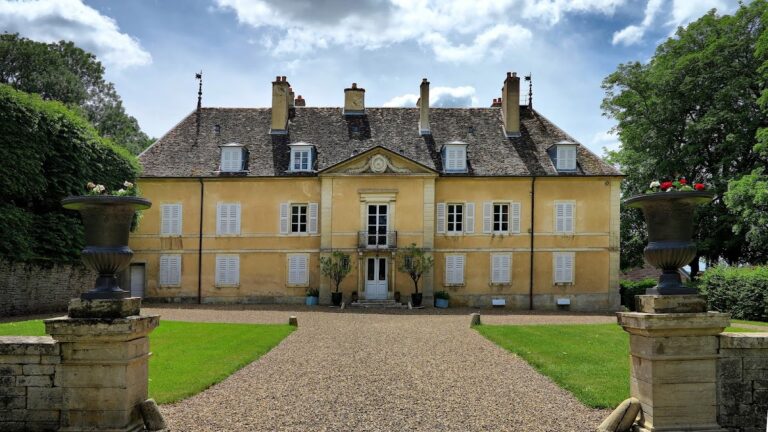
The eighteenth-century monastic complex is marked by imposing façades with long-pitched roofs. It includes the cloister and garden, the abbey house, library, guesthouse, agricultural buildings, and industrial buildings. Together, these structures preserve the organization of a community that combined worship, residence, administration, hospitality, farming, and later industrial work.
Waterworks and former workshops
The monks dug a diversion canal to supply the abbey. A sluice controlled the water, which served a mill and an oil mill. Both mills have disappeared, while a tileworks was established immediately nearby. The surviving industrial structures have a utilitarian, shed-like appearance and form part of the later working landscape of the monastery.
Nearby sites