Tolga Monastery: A Russian Orthodox Monastery near Yaroslavl


Site at a Glance
- Rating
- 4.9
- Popularity
- Low
- Country
- Russia
- Primary era
- Early Modern
- External website
- Open
- Eras represented
- Early Modern, Modern
- Civilizations
- Russian
- Site type
- Religious
- Remains
- Fortified Monastery
On this page18 sections
History
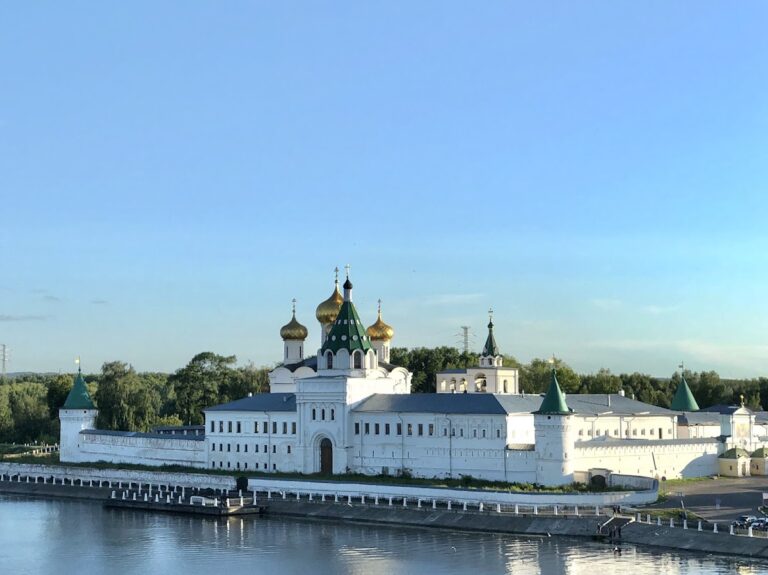
Tolga Monastery is a Russian Orthodox monastery in Russia near Yaroslavl, on the left bank of the Volga where the Tolga River reaches the larger river. Tradition places its foundation in 1314 by Prokhor, Bishop of Rostov, at the site where the Tolga Icon of the Mother of God, a sacred image used in Orthodox prayer and veneration, was believed to have appeared.
Foundation and the Tolga Icon
The foundation story dates the icon’s appearance to 7 August 1314, when Prokhor found it near the Volga, about eight versts from Yaroslavl. After the icon repeatedly returned to that place, a church dedicated to the Presentation of the Virgin was built there, followed by a monastery with an appointed abbot. The name Tolga came from the nearby river, and the icon’s appearance was commemorated each year on 21 August.
The precise date and circumstances of the foundation remain uncertain. The traditional account also names Trifon as founder, although this conflicts with the known dates of Trifon’s tenure as metropolitan of Rostov. A later interpretation places the monastery’s foundation in the 1430s or 1440s rather than in 1314.
Devotion and destruction
Ivan IV, commonly known as Ivan the Terrible and the first Russian ruler crowned tsar, visited Tolga Monastery in 1553. The healing of his leg was attributed to the Tolga Icon, strengthening the monastery’s devotional reputation. The early complex was mainly wooden and suffered repeated destructive fires. During a major fire in the sixteenth century, the entire monastery was reportedly destroyed except for the icon.
In 1609, during the Time of Troubles, a period of dynastic crisis and foreign intervention in Russia, Polish-Lithuanian forces attacked the monastery during the siege of Yaroslavl. The monks were killed and the monastery was looted. A chapel commemorating the murdered monks was later built within the grounds in 1893.
Religious processions connected with the monastery were credited with saving Yaroslavl from plague in 1612 and again in 1654, and with bringing relief from drought in 1657. Tolga also gained further prestige during the popular movement led by Minin and Pozharsky, who organized the volunteer force that expelled Polish-Lithuanian troops from Moscow in 1612. The monastery subsequently received donations and extensive landed property from the tsars.
Stone rebuilding in the seventeenth century
Large-scale rebuilding began under Abbot Gordian in the last third of the seventeenth century. Most of the monastery was reconstructed in stone, replacing the vulnerable wooden buildings. The Cross-Elevation Church had already been built in 1625, the Church of Saint Nicholas followed in 1652, and the principal Presentation Cathedral took its present form between 1681 and 1688.
Nineteenth-century associations and restoration
General Nikolai Tuchkov, a hero of the 1812 Patriotic War and the Battle of Borodino, was buried in the Saviour Church in 1812. A memorial plaque marking his burial place was installed there in 1990. Bishop Ignatius Brianchaninov, a nineteenth-century Russian Orthodox bishop and spiritual writer, visited the monastery in 1862. His relics, bodily remains preserved and venerated as those of a holy person, were transferred from Nikolo-Babaevsky Monastery to Tolga in 1988.
The heir apparent Nicholas Alexandrovich, the future Nicholas II, visited Tolga in 1883. Nicholas II and his family returned in 1913 during celebrations of the three-hundredth anniversary of the Romanov dynasty. Extensive repairs and restoration followed for the monastery’s six-hundredth anniversary in 1914 under Abbot Seraphim Samoilovich.
Closure and revival
Soviet authorities closed the monastery in 1928. From 1936, its buildings were administered by the Soviet internal-affairs authorities, and in the 1950s they were adapted for a children’s institution. These changes of use, together with alterations to the buildings, severely damaged surviving interior furnishings.
The monastery was returned to the Russian Orthodox Church in December 1987 and reopened as a women’s monastery. It became the first women’s monastery established in the Russian Soviet Federative Socialist Republic. Approximately 100 sisters now live there, and the monastery leases 254 hectares of agricultural land from the Russian state.
The oldest reputedly miraculous version of the Tolga Icon returned from a museum to the monastery in 2003, renewing its role as a pilgrimage center. In 2008, an order transferred all the monastery buildings from leasehold into the monastery’s ownership. Repairs to the protected complex undertaken from 2018 were completed in 2019. Tolga Monastery is a federal-level cultural-heritage property of the peoples of Russia and remains an active women’s monastery within the Yaroslavl ecclesiastical jurisdiction.
Remains
The monastery occupies ground near the mouth of the Tolga River. Its enclosure is defined by a defensive wall with eight towers, built at the end of the seventeenth century, and a small water-filled ditch running along the inside of the wall. The stone perimeter belongs to the period when most of the earlier wooden complex was rebuilt.
Entrance and enclosure
Holy Gate
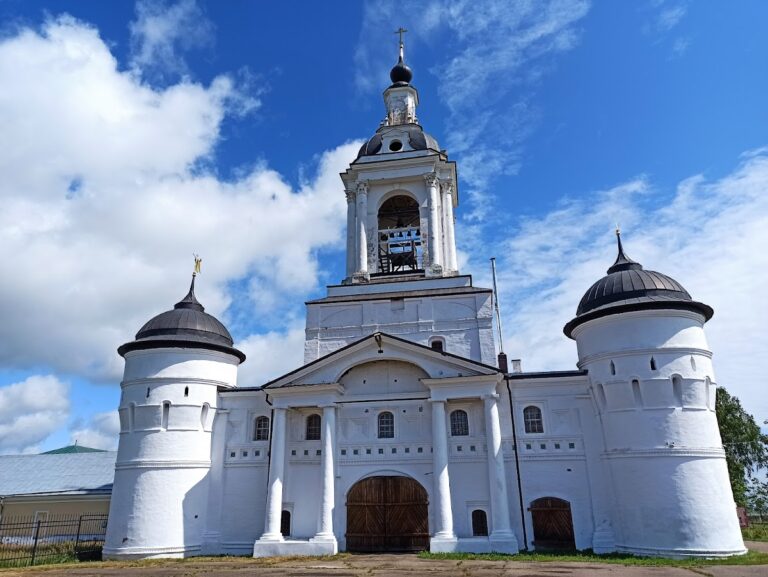
The southwestern entrance is formed by the Holy Gate, built in 1672 with financial support from the Yaroslavl merchant brothers Semyon and Ivan Svertchkov. A gate church dedicated to Saint Nicholas the Wonderworker is incorporated into the entrance structure.
Presentation Cathedral complex
Presentation Cathedral
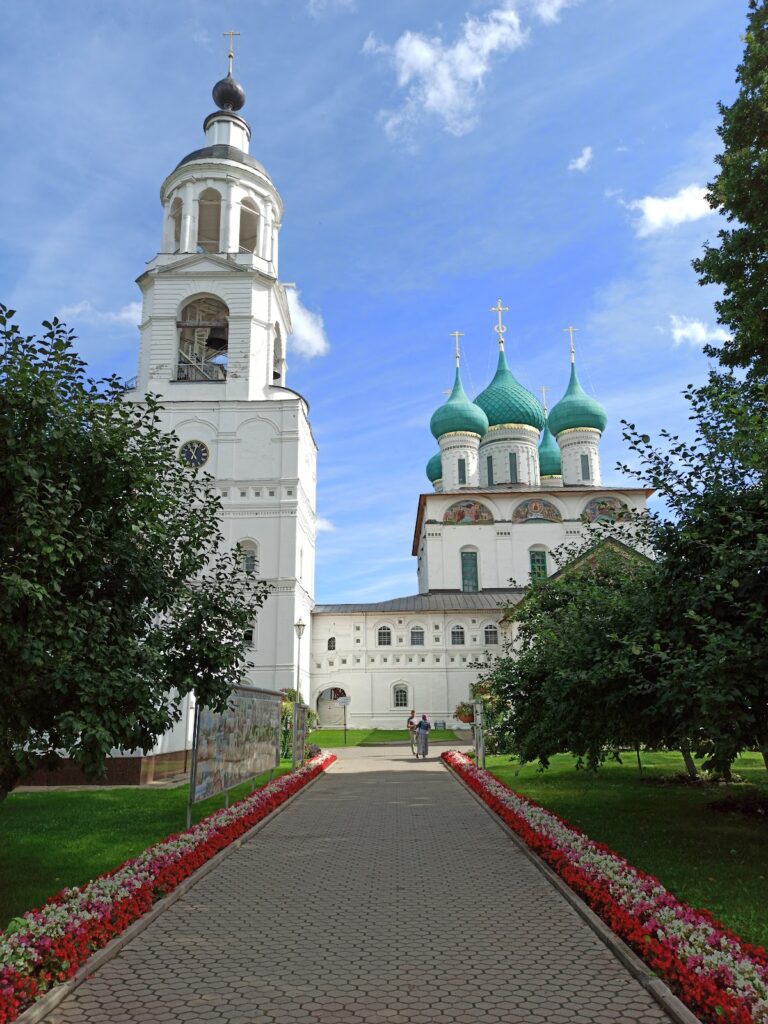
The Presentation Cathedral stands on the site of the first fourteenth-century wooden church. It replaced a sixteenth-century stone church traditionally said to have been donated by Ivan IV. The present building, constructed in 1681–1688, has a cubic five-domed main volume set on a high basement. A narthex, or entrance area, surrounds three sides, while entrance porches provide access to the building.
Its exterior is richly articulated with shallow vertical wall strips, arched gables, profiled cornices, and recessed panels containing glazed painted tiles. The lower level served for centuries as a burial place for influential townspeople, nobles, and the monastery’s abbots.
Extensive wall paintings were added to the cathedral interior in the 1690s. Signatures attribute them to prominent artists from Yaroslavl and Kostroma, including Dmitry Semyonov, Fyodor Fyodorov, and Vasily Osipov. Later overpainting, prolonged neglect, and moisture damage substantially impaired the paintings. Some of the damage was associated with the installation of a model of the Rybinsk Reservoir inside the church.
Bell tower
A bell tower adjoins the northwestern corner of the cathedral’s narthex. Its three lower stories belonged to a tower funded between 1683 and 1685 by Prince Nikita Lvov. Two further stories in the Classical style and a new bell frame were added in 1826, when the original round-arched openings for the bells were blocked.
Cross-Elevation and refectory buildings
Passage and refectory complex
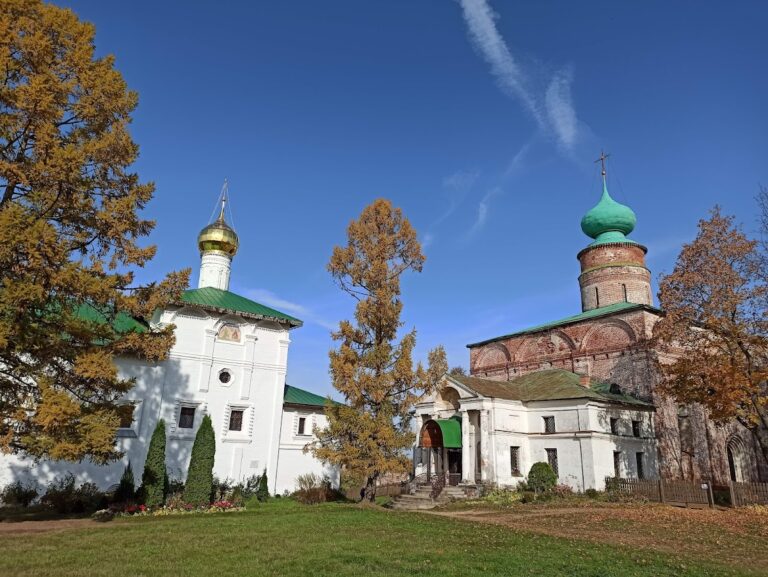
A subsidiary passage building connects the Cross-Elevation Church with the elongated, two-story refectory, the monastery’s communal dining hall. The passage contains a ground-level walkway and an enclosed gallery above it. The refectory has a church attached to its eastern side.
The complex has a core dating from 1625, was largely rebuilt in the 1670s, and was remodeled in the nineteenth century in the Classical style. During the Soviet conversion, steel beams were inserted and partition walls were removed, destroying its fixed historical interior decoration. The church’s present paintings were executed between 2000 and 2002 by artists of the Russian Academy of Arts in the style of the seventeenth-century Yaroslavl school.
Memorial and subsidiary churches
Monks’ memorial chapel
A chapel built in 1893 commemorates the monks killed during the 1609 attack. It stands within the monastery grounds as part of the complex’s later memorial architecture.
Saviour and hospital churches
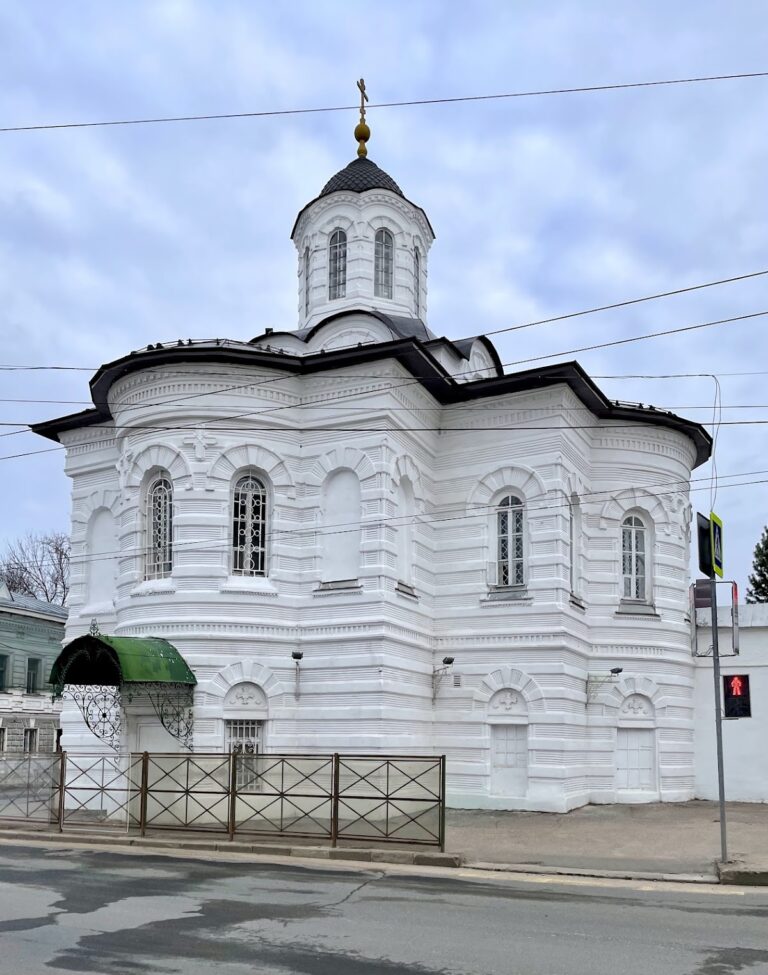
The Saviour Church contains the burial place of General Nikolai Tuchkov, while a memorial plaque installed in 1990 identifies the location. The monastery also includes a hospital church in the Baroque style.
Cedar grove
A grove of Siberian stone pines has grown inside the monastery walls since the sixteenth century, when it was established under Abbot Feodossi. Although the trees are not true cedars, they are traditionally called cedars in Russian usage.
Local tradition holds that the Tolga Icon survived the monastery’s last major fire while hanging from one of the grove’s branches. Cones from the trees are believed to have healing properties and are distributed to pilgrims during the annual feast of the Tolga Icon.
Nearby sites