Frigolet Abbey: A Premonstratensian Monastery in France


Site at a Glance
- Rating
- 4.6
- Popularity
- Medium
- Country
- France
- Primary era
- Medieval
- External website
- Open
- Eras represented
- Medieval, Early Modern, Modern
- Civilizations
- County of Provence, French, Holy Roman Empire
- Site type
- Religious
- Remains
- Monastery
On this page15 sections
History
Frigolet Abbey is a historic Premonstratensian monastery in France, located near Tarascon in the Montagnette. Its earliest construction traces date from the seventh century, while the surviving complex reflects Romanesque and nineteenth-century Neo-Gothic phases. The name comes from ferigoulo, the Provençal word for thyme.
Early foundations
A separate tradition places the monastery’s foundation around 960 and provisionally attributes it to Conrad I of Burgundy. Benedictine monks from Montmajour are said to have formed its first community. By the twelfth century, the site was occupied by Augustinian canons, clergy who followed the Rule of Saint Augustine while living in a religious community.
The Augustinian monastery
The prior Guillaume of Loubières is recorded at Frigolet in 1133, and Pope Adrian IV confirmed the community in 1155. During this period, the monastery developed its first major medieval complex, including a cloister, a Romanesque church, and the chapel of Our Lady of Good Remedy.
The Augustinian community declined during the fourteenth century. Under Pope John XXII, Frigolet was attached to Notre-Dame-des-Doms Cathedral in Avignon, and most of the canons left to serve at the cathedral. The canonical community was suppressed in 1480, after which the monastery was abandoned. The chapel of Our Lady of Good Remedy continued to attract pilgrims.
Renewal and revolutionary suppression
Religious life returned in the seventeenth century. Hieronymite monks took possession of the neglected monastery in 1647 and restored and enlarged it. Discalced Augustinians, a reformed branch of the Augustinian order, replaced them in 1661. They continued the building work and provided pastoral assistance in the surrounding region. By 1675, the site was known as Notre-Dame-du-Bon-Remède.
A fire destroyed the monastery library on 6 July 1788. During the French Revolution, the convent was seized, suppressed, and sold in 1791, and its four remaining canons were dispersed. The buildings later served as a college during the 1830s and until 1841. The Provençal poet Frédéric Mistral attended the college from 1839 to 1841.
The Premonstratensian restoration
In 1858, Edmond Boulbon, a former Trappist, acquired the old buildings and began restoring Premonstratensian religious life at Frigolet. The Premonstratensians, also known as Norbertines, are a Catholic order founded by Norbert of Xanten that combines communal religious life with pastoral and clerical work. With the support of Georges-Claude-Louis-Pie Chalandon, Archbishop of Aix, Boulbon admitted novices, re-established the community, and began constructing the present complex.
A new church dedicated to the Blessed Virgin Mary was solemnly consecrated on 6 October 1866. Pope Pius IX canonically established Frigolet as a priory on 28 August 1868 and elevated it to an abbey in 1869. Boulbon became its first abbot. The pope also authorized the formal coronation of the statue of Our Lady of Good Remedy, which took place on 15 October 1869. The statue of Saint Joseph received a canonical coronation in September 1874.
Expulsion, exile, and institutional growth
In November 1880, French anti-clerical legislation led government forces to besiege the abbey and expel the Premonstratensians. About sixty religious and roughly 3,000 lay supporters had initially fortified themselves inside. General Guyon-Vernier blockaded the site with 240 cavalrymen, later reinforced by 500 infantrymen and artillery. After the gates were forced, 68 religious were arrested and escorted to Tarascon; two sick members of the community were temporarily allowed to remain.
The expelled canons went into exile at Storrington Priory in England and later returned to Frigolet. A further expulsion in 1903 led them to take refuge at Leffe Abbey in Belgium and again at Storrington. The Premonstratensians reoccupied Frigolet in 1923.
After Boulbon’s tenure, the abbey was administered by Paulinus Boniface and then Denis-Hubert Bonnefoy. Boniface was removed after poor administration, while Bonnefoy died in office in 1899. Under Godefroid Madelaine, Frigolet sent missionaries to Madagascar and founded or developed priories in France and England. A decree of the Roman Curia dated 17 September 1898 incorporated the previously separate Frigolet congregation into the wider Premonstratensian Order.
Twentieth-century and recent history
Norbert Calmels became abbot in 1946 and served as Abbot-General of the Premonstratensian Order from 1961 to 1981. He also participated in the Second Vatican Council. Bishop Jean-Baptiste Penon retired to Frigolet in 1926 and died there in 1929. In 1984, Pope John Paul II elevated the abbey church to a minor basilica, a papal designation for a church distinct from the rank of cathedral.
Major works took place between 2010 and 2014 after the buildings had become unsafe. Since September 2016, the abbey has also housed a Catholic school and an independent private secondary school. A forest fire in the Montagnette on 14 and 15 July 2022 forced about 80 people to evacuate the abbey for three days. Firefighters and water-bombing aircraft prevented the flames from destroying the complex.
The cloister and chapel received French historic-monument classification in 1921. Protection established in 1995 included the cloister buildings and associated walls, turrets, cistern, chapel, chapter house, parlour, refectory, sacristy, Saint Michael’s Chapel, and abbey church. The entire abbey church was classified in 2015.
Remains
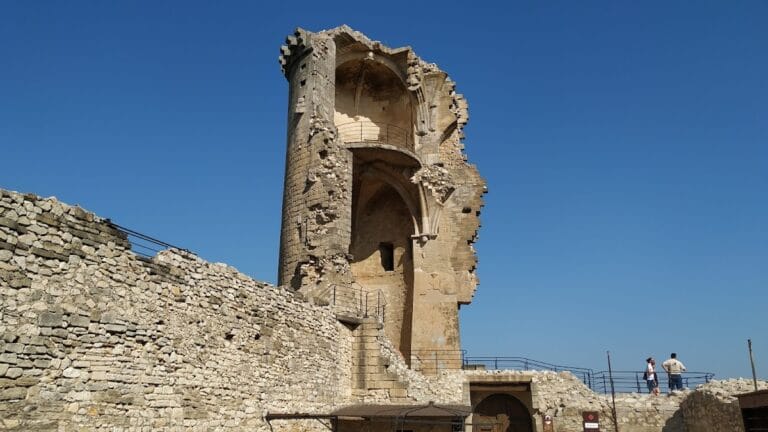
Frigolet Abbey stands in an isolated valley of the Montagnette, among pines, olive trees, and cypresses. Its surviving complex brings together twelfth-century Romanesque buildings, seventeenth-century alterations, and the nineteenth-century basilica and associated works. Enclosing walls, façades, roofs, turrets, a cistern, rooms around the cloister, and several communal and liturgical spaces form part of the protected architectural group.
Romanesque buildings and medieval spaces
Saint Michael’s Church
Saint Michael’s Church is a Romanesque building from the twelfth century. It underwent extensive restoration in the nineteenth century, when a bay was added at the west end. The building survives as part of the abbey’s medieval architectural group.
Chapel of Our Lady of Good Remedy
The twelfth-century Romanesque chapel of Our Lady of Good Remedy is enclosed within the larger basilica. Its interior is concealed beneath Baroque woodwork and seventeenth-century paintings. Anne of Austria sponsored the chapel’s Baroque ornamentation. The chapel remained a focus of pilgrimage after the medieval canonical community was suppressed.
Cloister and conventual rooms
The cloister is distinctly Romanesque and dates from the twelfth century, although it was remodeled in the seventeenth century. The surrounding complex includes the chapter house, where the community met for official business, together with the parlour, refectory, sacristy, and other rooms around the cloister. Enclosing walls, turrets, and a cistern contribute to the surviving monastic layout.
Nineteenth-century church and devotional features
Basilica of the Immaculate Conception
The Basilica of the Immaculate Conception is a nineteenth-century Neo-Gothic church consecrated in 1866. Its large nave is covered with oil paintings by Antoine Sublet, a French painter known for religious murals. The arrangement was produced on the model of the Sainte-Chapelle in Paris, the richly decorated Gothic royal chapel.
Saint Joseph’s Chapel and the Way of the Cross
A separate chapel within the abbey is associated with the venerated statue of Saint Joseph, which was formally crowned in 1874. Along the access road, a Way of the Cross is marked by a series of small turrets, extending the devotional organization of the complex beyond its principal buildings.
Nearby sites