St. Niklaus Parish Church: A Historic Catholic Church in Switzerland


Site at a Glance
- Rating
- 4.6
- Popularity
- Very Low
- Country
- Switzerland
- Primary era
- Modern
- External website
- Open
- Eras represented
- Medieval, Modern
- Civilizations
- Holy Roman Empire, Swiss
- Site type
- Religious
- Remains
- Church
On this page8 sections
History
St. Niklaus parish church is a Roman Catholic church in St. Niklaus, Switzerland, dedicated to Nicholas of Myra. The present building was inaugurated in 1965, continuing a religious tradition that reaches back to the medieval period and to the first place of worship in the Nikolai Valley, also known as the Matter Valley.
The medieval parish
The parish is first known from a document dated 12 May 1268. At that time, its territory extended along the entire valley, from Kipfen at 897 metres above sea level to the Theodul Pass at 3,295 metres. A church dedicated to Nicholas was mentioned at St. Niklaus Dorf in 1272. Nicholas, a fourth-century Christian bishop of Myra in Lycia, was remembered in Christian tradition as a patron of children, sailors, and travellers. His name became attached not only to the church, but also to the valley, village, political municipality, and civic corporation of St. Niklaus.
The parish’s chaplaincy appears in records from 1329. Its oldest surviving archive documents date from 1455 and 1506. Several later communities began as daughter parishes of St. Niklaus. Zermatt was mentioned in 1285, built a village chapel around 1290, and retained a degree of dependence on St. Niklaus until 1927. Täsch became separate in 1423, Randa in 1730, and Herbriggen in 1933, after its own parish church had been built. A shortage of priests later meant that the priest of St. Niklaus also served Herbriggen.
Parish life and prominent clergy
St. Niklaus produced several clergy whose work remains connected with the parish’s history. Nikolaus Schiner served as parish priest from 1465 to 1473 and became bishop of Sion in 1496. Three years later he resigned that office in favour of his nephew, Cardinal Matthäus Schiner.
Johann Peter Imboden was chaplain from 1729 and parish priest from 1730 until his death in 1764. During his tenure, a new parish house was erected in 1735. He opened a new baptismal register in 1736, the fourth surviving register of the parish, which continued in use until 1849. Imboden also wrote popular plays performed in St. Niklaus, and some of his original manuscripts remain in the parish archive.
Josef Tantignoni served as parish priest from 1849 to 1856, while Franz Xaver Tantignoni was chaplain during several periods between 1848 and 1889. Peter Josef Ruppen followed as parish priest from 1856 to 1862. In 1861, Ruppen published a family statistic of the parish, described as the oldest known printed local family register in the world. A painting in the church portrays him holding its 1857 edition. Karl Burgener, parish priest from 1965 to 1993, composed 126 pages of original musical scores.
Rebuilding and later history
The church has remained on the same site throughout its history, according to Peter Josef Ruppen. The present church replaced a large Baroque building and was inaugurated by Bishop François-Nestor Adam on 18 July 1965. Some altars from the earlier church were moved into the new structure, preserving a material link with its predecessor.
The parish house built in 1735 was renovated in 1967 and continues to serve as the residence of the parish priest. The church tower received work at its uppermost section in 1750 and was restored in its entirety during 1964 and 1965. In 1998, the tower was presented during the Christmas season as a figure of Saint Nicholas, with its onion dome representing the head. The presentation was entered in the Guinness Book of Records in 2000 in connection with the claim that it was the world’s largest Saint Nicholas.
Remains
Church setting and medieval tower
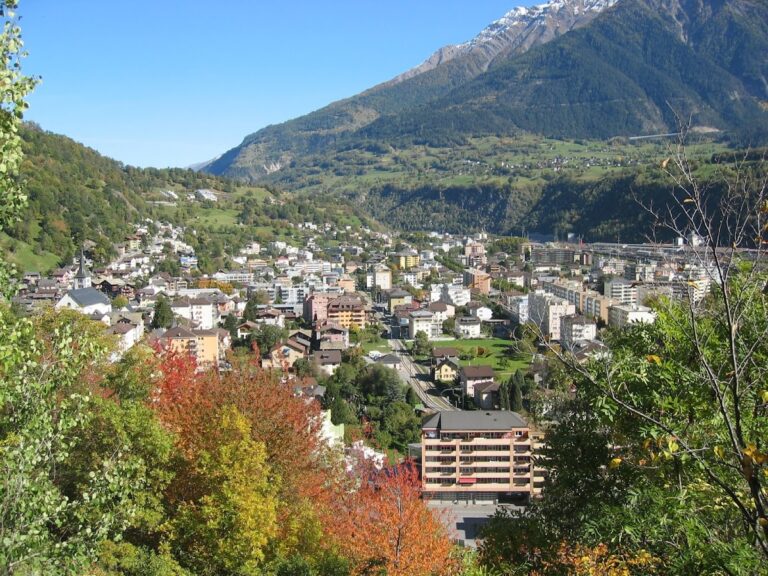
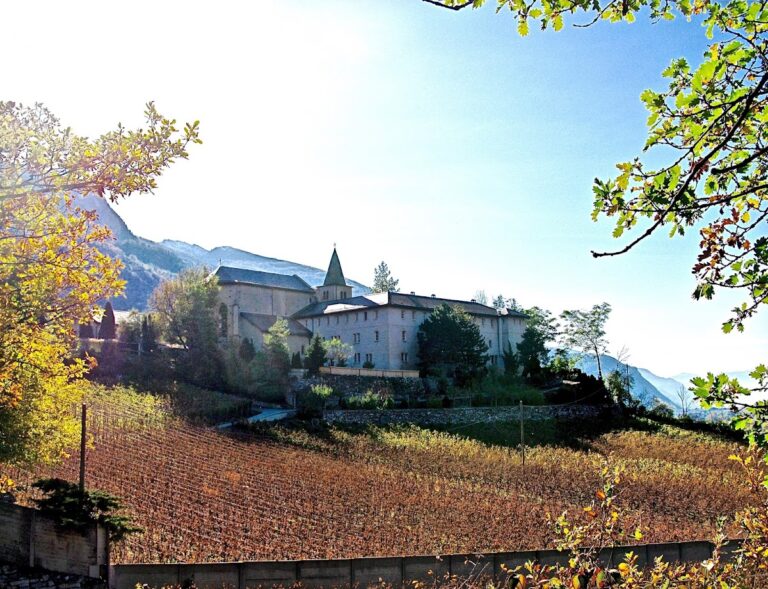
The church stands at the entrance to the old centre of St. Niklaus Dorf when approached from Visp. Its medieval tower is a Romanesque ashlar structure, built from regularly dressed stone blocks. At 36.80 metres high, it is described as the largest onion-domed tower in Upper Valais. The bulbous dome, which narrows toward its crown, was completed in 1726. The tower is associated with the period of Kaspar Stockalper, the prominent seventeenth-century Valais merchant and statesman, although it may be older. A sacristy links the tower to the church.
The tower contains a five-bell peal. Two historic bells are joined by three cast in 1948 by H. Rüetschi of Aarau. The largest bell dates from 1767 and was made by Bartholomeus Bozzius Mediolanensis of Milan. The second-largest was cast in 1876 by Victor Walpen of Reckingen. Together, the bells sound the notes E-flat, G-flat, A-flat, B-flat, and D-flat.
Interior furnishings and music
The 1965 church contains altars transferred from the demolished Baroque church. An altarpiece bearing the inscription “Death of Mary, from St. Niklaus, Valais, 1475” is preserved in the Swiss National Museum in Zurich, while the church retains other objects associated with its earlier history.
The church organ was built in 1968 by Späth Orgelbau of Rapperswil. It has 21 stops distributed across two manuals and a pedal. Six of those stops came from the 1857 organ of the former church. In organ building, a stop is a group of pipes with a particular tone, a manual is a hand-played keyboard, and a pedal is operated by the feet.
A portrait of Johann Peter Imboden dated 1738 is the oldest surviving portrait of a parish priest of St. Niklaus. It shows a chalice on an altar between two stars, surrounded by a decorative pattern. The inscription gives his age as 43 in that year.
Bergführer Monument
The Bergführer Monument has stood on the church square since 1995. Rising 3.70 metres, it is made of seven bronze panels. The panels honour the women mountaineers of the British Ladies’ Alpine Club, the men of the British Alpine Club, and the mountain guides of the municipality of St. Niklaus.