Shoana Church: An Alanian Christian Cathedral in Russia


Site at a Glance
- Rating
- 4.9
- Popularity
- Low
- Country
- Russia
- Primary era
- Medieval
- Eras represented
- Medieval, Modern
- Civilizations
- Russian
- Site type
- Religious
- Remains
- Cathedral
On this page7 sections
History
Shoana Church is a Christian cathedral in Russia, above Kosta Khetagurov village near Karachayevsk, associated with the historical Alanian Diocese, the medieval Christian institution serving Alania and the Alans of the North Caucasus. Built in the Byzantine architectural tradition during the late tenth or early eleventh century, it belongs to the third stage of Alanian church construction after the region returned to Christianity around 950. The church, a rock-cut burial site, and the ruins of a tenth- to eleventh-century Alanian settlement now form the Shoana historical and architectural complex.
The Alanian building tradition
Shoana Church was built after several earlier Alanian churches: Central Zelenchuk Church, dated to the 950s and 960s; Senty Church, dated to 965; and North Zelenchuk Church, dated to the late 960s and 970s. Its precise construction date cannot be established because no written evidence survives. Remnants of its fresco painting have been associated with the second layer of painting at Senty Church, supporting a date in the late tenth or early eleventh century.
The church is a reduced and modified copy of North Zelenchuk Church. Its builders followed a prestigious architectural model but adapted it freely. A. Vinogradov and D. Beletsky have considered the builders a local team with stronger technical training than the earlier builders, although the team cannot currently be assigned to a particular architectural school. The church’s original function remains unknown. The slope around it was once densely settled, and numerous burials were found both within the settlement and inside the church.
Later religious use and modern changes
At the end of the nineteenth century, Shoana Church became the church of a skete belonging to the Alexander-Athos Monastery. During this conversion, the building was replastered, its roof was replaced, and its side chapels were rebuilt.
In 2007, residents of Kosta Khetagurov village carried out an unauthorized repair after appealing to the republican government. Rough removal of late interior plaster damaged part of the earlier coating beneath it, but the exposed surfaces revealed remnants of ancient decorative painting, inscriptions in Greek, Arabic, Georgian, Armenian, and Russian from different periods, and numerous North Caucasian ancestral signs known as tamga. These distinctive marks could be associated with families, clans, or lineages. The eastern part of the church facing the village was whitewashed.
Unknown persons set fire to the church on April 30, 2011. The fire was extinguished quickly, and the interior furnishings and icons were not damaged. Shoana Church is a federally significant cultural-heritage property of the Russian Federation. It formerly belonged to the M. O. Baichorova State Karachay-Cherkess Historical, Cultural, and Natural Museum-Reserve. In 2018, it was transferred to the Alanian Christian Center in the North Caucasus, established in 2017. The Karachay people’s congress criticized the transfer as unlawful and questioned the center’s experience and qualifications for conserving and managing such monuments.
Remains
Setting and architectural form
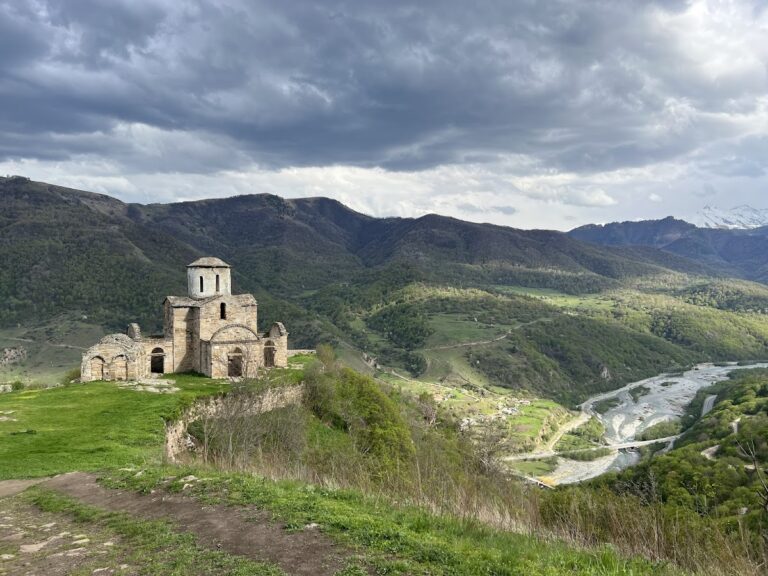
Shoana Church stands on the southeastern spur of Mount Shoana, on the left bank of the Kuban River near its confluence with the Teberda River. It rises above Kosta Khetagurov village, approximately 7 kilometres north of Karachayevsk. The building has an inscribed-cross plan, in which four vaulted arms of a cross are incorporated within a larger rectangular structure and support a central dome. It is a three-apsed, three-naved church, with apses slightly narrower than the naves. Four square pillars carry three levels of supporting arches and the dome. The church measures 12.9 metres from west to east, 8.9 metres across the western facade, and 12.9 metres in height.
Two closed, vaulted vestibules are attached to the north and south sides. Unlike North Zelenchuk Church, Shoana Church has neither a narthex, an entrance hall adjoining the main church, nor a western vestibule. Its eastern corner cells and side bema, the sanctuary area at the eastern end of a church, are arranged as a single compartment with one blind arch on the side wall. This distinctive arrangement provides the clearest architectural evidence of the building’s relationship to North Zelenchuk Church.
Masonry, dome, and exterior
The main volume is constructed from roughly worked sandstone blocks laid in lime, with a rubble-concrete filling inside the walls. Plinthite, a thin flat brick used widely in Byzantine architecture, occurs only in the arches. The windows are covered instead by stones carved with semicircular upper ends rather than by plinthite arches. Numerous scaffolding holes remain visible in the masonry. A piece of wooden beam survives in a hole in the western part of the south wall, where builders could not remove it and sawed it off.
The octagonal dome drum has eight windows. Each face ends in an overhanging archivolt, a band following the curve of an arch, carried on corner consoles shared by neighbouring arches. Strong stone substructures support the building. Exterior decoration is restrained, consisting of a cornice made from stone tiles, plinthite brow moldings on the drum, and stone brow moldings above some windows. A thin exterior plaster coating survives in places between the stone blocks.
The original roof form remains uncertain. A restored gable roof now covers the church, while one interpretation proposes that the original tiles rested on semicircular zakomary, gable-like medieval roof forms. The present multifaceted covering of the dome drum has no supporting scientific evidence. Inside, the walls were plastered and decorated with ornamental designs. The 2007 repair exposed ancient decorative painting, inscriptions from several periods, and numerous tamga marks on the surviving surfaces.
Burials and associated remains
The church stands within a wider archaeological landscape that includes a rock-cut burial site and the ruins of an Alanian settlement dating from the tenth to the eleventh centuries. Burials were found in both the settlement and the church, linking the surviving building to the occupied slope around it. Together, these remains form the physical setting of the Shoana historical and architectural complex.