Benedictine Abbey of Abdinghof, Paderborn: A Romanesque Monastic Complex


Site at a Glance
- Rating
- 4.5
- Popularity
- Low
- Country
- Germany
- Primary era
- Medieval
- External website
- Open
- Eras represented
- Medieval, Modern
- Civilizations
- Holy Roman Empire
- Site type
- Religious
- Remains
- Church
On this page15 sections
History
The Benedictine Abbey of Abdinghof, dedicated to Saints Peter and Paul, is a Romanesque monastery church and former Benedictine abbey in Paderborn, Germany, traditionally founded in 1015. Archaeological evidence suggests that the monastery buildings may instead have been erected in the late eleventh century, so Bishop Meinwerk may not have laid their foundations despite the traditional account.
Origins under Bishop Meinwerk
A predecessor building occupied the site before the year 1000. A major fire in that year destroyed Paderborn Cathedral and its associated monastery, including the diocesan archive. The loss of these records left the earliest history of the city and diocese difficult to reconstruct.
In 1009, the German king and Holy Roman Emperor Heinrich II appointed his friend Meinwerk bishop of Paderborn. Meinwerk is regarded as the second founder of the diocese. He laid the foundations of the abbey in 1016 according to the traditional chronology, while the construction of its church began in 1021. The Benedictine complex had developed by 1031. Meinwerk consecrated the crypt to Saint Stephen on 2 January 1023 and the abbey church in 1031. After his death on 5 June 1036, he was buried in the crypt according to his wishes.
The monastery became an important religious and cultural institution. Fifty-one abbots governed it during its existence, while its library, school, hospice, manuscript-illumination and bookbinding workshops, and church treasures supported its intellectual and religious work. Its lands extended through the Weser region and along the Lower Rhine, reaching as far as the Netherlands.
Rebuilding and intellectual activity
A second city fire in 1058 destroyed the cathedral and damaged the Abdinghof church. Bishop Poppo and Saint Altmann of Passau, an expelled bishop, consecrated the rebuilt church in 1078. Poppo was buried there after his death in 1083. Bishop Heinrich II consecrated a large triumphal cross for the church in 1090. Three years later he confirmed the monastery’s purchase of the Externsteine and consecrated the rock chapel established there in 1115.
The community also extended its influence through dependent and associated monasteries. Monks from Abdinghof moved to Boke around 1100 and then permanently to Flechtdorf in 1104, a monastery founded by Erpo of Padberg. The Annales Patherbrunenses, the earliest systematic collection of information about Paderborn’s history, were probably compiled at Abdinghof between 1105 and 1125. The monastery was also connected with the Helmarshausen scriptorium, a monastic writing room for copying and decorating manuscripts, particularly during the time of Abbot Wino.
In 1120, Vicelin of Hamelin gave Abdinghof relics of Saints Willehad, Ansgar, and Rimbert, together with a manuscript describing their lives. The Abdinghof Blood Blessing also dates from the first half of the twelfth century. After the fire of 1165, which damaged both the abbey church and the nearby Church of Saint Pankratius, the monastery was rebuilt with a new abbot’s chapel and new conventual buildings. During the twelfth century, the monastery’s writing office also produced more than thirty forged documents, possibly in connection with the consequences of the fire.
Late medieval authority and reform
Meinwerk’s remains were placed in a high tomb in the choir in 1376. During the Western Schism, a dispute between rival papal obediences, tensions between the monastery and Paderborn’s prince-bishop became particularly sharp. In autumn 1409, the newly elected Abbot Heinrich Knipping came into conflict with Prince-Bishop Wilhelm I of Berg and his official Gobelin Person. With a papal privilege and support from Paderborn’s citizens, the monastery ultimately escaped the bishop’s jurisdiction.
Under Prince-Bishop Simon III, Abdinghof joined the Bursfeld Congregation in 1477. This Benedictine reform association sought to strengthen monastic discipline and observance. Brother Jodokus Cassel endowed the Abdinghof Chalice in 1496, and the Abdinghof Gradual, a manuscript of liturgical chants for the church year, was produced at the monastery in 1507.
Reformation and confessional conflict
At the beginning of the Reformation around 1525, Abdinghof remained Roman Catholic. The Church of Saint Pankratius and parts of the cathedral chapter, however, supported evangelical teaching with backing from Lippstadt and the Landgraviate of Hesse. In 1577, the Protestant majority of the cathedral chapter elected Heinrich of Saxony-Lauenburg as Heinrich IV, an elected bishop who tolerated Lutheran teaching alongside Catholic worship.
Catholic resistance gathered around the cathedral provost Dietrich von Fürstenberg, who became prince-bishop in 1585 and reasserted Catholic control. Leonhard Ruben, later a Benedictine monk and abbot of Abdinghof, supported the Catholic side. As abbot in 1604, he received Count Johann of Rietberg and his wife into the Catholic Church after their conversion, in the presence of the prince-bishop.
War, dissolution, and military reuse
The monastery was plundered during the Thirty Years’ War, the European conflict of 1618 to 1648 that involved religious and political struggles across the Holy Roman Empire. From 1632, Abbot Gabel Schaffen attempted to reform monastic discipline, initially facing united resistance from the monks. In 1734, Abdinghof entered a prayer confraternity with Hardehausen Abbey and Marienmünster Abbey.
Prussian troops occupied Paderborn in 1802 in preparation for the secularization of the ecclesiastical principality. Secularization here meant the legal dissolution of a religious institution and the transfer of its property to secular authority. On 25 March 1803, Prussian commissioners von Pestel and Schwarz announced the abbey’s dissolution. The monastery was confiscated and converted into a Prussian barracks.
French troops occupied Paderborn in 1806, and the former abbey church became a fodder magazine and stable for military horses. The remains of Bishops Meinwerk and Poppo were transferred to the Busdorf Church. After the French defeat, Prussian troops retook the former monastery in 1815, and it remained in military use from 1816 until 1939. The complex included the headquarters and training squadron of the 15th Cavalry Regiment.
Protestant church and postwar rebuilding
Security work began on the church in 1862 after Paderborn citizens had used it as a source of building stone. In 1863, the Protestant congregation acquired the building and rebuilt it as the first Protestant church in Catholic Paderborn. Reconstruction was commissioned in 1868 and directed by Max Pommer from April 1869. The church was rededicated on 25 April 1871, and its interior received a cycle of paintings from the Old and New Testaments between 1915 and 1919.
An air mine and incendiary bombs destroyed the church and former monastery buildings on 22 and 27 March 1945. Excavations directed by Bernhard Ortmann from 1949 to 1956 examined the church and monastic grounds. Most of the monastery buildings were demolished in 1952, and Paderborn built a new administration complex and municipal gallery on the site. The church was rededicated on 17 March 1951, the crypt on 25 December 1957, and the organ on 14 May 1961. Members of both major Christian confessions in Paderborn supported the rebuilding.
From autumn 2023 until after Easter 2025, extensive interior conservation cleaned and repainted the walls, repaired the windows, renewed electrical and lighting systems, and repaired the floors with new sandstone slabs. The work also added underfloor heating supplied by heat pumps using water from the Pader, created barrier-free access, restored a visible sandstone finish in the entrance hall, replaced pews with chairs, and reconstructed two choir windows from historical illustrations. The church reopened with a service on 25 May 2025. It is now the principal church of Paderborn’s Evangelical Lutheran congregation, whose parish includes the central city, several parish districts, Dahl, and Dörenhagen.
Remains
Church, crypt, and monastery grounds
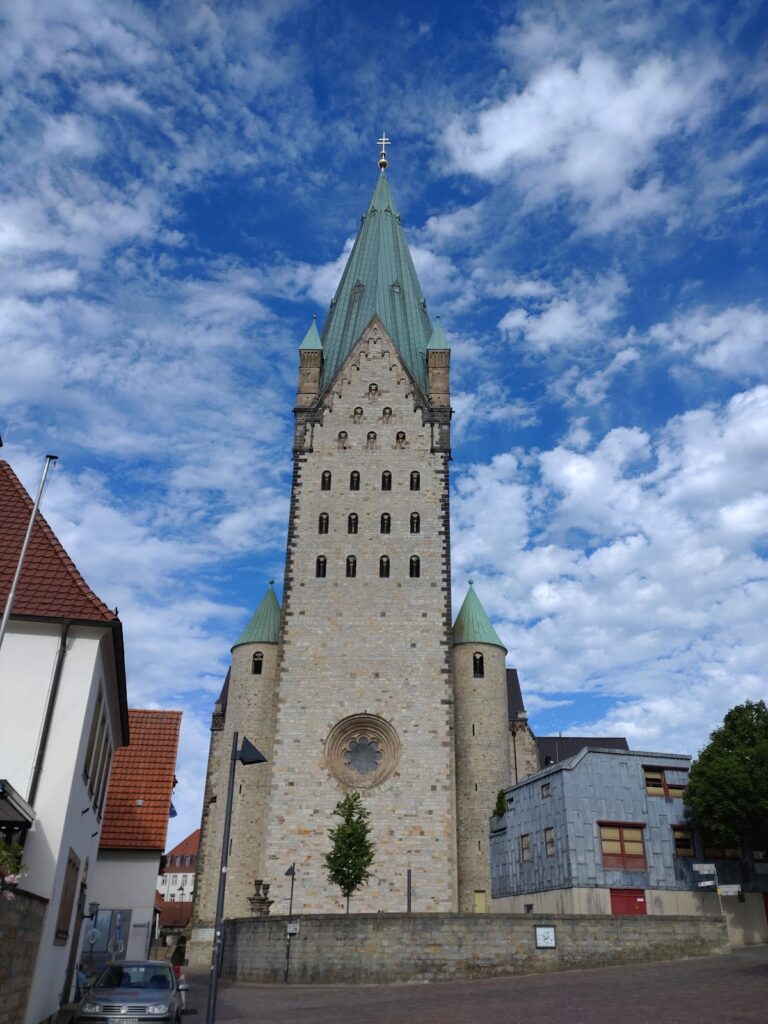
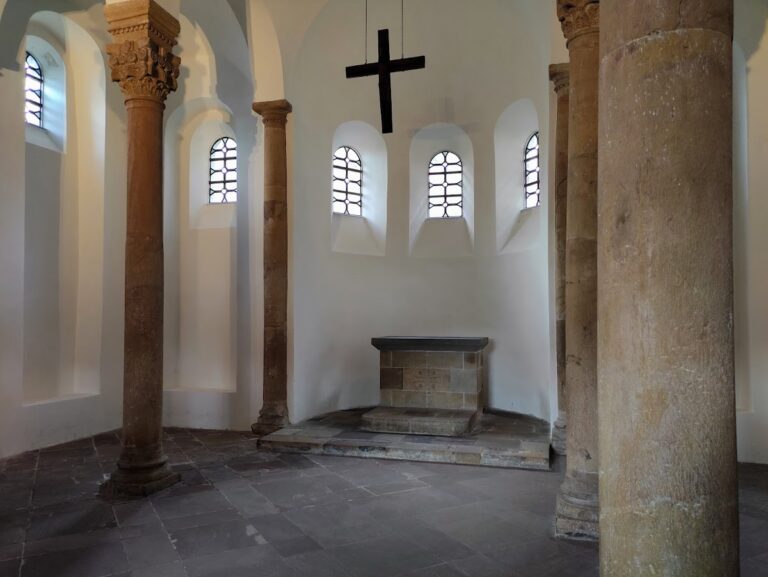
The surviving church is a Romanesque building that formed the main worship space of the Benedictine complex. Its early medieval arrangement included a crypt dedicated to Saint Stephen. The later monastery contained an abbot’s chapel, conventual buildings, a refectory, a cloister, and an inner courtyard. After the destruction of 1945 and the demolition of most of the monastic buildings in 1952, the Remter, a surviving monastery hall, parts of the cloister, and sections of the courtyard remained.
The former conventual area is now occupied by Paderborn’s municipal administration and municipal gallery. Franz-Stock-Platz occupies the former courtyard, and its paving marks the positions of the monastery foundations. These traces preserve the outline of parts of the former monastic complex within the modern urban setting.
Burial remains and historic objects
Meinwerk’s burial memorial
Meinwerk’s stone sarcophagus was kept in the crypt after his burial. Since 1958, the sarcophagus has been in the Busdorf Church. Its surviving slab is not eleventh-century; comparative finds place it in the middle of the thirteenth century, while the appearance of the original slab is unknown. Meinwerk’s tomb slab was transferred first to the Bartholomew Chapel and later to the diocesan museum. Parts of his remains and the slab are now in Paderborn Cathedral’s bishops’ crypt, while another part of his remains is kept in the sacristy of the Busdorf Church.
Manuscripts and liturgical treasures
The Abdinghof Gospel, dating to about 1060, is preserved in Berlin’s Kupferstichkabinett. The Abdinghof Chalice, endowed in 1496, forms part of the furnishings of the parish church of Saint John of Nepomuk in Hövelhof. The Abdinghof Gradual of 1507 is held by the Archiepiscopal Library of Paderborn.
Bells and organ
Cast-steel bells
Three cast-steel bells made by the Bochum Association were installed in the church in 1869 and 1870. They are tuned to e’, gis’, and h’ and continue to ring.
Main organ
The main organ was built by Emil Hammer Orgelbau of Hanover and inaugurated on 14 May 1961. It is a mechanical slider-chest organ, using sliding boards beneath the pipes to connect selected stops with the wind supply. The instrument has four divisions, 34 stops, approximately 2,500 pipes, three manuals, and a pedal, and stands against the east wall of the choir.
Architect Wulf Knipping of Hagen designed the organ case as a triptych, a three-part composition resembling a winged altarpiece. For visual reasons, the pedal division is arranged in two pedal towers. Both the notes and stops use mechanical action, and the instrument has slider chests with the couplers II/I, III/I, I/P, II/P, and III/P.
Nearby sites