Brauweiler Abbey: A Benedictine Monastic and Cultural Complex in Germany


Site at a Glance
- Rating
- 4.5
- Popularity
- Low
- Country
- Germany
- Primary era
- Medieval
- External website
- Open
- Eras represented
- Medieval, Early Modern, Modern
- Civilizations
- Holy Roman Empire
- Site type
- Religious
- Remains
- Monastery
On this page18 sections
History
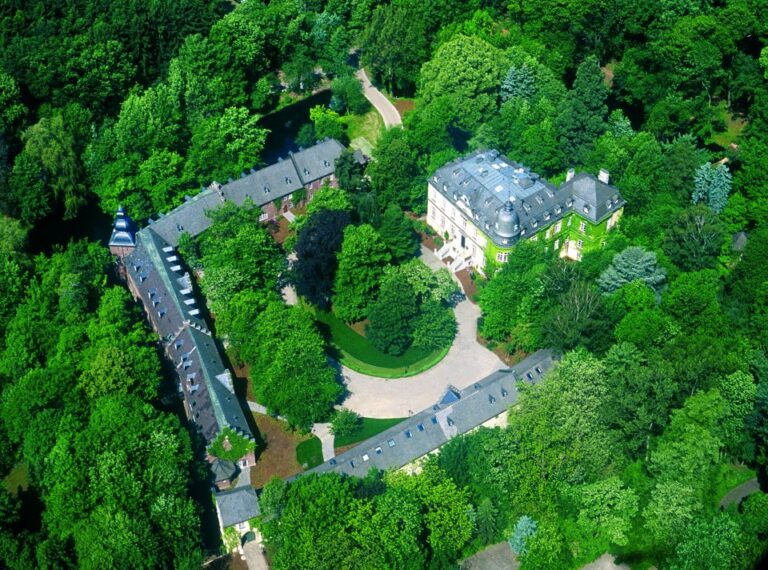
Brauweiler Abbey is a former Benedictine abbey in Germany, located in Brauweiler, now part of Pulheim near Cologne. Founded in the early eleventh century by the Ezzonian aristocratic family, it became a religious center whose present church is one of the major Romanesque buildings of the Rhineland. The church remains a Catholic parish church dedicated to Saint Nicholas and Saint Medardus, while the former abbey complex serves regional cultural and archival purposes.
Early settlement and the Ezzonian estate
Human activity at Brauweiler reaches back to the older Iron Age, when pottery fragments, worked flint, and a Hallstatt cremation grave were deposited at the site. Excavations in 1983 and 1984 also revealed a Roman fortified installation and a villa rustica, a Roman rural estate or farm complex, with two building wings. The estate was destroyed by fire in the fourth century and was not rebuilt.
A monastic narrative written in the late eleventh century preserves the tradition of an earlier wooden chapel. According to this account, a man named Brun brought relics associated with Saint Medardus of Soissons, a sixth-century bishop of Noyon linked with Soissons, and placed them at the chapel’s altar. The chapel may have been built in the middle of the eighth century, although this cannot be confirmed by surviving documentary evidence. Its decayed remains were reportedly rediscovered around 985.
Count Palatine Hermann I of the Ezzonian dynasty subsequently built a stone chapel on the site. The Ezzonians were a powerful aristocratic family whose members held the count palatine office in Lotharingia and maintained close ties to the imperial court. Warin, Archbishop of Cologne, consecrated the chapel. Hermann also rebuilt the earlier estate beside it, creating the center of a settlement that has continued without abandonment. The property was an important allod, meaning land held as the family’s own possession rather than as a feudal holding, and was one of the Ezzonians’ fortified residences, together with Tomburg and Siegburg.
Foundation of the monastery
Around 991 to 993, Hermann’s son Ezzo-Ehrenfried married Matilda, the daughter of Emperor Otto II and the Byzantine-born empress Theophano, at the Brauweiler estate. Ezzo transferred the estate to Matilda as her morning gift. Through the Medardus Chapel, she dedicated the property to Christ and the saints. The marriage strengthened the family’s position within the imperial aristocracy.
Before 1024, Ezzo and Matilda travelled to Rome on a pilgrimage connected with plans to establish a monastery. They obtained relics and a cross from Pope Benedict VIII. Brauweiler was probably chosen because the family held a concentration of property there and because the estate occupied a strategically favorable position on two roads linking Cologne with Aachen and Roermond.
The reforming abbot Poppo of Stavelot was commissioned to establish the monastery through the mediation of Pilgrim, Archbishop of Cologne. Seven monks sent by Poppo arrived on 14 April 1024 and began building on the highest part of the site. The existing chapel was incorporated into the new complex, while the church was placed about 26 meters to its north.
Matilda died at Aeccheze, probably Echtz near Düren, on 20 November 1025, while construction was still under way. She was buried in the center of the cloister in front of an altar. Archbishop Pilgrim consecrated the church and monastery on 8 November 1028.
Medieval churches and monastic reform
In 1048, Ezzo and Matilda’s eldest daughter, Richeza of Lotharingia, built a new abbey church dedicated to Saints Nicholas and Medardus. The abbey became the burial place of the founding couple and of their sons Liudolf, Count Palatine of Lotharingia, who died in 1031, and Otto II, Duke of Swabia, who died in 1047.
From 1065 until his death in 1091, Wolfhelm of Brauweiler served as abbot. He was later regarded as Saint Wolfhelm. His relics were once kept in the abbey church, and miracles were reported at his tomb, but the relics disappeared many centuries ago.
Under Anno II, Archbishop of Cologne, the monks adopted the rules of the Siegburg Reform. The abbot later disputed with Anno over the Moselle estate of Klotten. The present abbey church, the third church built at Brauweiler, was constructed from 1136 until after 1220. Bernard of Clairvaux visited the abbey in 1147.
The Bursfeld Reform reached Brauweiler in 1467. This fifteenth-century movement sought stricter observance and shared standards among Benedictine monasteries, and its introduction began a new period of prosperity. From 1500 the abbey’s economic position recovered, although the continuing dispute with Jakob I of Sierck, Archbishop of Trier, over territorial authority at Klotten placed heavy financial burdens on the monastery.
Authority, protection, and the sixteenth century
The abbey’s bailiwick, the office of lay protection and legal representation, initially remained with the founding Ezzonian family. It was held first by Ezzo, then by his son Liudolf, and later by Konrad, also called Kuno. The office may subsequently have passed to another of Ezzo’s sons, Hermann. In 1051, a legal act before a Cologne princely court placed the monastery and its possessions under the protection of Saint Peter and therefore of the Archdiocese of Cologne. Afterward, the archbishops of Cologne assigned the bailiwick to ministeriales, dependent officials who served rulers and ecclesiastical institutions in administrative and military roles.
Conflicts over the office intensified in the second half of the thirteenth century, when Heinrich of Bachem encroached on monastic property. Two settlements eventually ended the dispute. Four altered documents and nine wholly forged documents are known from the conflict. They were produced to resist excessive demands by the bailiffs rather than to obtain unjustified privileges for the abbey.
From 1360, Carsilius of Palant and Philipp of Kendenich demanded excessive payments for the bailiff’s office. The convent rejected their demands, and raids followed against monastic property. Dependents of the abbey were abducted and held for ransom. In 1365, the monastery bought back the bailiwick, paying 1,500 gold shields to the Kendenich family and 1,300 to the Palant family. A loan at ten percent annual interest burdened the monastery until 1383, when the Cologne commandery of the Knights Hospitaller provided 1,500 gold shields without interest to settle the debt and other liabilities. Thereafter the office was granted for terms of only two years, and no further bailiff-related problems are recorded.
Abbot Hermann III Laer, appointed in 1532, reorganized the monastery’s finances and advanced planned building projects. Brauweiler also became a Catholic stronghold during the emergence of the Protestant movement. In 1547, Emperor Charles V confirmed the abbey’s rights and liberties under a major privilege and granted it the right to bear its own coat of arms. The monastery nevertheless remained under the authority of the Archbishop of Cologne rather than becoming directly subject to the Empire.
Dissolution and changing institutional uses
French forces occupied the abbey in 1794. Secularization under Napoleon dissolved the monastery in 1802. The abbey church became a parish church. From 1811, the former abbey buildings served as a beggars’ depot under Napoleonic law, and from 1815 the Prussian government used them as a workhouse.
In 1920, the buildings known as the custodial house and cell building were rented to the Cologne judicial administration. Under National Socialist rule, they served as a concentration camp for one year from 1933 and then as a Cologne Gestapo prison until 1945. More than 1,000 people were imprisoned at Brauweiler during this period, including Konrad Adenauer, who later became the first Chancellor of the Federal Republic of Germany. His second wife, Auguste, attempted suicide during her detention and never recovered. Since 2008, a memorial site and permanent exhibition on the grounds have documented these crimes and the buildings’ later institutional use.
After United States forces reached the region in March 1945, Brauweiler became a displaced-persons camp. It initially functioned mainly as a transit camp for western European displaced persons, including Italians, French, and Belgians. It later became one of the largest Polish displaced-persons camps in the British occupation zone. An average of up to 2,500 people lived there until the camp closed in autumn 1949. Administration later passed to the United Nations Relief and Rehabilitation Administration, known as UNRRA, and then to the International Refugee Organization, or IRO.
After the Landschaftsverband Rheinland was established in 1954, the abbey came under the administration of this regional municipal association in North Rhine-Westphalia. Between 1954 and 1978, the complex housed treatment for people with mental illnesses and for those dependent on alcohol or drugs. A regional specialist clinic for psychiatry and neurology operated there from 1969 until 1978.
Restoration and present role
Extensive restoration and renovation began in 1980, followed by the creation of the present abbey park. These works prepared the complex for cultural and archival use. The LVR Office for the Preservation of Historic Monuments in the Rhineland and the LVR Archive Advisory and Training Center now occupy the buildings. The archive center also operates the LVR archive in a building completed in 2004 at the northeastern edge of the abbey park.
A list begun by Abbot Johannes IV Münch and later supplemented by other writers records fifty-one abbots between 1030 and 1802. The Friends of Brauweiler Abbey, an association that includes the city, churches, institutions, and private individuals, organizes exhibitions and cultural events at the complex.
Remains
Romanesque abbey church
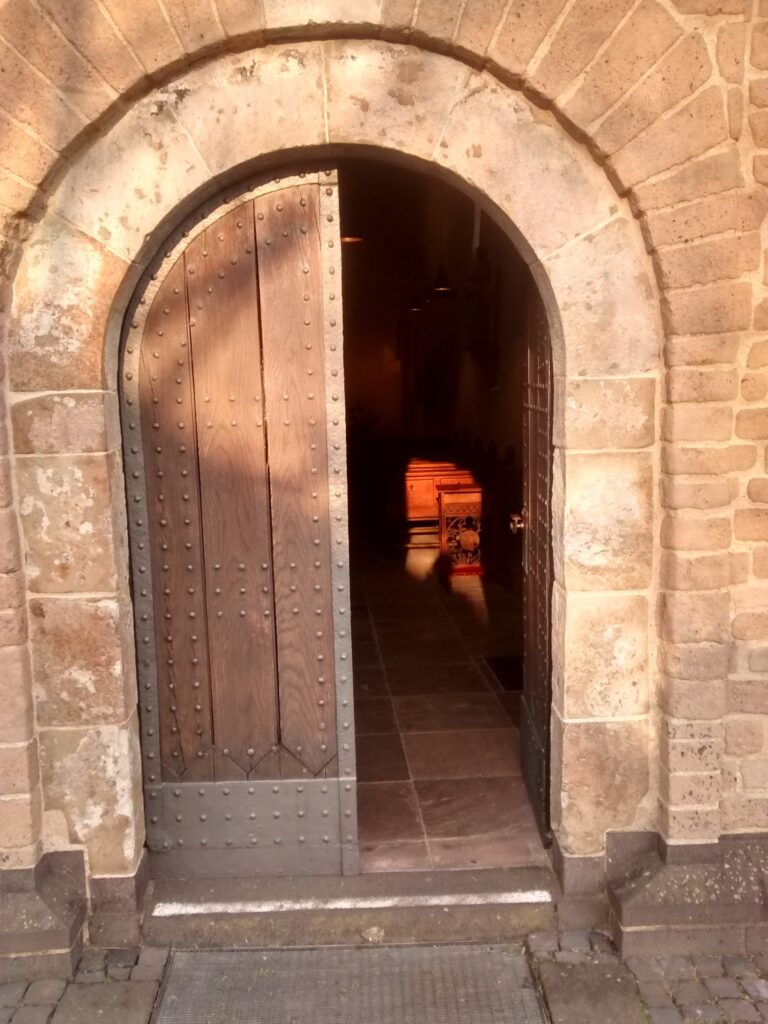
The former abbey church of Saint Nicholas and Saint Medardus forms the architectural center of the complex. Built between 1136 and after 1220 as the third church on the site, it incorporated part of its predecessor. Both the crypt and the upper church reproduce, in reduced form, the plan of Cologne’s church of Saint Mary in the Capitol. The building’s tall west front remains a dominant feature of the Brauweiler townscape and a widely visible local landmark.
West front and interior elevation
The central west tower is flanked by two narrower towers dating from around 1138. This western group contrasts with three eastern towers completed only in the nineteenth century. The nave is notably short and dates approximately from 1140 to 1150, while the aisles provide an unusually spacious interior. The central nave introduced a three-level elevation with a blind triforium, a decorative gallery-like zone that is not open, and this arrangement soon became common in Romanesque basilicas.
Sculpture, painting, and altarpieces
The architectural sculpture preserves traces of its original Romanesque polychromy, or colored painted finish. The vaults carry delicate vine-scroll painting from the Late Gothic period, while the nave piers bear monumental painted saints from the fourteenth century. A stone Marian retable, an ornamental structure behind an altar, dates from the end of the twelfth century and stands at the southern side altar. The church also contains a seated figure of Saint Nicholas from the High Romanesque period.
Organs and bells
West and choir organs
The west organ retains its richly gilded Baroque case from the end of the seventeenth century. Balthasar König first rebuilt the instrument in 1715, and Willi Peter made its last alteration in the 1960s. The Weimbs organ company later rebuilt it according to its original conception, with mechanical action and a central console. The reconstructed instrument was inaugurated on 25 January 2013.
A new choir organ built by Hermann Eule Orgelbau Bautzen was inaugurated in March 2018. Its two suspended cases occupy the arms of the transept and are supported from the attic by a carrying structure. A mobile console stands in the church. Electric action controls 45 stops across three manual divisions and the pedal, while the stops of the remote division are borrowed from those of the swell division.
Historic bell peal
The church has a seven-bell peal. Four bells hang in the west tower, including the two oldest bells in the peal. The Misericordia bell, cast in 1300 by an unknown Cologne master and consecrated after the feast of Saint Martin, is the oldest precisely dated bell in the Rhineland.
The medieval main peal probably comprised the notes C, D, and E and may have been the first deliberately coordinated peal in the Rhineland. Two other bells were recast in 1630 by Johannes Helling of Kalkar in an exceptionally heavy rib, causing them to sound a semitone higher. The Maria bell survives. Five additional bells dating from around 1300 and from 1518, 1673, and 1872, together with the larger of the two Helling bells, were melted down during the Second World War. Five new bells cast by the Mabilon bell foundry were added in 1961, with two placed in the west tower and three in the crossing tower.
Monastery buildings and memorial area
Baroque courtyard and prelate’s wing
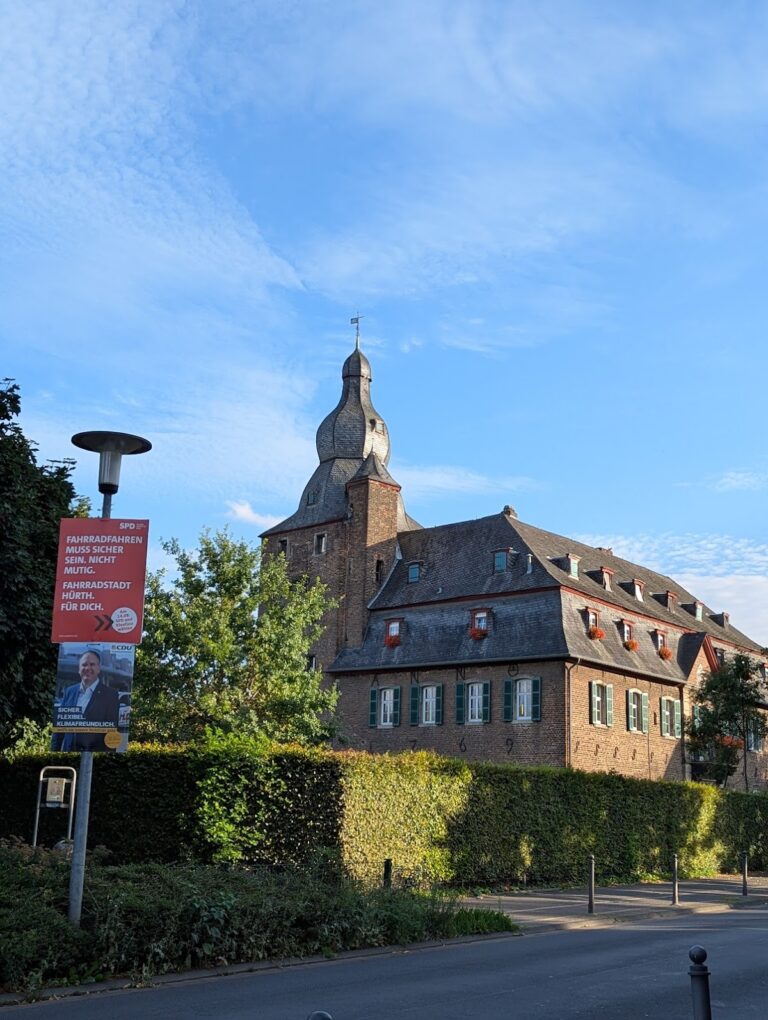
The Baroque monastery courtyard was begun in 1780. Between 1780 and 1785, the abbey also constructed the Prälatenflügel, or prelate’s wing, to designs by Nikolaus Lauxen. The building is considered Lauxen’s principal work and follows forms from his earlier plans for Nonnenwerth Abbey.
Custodial house and cell building
The former custodial house and cell building remain identifiable parts of the abbey complex. They were adapted first for institutional purposes and later for concentration-camp and Gestapo-prison functions. They now form part of the memorial and exhibition area dedicated to the crimes committed there under National Socialist rule.
Park and surviving natural feature
The abbey park provides the landscaped setting of the restored complex. Near the former monastery stands a mulberry tree traditionally regarded as a thousand years old. Associated with the abbey since 1024, it is treated as a natural monument and is considered probably the oldest tree of its kind in Germany.