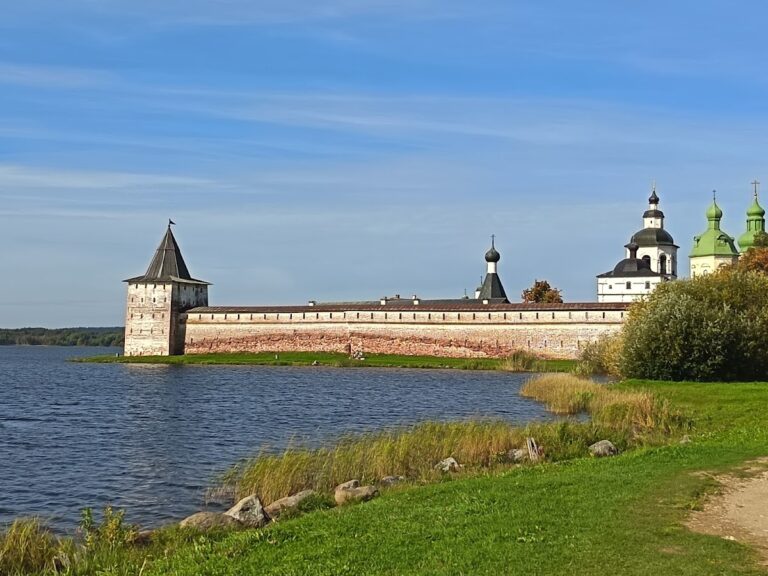
Ferapontov Monastery: A Russian Orthodox Religious and Cultural Center


Site at a Glance
- Rating
- 4.8
- Popularity
- Medium
- Country
- Russia
- Primary era
- Medieval
- External website
- Open
- Eras represented
- Medieval, Modern
- Civilizations
- Russian
- Site type
- Religious
- Remains
- Monastery
On this page14 sections
History
Ferapontov Monastery is a Russian Orthodox monastic complex in Ferapontovo, Russia, founded in 1398 by Saint Ferapont Belozersky during the expansion of the Grand Duchy of Moscow’s political influence. Established in the Russian North, it became involved in the religious and cultural developments that accompanied the formation of the centralized Russian state.
Foundation and early community
Ferapont came from the Poskochins boyar family and became a monk at Moscow’s Simonov Monastery. He later travelled north with Saint Cyril of Beloozero, who founded the nearby Kirillo-Belozersky Monastery. Ferapont established his own community near Cyril’s monastery, creating the foundation of Ferapontov Monastery.
After about ten years, Ferapont departed to establish the Luzhetsky Monastery near the Moskva River. The monks then asked Martinian Belozersky, a disciple of Cyril, to lead their community. Under Martinian’s direction, the monastery’s reputation grew. Initially small and remote, it expanded during the early fifteenth century as monks built cells, a wooden Church of the Nativity of the Virgin in 1409, and a refectory.
Religious and cultural expansion
For approximately four centuries, Ferapontov Monastery served as a major religious, cultural, and educational center in the Belozersk region. Its scribes produced books, chronicles, hagiographic works about saints, philosophical writings, and compilations. Among the scribes associated with the monastery were Martinian, Spiridon, Philotheus, Paisius, Matthew, and Ephrosin.
The monastery also became connected to a northern trade route leading to Arkhangelsk. Pilgrims travelling toward Solovetsky Monastery used the same route, giving Ferapontov both religious and economic importance. Donations and land endowments came from the Mozhaisky princes, Vasily III, Ivan IV, and the princely families of Staritsky, Kubensky, Lykov, Belsky, Shuisky, Vorotynsky, Godunov, and Sheremetev. A donation register begun in 1534 also records contributions from bishops of Siberia, Rostov, Vologda, Belozero, and Novgorod.
By the beginning of the seventeenth century, the monastery was one of the largest landowners in the Belozersk region. Its holdings included several settlements, about 60 villages, approximately 100 wastelands, and more than 300 peasants. The discovery of Martinian’s relics and his subsequent canonization increased the monastery’s religious standing, donations, and income.
Ferapontov attracted members of the ruling family. Vasily III and Elena Glinskaya visited in 1528 to pray for an heir, while Ivan IV came in 1547 and 1553. Ivan granted the monastery special privileges and made substantial contributions to its development. The community also produced prominent church figures, including Joasaph Obolensky, later archbishop of Rostov and Yaroslavl; Philotheus, later bishop of Perm and Vologda; and Ferapont, later bishop of Suzdal. Cassian the Greek, identified as Prince Constantine of Mangup, was also associated with the monastery.
The monastery served at times as a place of confinement for senior churchmen. The future metropolitan of Kyiv Spiridon-Savva was imprisoned there, and Patriarch Nikon lived in exile at Ferapontov from 1666 to 1676. Metropolitan Arseny Matseevich of Rostov was also exiled there.
Stone building and wartime destruction
The first stone building was the Cathedral of the Nativity of the Virgin, erected in 1490 by masters from Rostov. Its construction began the stone architectural ensemble that developed between the fifteenth and seventeenth centuries. The sixteenth century brought further prosperity and intensive building, including the Church of the Annunciation, the Treasury Chamber, a drying house, a guest chamber, and a kitchen.
During the Time of Troubles, a period of political crisis and armed conflict in Russia, Polish-Lithuanian raiding forces sacked the monastery in 1614. The cells and gates were burned, nearby villages were plundered, and local inhabitants were killed. Because the monks had been warned, they hid the most valuable objects before the attack. Economic difficulties in the Belozersk region then delayed recovery and interrupted stone construction for about 25 years.
Building resumed in the mid-seventeenth century. The monastery erected the Church of Saint Martinian, churches over the Holy Gates, and a bell tower. Its fortunes declined again during the second half of the century. The secularization reform of 1764 transferred the monastery’s lands and settlements to state administration. In 1798, the Holy Synod abolished the monastery and converted its churches into parish churches.
From former monastery to museum and religious revival
During the nineteenth century, the reduced former monastic territory was enclosed by a stone wall. The earlier enclosure had remained wooden until that time. A women’s monastery was briefly established in 1904, and extensive restoration was carried out under the supervision of the Imperial Archaeological Commission. The women’s community ended in 1924. Worship continued for a time, but the monastery was completely closed during the 1930s.
A museum opened in the former monastery during the 1920s. By the mid-1970s, it had developed into the Museum of Dionysius’ Frescoes, a scientific, research, and educational center and a branch of the Kirillo-Belozersky Historical, Architectural, and Art Museum-Reserve. Regular worship resumed in a gate church in 1989. After 1991, the site remained primarily under state and museum administration, although efforts to restore monastic life continued.
A diocesan religious organization associated with the monastery was established in 2014. On 21 September 2016, the first full service in the Cathedral of the Nativity of the Virgin for many decades was held there. In 2018, the Holy Synod decided to reopen the monastery, and Patriarch Kirill visited that year in support of restoring monastic life. The monastery resumed activity in 2018 while the museum remained on the site. In 2019, the Treasury Chamber was transferred to the monastery for temporary use for 490 years.
Ferapontov Monastery is a federally significant historical and cultural monument of Russia. It entered the state register of especially valuable cultural-heritage sites in 1997, and UNESCO added the ensemble to the World Heritage List in 2000 under criteria (i), exceptional artistic or creative achievement, and (iv), an outstanding example of a building, architectural ensemble, or landscape illustrating an important stage of history. It is the only UNESCO World Heritage site in Vologda Oblast.
Remains
The monastery stands on elevated ground between two lakes linked by the small Paska River, while the village of Ferapontovo lies mainly on the opposite bank. Its surviving ensemble is composed principally of buildings from the fifteenth to seventeenth centuries. The complex includes four churches with six altars, the bell tower, the Treasury Chamber, the Refectory Chamber, and service buildings. Its architecture and painting are unified by the theme of the Incarnation, expressed through both the buildings and their decoration.
Cathedral and wall paintings
Cathedral of the Nativity of the Virgin
Built of brick in 1490 by masters from Rostov, the Cathedral of the Nativity of the Virgin is described as the oldest stone church in the Russian North. It is also the best-preserved of three related cathedrals built in the region during the 1490s. The cathedral contains about 600 square metres of wall painting arranged in approximately 300 compositions.
Dionysius and his sons Vladimir and Theodosius, possibly working with Andrei, painted the cathedral between 6 August and 8 September 1502. An inscription on the northern door jamb preserves the dates. The painted cycles include the Akathist to the Virgin, the Ecumenical Councils, and the Last Judgment, together with other scenes and individual compositions arranged according to the building’s architectural divisions.
These frescoes, wall paintings made with pigment applied to wet plaster, are characterized by delicate tonal variation, rhythmic harmony, varied color, interconnected subjects, and philosophical depth. They are described as Dionysius’ only surviving documentary-confirmed wall painting and as the last surviving Russian medieval church with fully painted walls. The paintings have never been repainted or retouched and survive in their original form. A fresco of Saint Nicholas by Dionysius is also associated with the monastery.
Conservation of the cathedral paintings
Conservation work on Dionysius’ monumental paintings took place from 2012 to 2018 in the cathedral’s northern, western, southern, and eastern parts, as well as in the northern altar and sacrificial apse. Further work in the eastern and central apses continued in 2018, and the preservation work was reported complete in 2019. The conservation aimed to control the condition of paintings that had already undergone earlier conservation.
Sixteenth- and seventeenth-century churches
Church of the Annunciation
The Church of the Annunciation, dated to 1530–1534 or approximately 1531, includes a refectory and a belfry. It belongs to the sixteenth-century group of additions that also included the Treasury Chamber, drying house, guest chamber, and kitchen.
Church of Saint Martinian
The Church of Saint Martinian was built around 1640–1641, after the interruption in stone construction that followed the 1614 attack. It forms part of the later building phase that reshaped the monastery’s surviving ensemble.
Gate Church of the Epiphany
The gate Church of the Epiphany, with a side chapel dedicated to Saint Ferapont, was erected around 1650. A bell tower was added around 1680. Its clock, dated 1638, is said to be the oldest in Russia.
Chambers, relics, and museum collections
The architectural complex includes the Treasury Chamber and Refectory Chamber alongside service buildings. Relics of Saints Martinian and Galaktion Belozersky are kept beneath a shrine associated with the monastery. The Cathedral of the Nativity of the Virgin is also connected with nine ancient antimensia, consecrated cloths used in Orthodox worship, dating from the fifteenth to seventeenth centuries.
The Museum of Dionysius’ Frescoes occupies buildings of the former monastery. As a branch of the Kirillo-Belozersky Historical, Architectural, and Art Museum-Reserve, it preserves and interprets the ensemble’s architectural and artistic monuments. The museum also houses the Siversky Idol, an object approximately one metre high and dated to the fourth through ninth centuries. It was found in the village of Siverovo in Kirillovsky District, rather than within the monastery itself.