Church of the Transfiguration: A Former Cathedral in Belozersk
Site at a Glance
- Rating
- 4.7
- Popularity
- Very Low
- Country
- Russia
- Primary era
- Early Modern
- External website
- Open
- Eras represented
- Early Modern, Modern
- Civilizations
- Russian
- Site type
- Religious
- Remains
- Church
On this page11 sections
History
The Church of the Transfiguration is a former Russian Orthodox cathedral in Belozersk, Russia, built in the second half of the seventeenth century within the earthen rampart of the Belozersk Kremlin. Dedicated to the Transfiguration, the Christian event in which Jesus is revealed in radiant glory before three apostles, it became the dominant building inside the fortress.
From the wooden church to the stone cathedral
An earlier wooden Church of the Transfiguration stood at the site in 1617 and 1618. Built by the parish community, it included chapels dedicated to the Great Martyr Catherine and Demetrius of Thessaloniki, as well as a refectory and a bell tower with two bells. By the middle of the 1670s, it was the only church building still standing inside the Belozersk Kremlin. At that time, it had a plank roof, a refectory, and a bell tower containing four bells.
Construction of the stone cathedral began in 1668. The work was financed by the sovereign’s treasury and by donations from people of different social ranks. The building was completed by the end of the 1670s, giving the Kremlin a permanent stone church whose forms combined the architectural language of its own period with older local traditions.
Furnishings and changes before 1917
The cathedral was known for the elaborate appearance of its interior. A description from 1884 mentioned an unusually complex iconostasis, the screen separating the sanctuary from the main worship space in an Eastern Orthodox church. It contained painted wooden figures of Christ, prophets, and angels, together with seven large wooden lamps. Its arrangement was considered reminiscent of Catholic artistic conventions.
A description made in 1914 recorded a richly decorated iconostasis containing both older and newer icons. It also mentioned a semicircular altar screen, life-size carved wooden figures of angels and apostles, and an almost square embroidered Shroud showing Christ in the tomb. The sacristy held objects including a processional lantern, an icon of Saint Basil the Great, and a large silver censer.
In 1915, carved figures of the prophets Moses and Aaron and two angels were removed from the iconostasis. The action followed repeated directives from the Holy Synod, the governing body of the Russian Orthodox Church during the imperial period, and a circular order from diocesan authorities. A diocesan consistory, the administrative office of the church jurisdiction, described the removal in a response dated 22 June 1916. Photographs preserved the appearance of the iconostasis before and after the alteration.
The silver censer made by Abbot Varlaam and his brethren on 19 May 1586, during the reign of Tsar Feodor Ivanovich and with royal funds, was listed by 1916 in the Novgorod diocesan church repository. It is now held by the Novgorod Museum-Reserve, together with documents originating from the cathedral.
Closure, protection, and museum use
The icon known as the Mother of God of Tenderness, or Belozerskaya, was removed from the cathedral around 1931. It was exhibited at the State Russian Museum in Saint Petersburg from 1932 to 1935 and remains there. An inspection in August 1931 recognized the artistic value of the cathedral and prevented its destruction.
Divine services continued until August 1937. Their end came during the Yezhovshchina, the period of intense political repression in the Soviet Union associated especially with Nikolai Yezhov, who headed the Soviet security service from 1936 to 1938. Belozersk priests were arrested and shot in Leningrad. After the cathedral closed, its interior remained in relatively good order, although the building housed a lumber warehouse for many years.
The cathedral was placed under state protection in 1960 as an architectural monument and is a federally significant cultural-heritage property of Russia. Restoration campaigns continued from the 1970s through the 1990s. The iconostasis was restored in 1975, emergency work followed in 1975 and 1976, and restoration specialists from Veliky Novgorod worked on the building in 1986 and 1987.
The 1975 and 1976 emergency works strengthened the foundation, repaired cracks and the domes’ supporting drums, and replaced the rafter system and roofing. A concrete apron, additional fill, and a raised street level caused water to collect beneath the foundation and increased dampness inside the cathedral. Later archaeological excavations created a trench through which the water was drained.
A restoration project was prepared and approved in 2010. Work in 2011 and 2012 restored the exterior and interior, conserved the canopy over the iconostasis, and consolidated the gilding. On 25 August 2012, a copy of the Mother of God of Tenderness was presented to the cathedral. The copy was made by Mikhail Bushuyev, a leading restoration artist and copyist of the State Russian Museum.
Since October 2017, the cathedral has belonged to the Cherepovets Diocese. Under a free-use agreement, the Belozersk Regional Local History Museum uses it as a museum display site, presents part of its icon collection, and conducts tours. It is no longer an active parish church, although a prayer service is held there during the August feast of the Transfiguration.
Remains
Plan and exterior architecture
Main structure
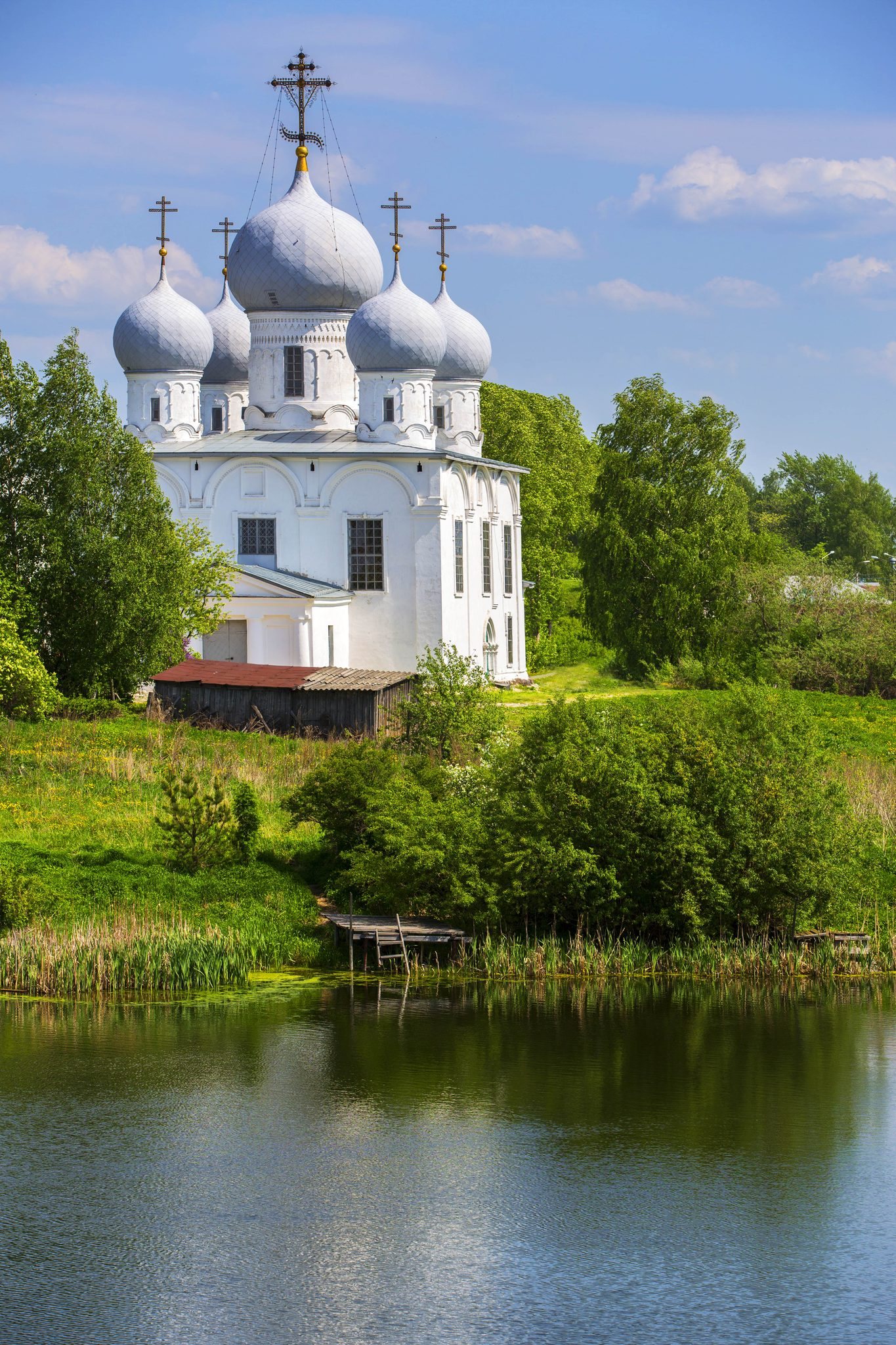
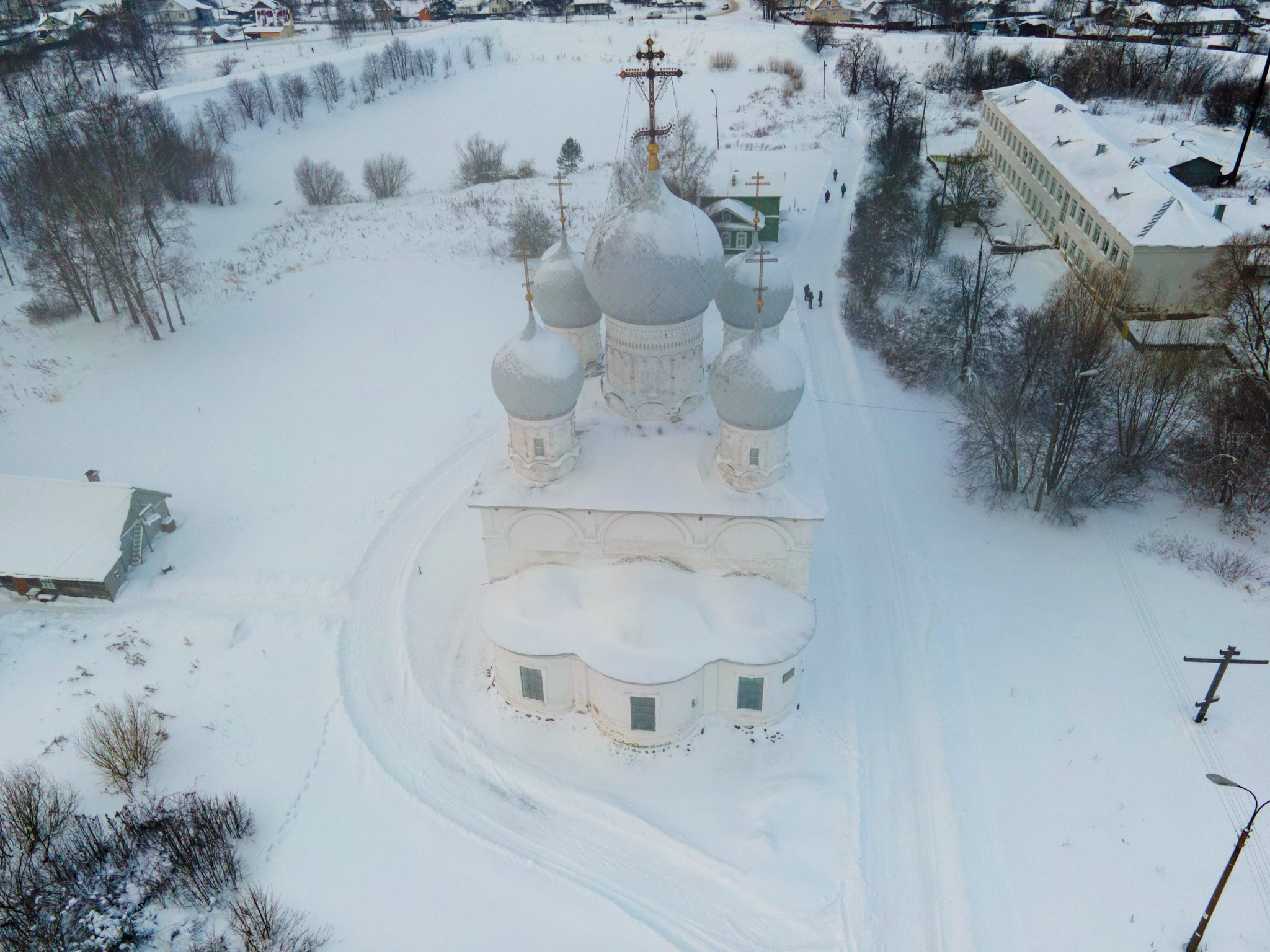
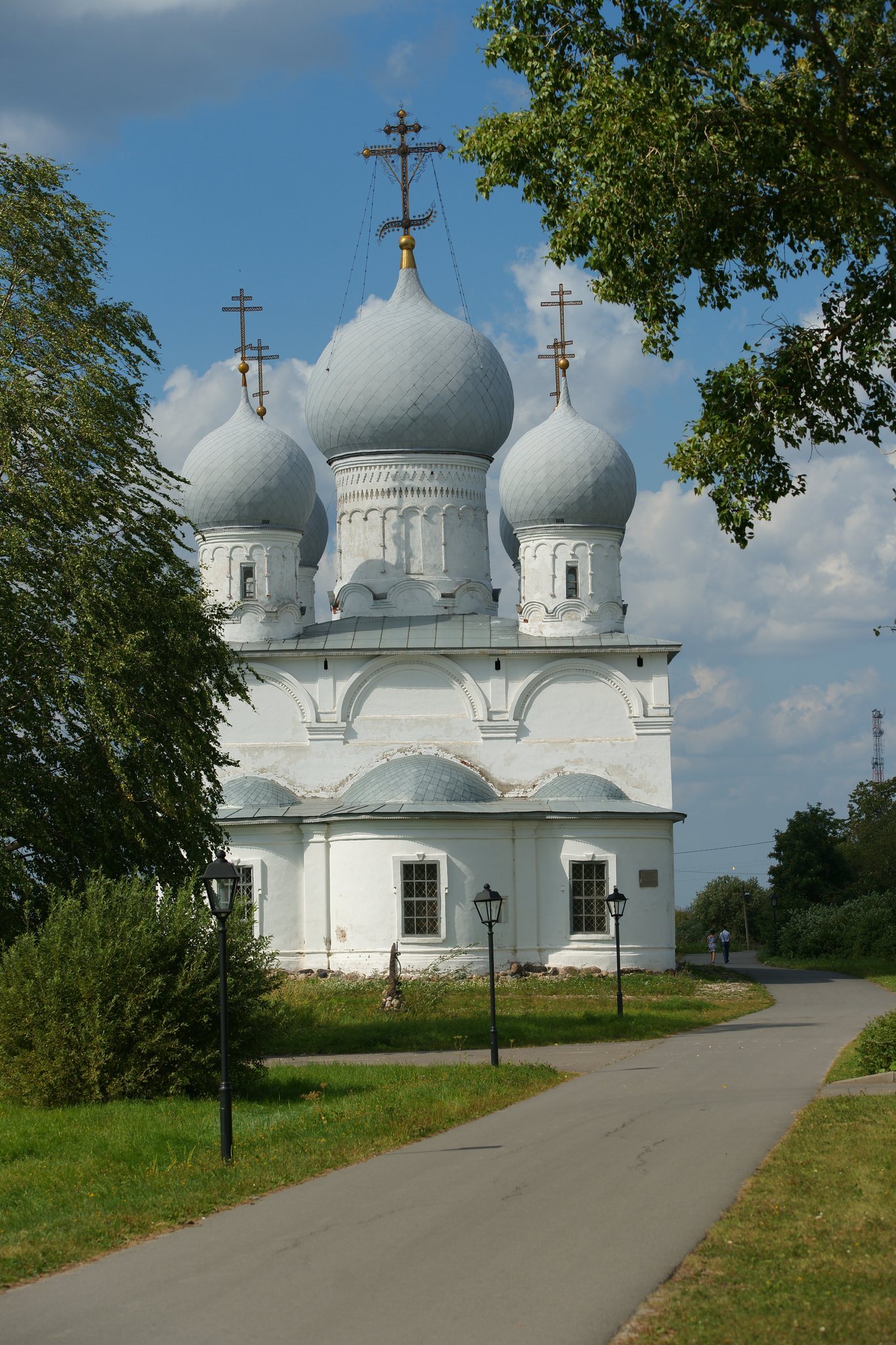
The cathedral is a four-pillar church with three apses, or semicircular sanctuary ends, and five onion-shaped domes. It stands on a foundation of rough stone. Its design follows forms common in the second half of the seventeenth century while retaining features associated with sixteenth-century cathedral architecture.
The massive central cube has restrained decoration. Flat pilasters divide each wall surface into three vertical sections, while severe semicircular zakomars, gable-like elements that complete the upper parts of traditional Russian church walls, rest on projecting imposts. An impost is a block or band that supports an arch. The walls have no conventional cornice beneath the zakomars.
The facades include archivolts, decorated bands that follow the curves of arches, and flat pilasters reflecting local sixteenth-century traditions. Characteristic perspective portals are set on the northern and southern sides. The drums, which are the structures supporting the domes, have richer seventeenth-century ornament. Their decoration includes small arched kokoshniks at the bases, an arcade frieze, bands of niches, and saw-tooth patterns.
Roof and later additions
The original roof form remains uncertain. Some researchers consider the cathedral to have first had roofing that followed the zakomars and was altered later. Others believe that it originally had the four-sided roof form visible today. The large central cross is genuinely old and was brought to Belozersk from another place, although its origin is unknown.
A vestibule in the spirit of Classicism was added on the western side during the nineteenth century. The cathedral stands within the Kremlin’s earthen rampart, which partly conceals it from outside views. Inside the Kremlin, however, the building forms the dominant architectural element.
Interior furnishings and surviving objects
Iconostasis
The former iconostasis included painted and carved wooden figures, a sculptural representation of Christ beneath the dome, and figures of prophets and angels near the royal doors, the central doors of the screen. Life-size carved angels and apostles stood beside the entrance to the altar. Some of these figures were removed in 1915, altering the appearance of the interior.
Icons and liturgical objects
The historical Mother of God of Tenderness icon is now preserved in the State Russian Museum, while a copy made for the cathedral was presented in 2012. The 1586 silver censer formerly associated with the cathedral is held by the Novgorod Museum-Reserve. These objects, together with the preserved documents, connect the building’s present museum display with its earlier religious use.