The Museum of Mining and the Roman Galleries at Roșia Montană


Site at a Glance
- Rating
- 4.2
- Popularity
- Low
- Country
- Romania
- Primary era
- Classical
- External website
- Open
- Eras represented
- Classical, Early Modern, Modern
- Civilizations
- Habsburg, Roman
- Site type
- Economic
- Remains
- Mine
On this page14 sections
History
The Museum of Mining and the Roman Galleries is a mining-history museum in Roșia Montană, Romania, preserving evidence of Roman gold extraction and the settlement’s later mining traditions. The museum was inaugurated in 1981 during events marking 1,850 years of documented history for Roșia Montană and its mining activity. That anniversary was based on wax tablet no. 18, dated 6 February 131 AD.
Roman gold mining at Alburnus Maior
During the Roman period, Roșia Montană was known as Alburnus Maior. After Rome conquered Dacia, the province established in the region in the early second century AD, the settlement became a major gold-mining centre. Roman extraction continued for more than 166 years, until the Roman withdrawal around 271 AD, and produced approximately 500 tonnes of gold.
Roman mining extended through the Cârnic, Lety, Orlea, and Cetate massifs. The mining complex included underground workings, ore-processing areas, settlements, administrative buildings, sacred places, and necropoleis, or burial areas. Imported Roman technology was combined with techniques developed locally. Later workings, made on a smaller scale from the medieval period into the modern era, surrounded and cut across the Roman galleries.
The settlement’s written and archaeological evidence reveals more than the organization of extraction. Wax-coated wooden writing tablets contain legal, social, economic, demographic, and linguistic information about the mining community and the wider province of Dacia. Stone inscriptions provide evidence of everyday life and cultural practices, while sanctuaries, funerary monuments, and domestic remains show the range of activities associated with the mining settlement.
Medieval and early modern renewal
The first historical mention of renewed mining after the Roman withdrawal dates to the thirteenth century. The Hungarian ruler of Transylvania sent German colonists to resume gold extraction at Roșia Montană. By the middle of the sixteenth century, most miners were Romanians, and more than 100 stamp mills stood along the main rivers by 1676.
Mining expanded during the eighteenth and nineteenth centuries under the Habsburg Empire, the Central European monarchy ruled by the Habsburg dynasty whose authority included Transylvania during this period. Miners from across the empire settled at Roșia Montană, which developed into a prosperous mining town with churches, schools, a miners’ club, monumental houses, and a maternity facility. The surrounding agro-pastoral landscape was shaped by communities that supported mining, particularly between the eighteenth and early twentieth centuries.
State mining and modern pressures
After Romania’s unification in 1918, the Romanian state became the owner of the underground mineral resources. The communist government nationalized the mining industry in 1948, and extraction continued during the communist period and afterward. These later operations treated historic monuments and the environment with insufficient regard.
In the early 2000s, Gabriel Resources proposed a large cyanide-based gold and silver mine at Roșia Montană. Local resistance to the sale of houses and nationwide protests in 2013 helped delay the project, which posed a major threat to the historic mining landscape.
Roșia Montană was inscribed on the UNESCO World Heritage List in 2021 under criteria (ii), (iii), and (iv), while also being placed on the List of World Heritage in Danger. Romanian law and the country’s historic-monuments legislation provide legal protection for the property. The museum, its Roman galleries, and the wider mining landscape contribute to the historical evidence for one of Europe’s oldest documented mining communities.
Remains
The museum occupies the compound of the state mining enterprise at Roșia Montană. Its pavilion exhibition is housed in a former administrative building, while the Roman galleries lie underground in the Orlea Massif. Together, the museum displays, surviving workings, processing equipment, stone monuments, photographs, and archaeological material present the development of mining from Roman extraction to the modern state industry.
Roman underground workings
Orlea galleries
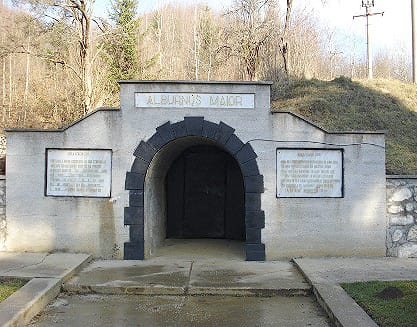
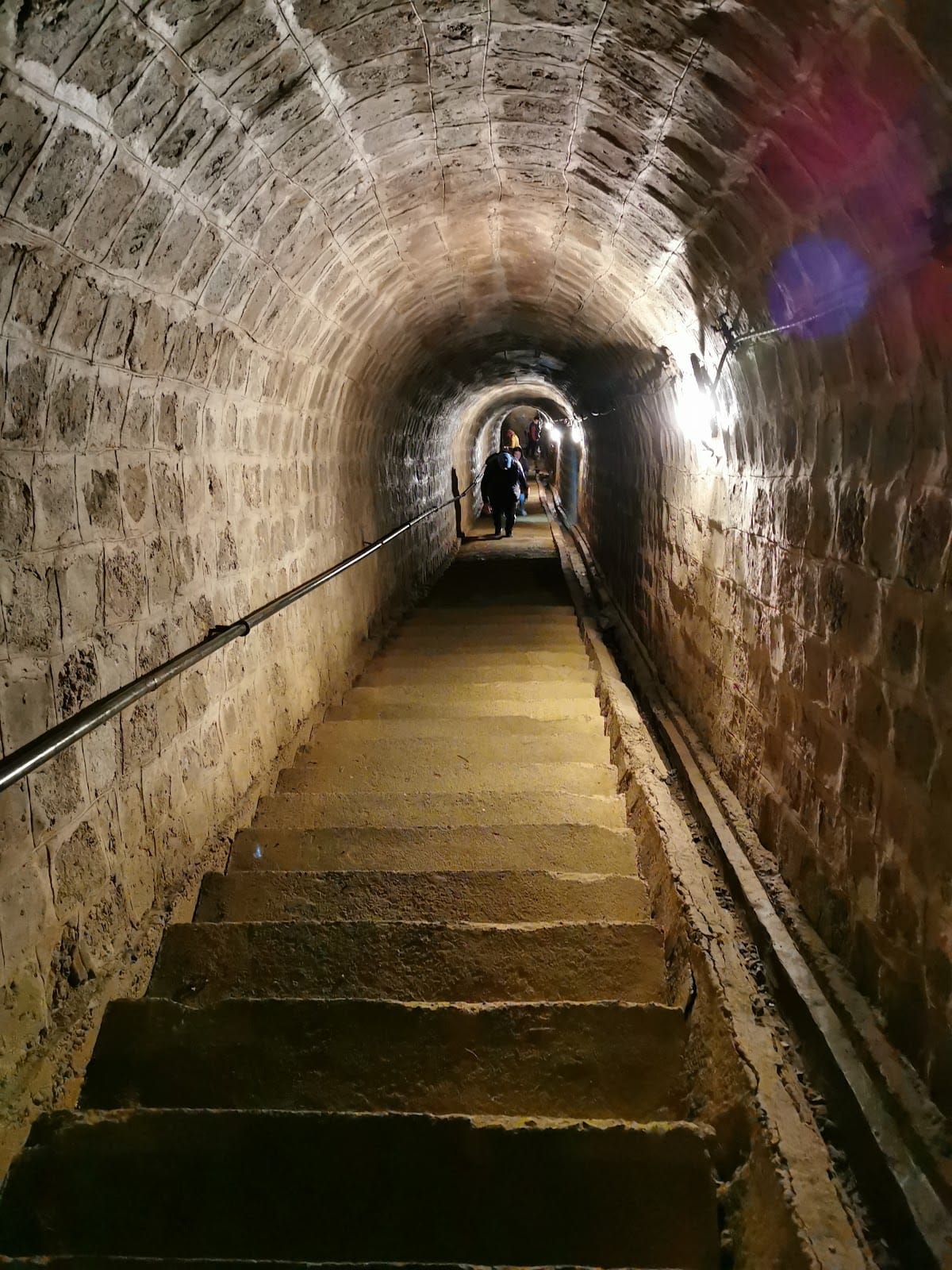
The Roman galleries in the Orlea Massif remain in situ, meaning that they survive in their original location. The preserved route extends for 170 metres over two underground levels and is described as very well preserved. Entry is through a concrete portal and an inclined passage 53 metres long, with 157 concrete steps and a handrail. The passage descends approximately ten storeys before returning to the surface by the same route.
The underground passages are approximately 1.80 metres high and 1.70 metres wide at the base, narrowing to about 1 metre at the ceiling. Temperatures remain between 7 and 10 degrees Celsius throughout the year. Natural ventilation results from differences in temperature and air pressure, while humidity is above 85 percent.
Wider Roman mining complex
More than 7 kilometres of discovered ancient underground workings form part of the wider Roman complex. The surviving features include galleries with trapezoidal sections, helicoidal shafts, inclined communication galleries with stairs cut into the bedrock, and vertical extraction areas. Chambers containing treadmill-operated water-dipping wheels were used for drainage.
The Roman mining landscape extended beyond the tunnels. Its archaeological remains include settlements, administrative buildings, sanctuaries with altars, a necropolis, a mausoleum, houses, and a house equipped with floor and wall heating. These features connect the extraction areas with the residential, administrative, funerary, and religious activities of Alburnus Maior.
Mining machinery and ore processing
Traditional and industrial equipment
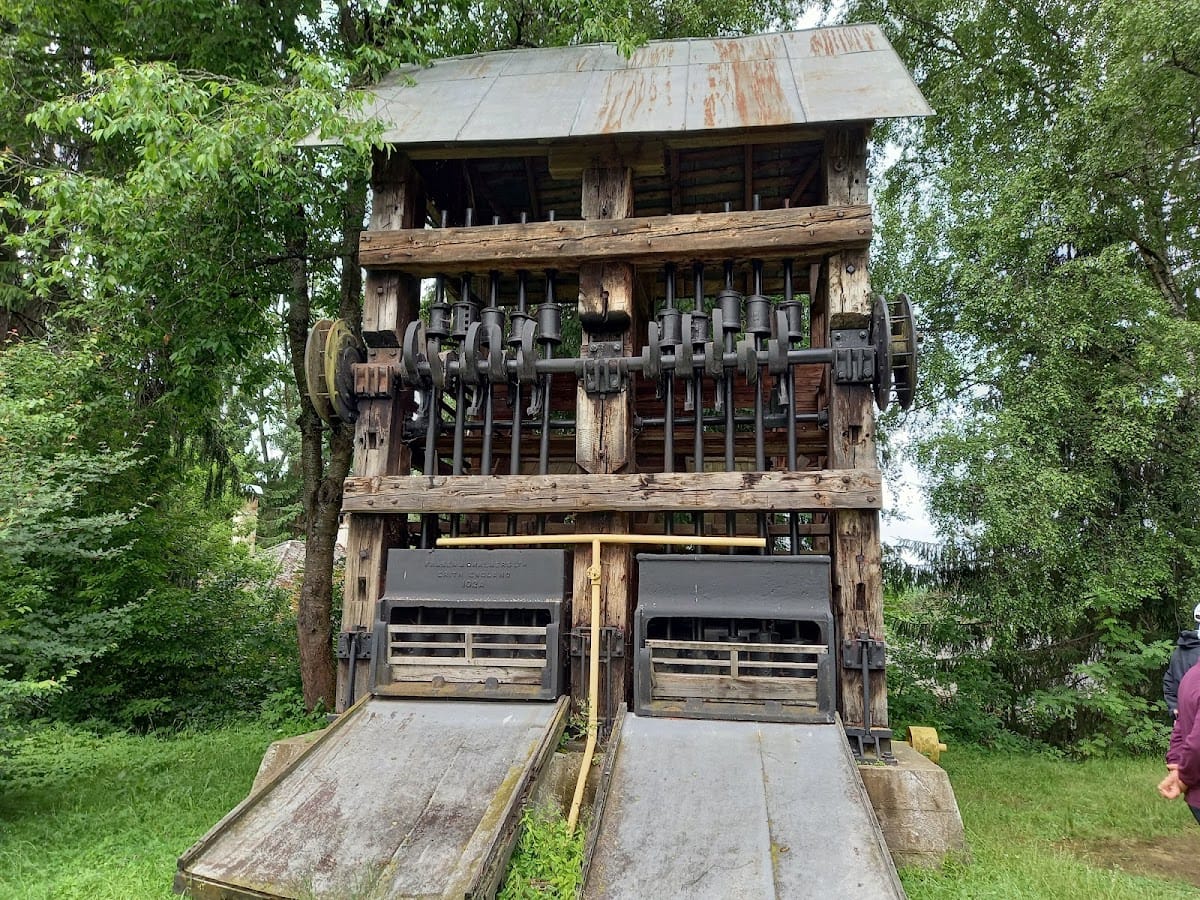
The outdoor machinery exhibition contains traditional and industrial tools and installations used to process gold-bearing ore. Wooden stamp mills demonstrate methods in which heavy stamps repeatedly crushed ore before grinding and washing separated precious metals. The equipment represents ancient and pre-industrial approaches to gold processing.
Iron stamp mills represent techniques used at the state mines from the late nineteenth and early twentieth centuries, through the interwar period, and up to 1948. A flotation installation represents later methods used at the state mines between 1960 and 2006. Flotation separates mineral particles according to their physical and chemical properties, following stages of grinding, classification, floating, and filtering for gold- and silver-bearing ore.
Stone monuments and photographic evidence
Lapidarium
The lapidarium, a display of stone monuments, contains original Roman monuments found in the territory of Roșia Montană. Funerary stelae, upright stones associated with burials, and votive altars dedicated to deities or religious offerings illustrate the ancient settlement’s habitation areas, necropoleis, and sacred places.
Wax-coated wooden writing tablets complement the stone evidence by preserving information about legal arrangements, social and economic relations, population, and language. In combination with the sanctuaries, houses, funerary buildings, and inscriptions, these objects help explain the organization and cultural life of the Roman mining community.
“Aurarii” photographic collection
The pavilion exhibition preserves the original “Aurarii” collection, approximately 150 artistic and documentary black-and-white photographs made by Iosif Bazil Roman during the interwar period and up to 1948. The photographs show the extraction and processing of gold ore in the Roșia Montană valley and surrounding territory.
The collection also presents mining carried out with traditional or archaic methods and the household crafts associated with small-scale producers. It therefore records practices linked to the later mining community alongside the machinery and installations of the state industry.
Historic mining landscape
Roșia Montană lies in a natural amphitheatre formed by massifs and radiating valleys in the Metalliferous range of the Apuseni Mountains. The four Roman mining massifs visually dominate the landscape, which is surrounded on three sides by ridges and peaks.
The wider historic landscape includes an agro-pastoral setting shaped by communities that supported mining between the eighteenth and early twentieth centuries. Historic houses with Neoclassical and Baroque elements, schools, churches, cemeteries, and the former miners’ club remain associated with Roșia Montană’s later mining identity.