Black Tower: A Medieval Observation and Defense Tower in Brașov


Site at a Glance
- Rating
- 4.5
- Popularity
- Medium
- Country
- Romania
- Primary era
- Medieval
- Eras represented
- Medieval
- Civilizations
- Hungarian
- Site type
- Military
- Remains
- Tower
On this page7 sections
History
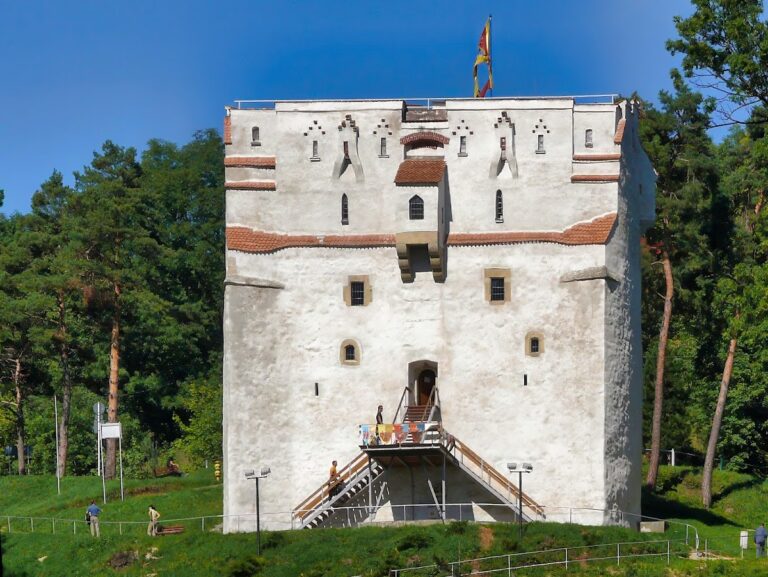
The Black Tower is a medieval observation and defense tower in Brașov, Romania, built as one of four external towers outside the city walls during the second half of the fifteenth century, probably around 1460. It was constructed independently of the walls, at approximately the same time as the White Tower, although an earlier fifteenth-century origin has also been proposed. Together, the two towers controlled the ground below the fortifications and guarded against attackers approaching from Warthe Hill, including attempts to roll stones downhill toward the city walls.
Fortification and early history
The tower also helped control movement around the fortress. A chain weighing about 300 kilograms could be lowered between the rocky support of the tower and the city wall, closing the passage in an emergency. This barrier may also have been used to prevent smuggling. The Black Tower is first documented in 1541.
The exposed slope around the Black Tower and the White Tower was kept clear of trees until the end of the nineteenth century, giving guards a broad field of view. The tower’s defensive role continued into the eighteenth century. During the plague epidemic of 1756–1757, it served as a shelter and observation post for guards enforcing a sanitary cordon, a guarded perimeter intended to restrict movement and limit the spread of disease.
Fire, rebuilding, and restoration
Lightning struck the tower on 23 July 1559, starting a fire that seriously damaged the building and destroyed its roof. The walls were blackened by soot, giving the tower the name it retained for centuries. The great fire of 1689, which nearly destroyed Brașov’s fortress, caused further damage, and another lightning strike followed in 1696. The tower was rebuilt in 1735.
In 1827, Johann Birthelmer, the city’s building caretaker, proposed a new roof to protect the tower as an old monument of the ancestors. The magistrate rejected the proposal because the tower was considered to bring no benefit to the city. Concern for its preservation returned in 1900, and the upper part of the walls was reinforced in 1901.
After the south wall collapsed during heavy rain in July 1991, the tower underwent major restoration between 1993 and 1995. The work repaired the walls, removed the soot layer, and added a pyramidal glass roof recalling the form of the original roof. Interior renovation was completed in 2001, and an exhibition on the towers of Brașov’s medieval defensive system opened there on 5 September that year. The Black Tower is protected as a historic monument within Brașov’s outer fortifications under designation code BV-II-m-A-11294.05.
Remains
Structure and materials
The Black Tower stands on a rocky projection of Romurilor Hill, also known as Straja Hill, near the northern side of Brașov’s historic center and approximately 31 meters from the city walls. It has a square plan with a floor area of about 50 square meters and rises approximately 10.6 meters. Each side measures about 7 meters, while the walls are approximately 1.7 meters thick. Natural stone set in lime mortar forms the main construction, with dressed blocks of calcareous tuff, a porous limestone formed by mineral deposits, at the corners.
Roof and defensive levels
The original roof was a wooden pyramid covered with shingles, but it was destroyed by fire. The present glass roof follows its pyramidal shape. Inside, three defensive levels contain galleries running around each floor. Every level has two openings in each direction, used as windows or loopholes. The original roof was associated with a covered defensive gallery around the upper part of the tower, where guards watched over the city and sounded alarms when fires threatened.
Entrances and fortified connections
The entrance on the city side was about 2 meters above ground and could be reached by a movable ladder. Historically, movable bridges connected the tower with the Blacksmiths’ Bastion and the Butchers’ zwinger, a defended passage or open space between lines of fortification. A movable bridge suspended over the Graft, a canal or defensive water channel belonging to Brașov’s fortifications, linked the tower with the western corner fortifications of the city. The tower may also have had a second entrance through an underground tunnel.