Kykkos Monastery: An Orthodox Monastic and Cultural Centre in Cyprus


Site at a Glance
- Rating
- 4.8
- Popularity
- Medium
- Country
- Cyprus
- Primary era
- Modern
- External website
- Open
- Eras represented
- Medieval, Early Modern, Modern
- Civilizations
- British, Byzantine, Ottoman
- Site type
- Religious
- Remains
- Monastery
On this page17 sections
History
Kykkos Monastery is an active male monastery of the Orthodox Church of Cyprus in Cyprus, traditionally associated with a Byzantine foundation near the end of the eleventh century under Emperor Alexios I Komnenos, who ruled from 1081 to 1118. Formally known as the Holy, Royal, Patriarchal, Stavropegic Monastery of the Kykkos Icon of the Virgin Mary, it became one of the island’s major spiritual centres and a long-standing institution for the preservation of Greek religious tradition and culture.
Foundation and the Kykkos Icon
The monastery’s foundation tradition centres on Isaiah, a hermit living in the Troodos mountains, and Manuel Voutomitis, the Byzantine governor of Cyprus. After Voutomitis became lost while hunting, he treated Isaiah harshly. He later fell ill, but recovered after Isaiah prayed for him. Voutomitis then accompanied the hermit to Constantinople, where they asked Alexios I Komnenos to send to Cyprus an icon of the Virgin Mary believed to have been painted by the Apostle Luke.
According to the same tradition, the emperor’s daughter suffered from the illness that had afflicted Voutomitis and was healed after Isaiah’s intervention. Alexios eventually sent the icon to Cyprus and financed a church and monastery in the mountains to house it. The icon was carried in procession from the coast into the Troodos, and the monastery acquired the epithet “Royal” because of the emperor’s foundation and financial support.
Voutomitis later granted the monastery stavropegic status, placing it under direct ecclesiastical authority rather than ordinary local administration, and assigned its maintenance to income from the villages of Peristerona, Milon, and Mylikouri. The origin of the name Kykkos remains uncertain. Explanations have connected it either with a local shrub or with a mountain bird.
Medieval development
The earliest stated documentary evidence dates to 1136 and concerns Abbot Daniel’s purchase of a Bible. During the Latin period, the era of western European, especially Lusignan, rule in Cyprus before the Ottoman conquest, Kykkos maintained a workshop for copying and illuminating manuscripts. Although many works were later lost, the monastery’s artistic influence can be traced through icons made in Cyprus and elsewhere between the thirteenth and fifteenth centuries.
Fire repeatedly altered the monastery. A blaze in 1365 severely damaged the complex, after which Queen Eleanor, the wife of Peter I of Cyprus, and local inhabitants contributed to reconstruction. The rebuilding was completed within six months. Another major fire in 1541 led to a complete rebuilding in stone, replacing the earlier wooden construction. Further fires affected the church and its frescoes in 1751 and 1813, while the present church is also associated with reconstruction in 1831.
Ottoman rule and education
Under Ottoman rule, Kykkos sheltered Christians through its numerous metochia, dependent ecclesiastical estates or subsidiary monasteries spread across Cyprus. It supported icon painting, wood carving, elementary education, literary study, and the preservation of manuscripts, musical codices, documents, and other ecclesiastical treasures. Its resources grew through donations, monastic labour, and the gradual accumulation of cultivated land, vineyards, mills, wineries, orchards, olive groves, and livestock.
The monastery’s brotherhood varied greatly in size. It numbered about 200 monks in 1678, 400 in 1683, 70 in 1738, 60 in 1745, and 180 at the beginning of the nineteenth century. Kykkos also intervened in wider Cypriot economic and ecclesiastical affairs. It paid a Turkish lender’s claim against the Archangelos monastery on behalf of the archbishop, bringing that establishment into its properties. In 1880, Abbot Sophronios purchased the Turkish farms of Agios Domenios, Engomi, and Lakatamia in an action described as helping save Nicosia from economic ruin.
A Greek school operated at Kykkos from the eighteenth century. It first educated novices and other young people and later developed into a three-year secondary school, whose pupils often continued at theological schools. The monastery also financed or supported schools elsewhere, including the Greek School of Limassol in 1819, the reopening of the Greek School of Nicosia in 1830, and schools at Tsakistra, Galata, Polemi, and Milikouri between 1917 and 1931.
Kykkos was also an important centre of historical and theological writing. Ephrem the Athenian wrote a history of the monastery, which Protosynkellos Seraphim Pissidios published in Venice in 1751. Archimandrite Kyprianos wrote a History of Cyprus in 1788. It is described as the only primary source for the Ottoman period, and Kyprianos is regarded by many as the first modern Greek historian. Several monks later held senior positions in the Orthodox hierarchy, including the Cypriot archbishops Timotheos and Nikiforos and the metropolitans Charalampos and Meletios. Others served Orthodox communities elsewhere in the eastern Mediterranean and southeastern Europe.
The monastery was robbed and looted several times during Ottoman rule, especially during the Greek Revolution. Archbishop Kyprianos, a metropolitan, and Abbot Josif were killed during this period. Despite these losses, Kykkos reorganized and regained prosperity toward the end of Ottoman rule and the beginning of British administration.
British administration and the modern political era
Under British administration, Kykkos continued its social, cultural, educational, national, and religious activities. Abbots Gerasimos and Kleopas represented the population in the Legislative Council established in 1882. Other monks became bishops and archbishops, among them Makarios III and Chrysostomos.
Makarios III began his ecclesiastical career at Kykkos in 1926. He later became archbishop, a political leader in the Cypriot struggle for independence, a figure associated with EOKA, the organization that conducted an armed campaign against British rule and for union with Greece, and the first president of Cyprus. During the anti-colonial struggle, Kykkos financed fighters and provided refuge in the monastery and nearby hiding places. The British closed the monastery to the public from June 1956 until March 1959.
Kykkos monks also participated in Greek military and nationalist movements. Twelve went to Crete in 1897, while seven novices led by the future Abbot Chrysostomos enlisted in the Greek army during the Balkan Wars of 1912 and 1913. The monastery collected funds to assist imprisoned Greek fighters. In 1950 it established Cyprus’s only seminary and supported agriculture through cultivation, gardening, apiculture, and viticulture at the monastery and at the Agios Procopios dependency.
After Cyprus became independent, the monastery founded or financed educational institutions, assisted people displaced during the 1974 Turkish invasion, supported the Cypriot armed forces, and provided land for barracks. Makarios III was buried near Kykkos after his death in 1977, and his grave near the Throni became an important destination for pilgrims and visitors.
Research, conservation, and continuing work
A Kykkos Research or Studies Centre was established in 1986 to investigate the monastery’s history and archival material. It includes an archive, a major library, and a workshop for preserving manuscripts and icons. The monastery continued its educational, humanitarian, cultural, and ecclesiastical work by supporting schools, cultural centres, hospitals, children’s and youth facilities, homes for the elderly, charitable institutions, Orthodox patriarchates, and missionary organizations.
From the late 1980s, Abbot Nikiforos directed a major renewal of the central area. Corridors, the church, the baptismal area, and a chapel were redecorated with frescoes, while mosaics were added to the main entrance and courtyards. The monastery museum opened during the 1990s. Kykkos forms part of the Troodos mountain district complex inscribed on Cyprus’s UNESCO World Heritage List. In 2017, fifteen monks were recorded as living at the active monastery. Its emblem is a bee, associated with diligence, industriousness, vigilance, and purity.
Remains
Kykkos Monastery stands in a wooded mountain setting west of the Troodos range, at approximately 1,140 to 1,150 metres above sea level and about 18 kilometres from Mount Olympus. The complex is arranged around a central church and includes buildings from different periods, such as the abbot’s residence, communal hall, monks’ cells, library, museum, reception halls, and other monastic structures. A large paved courtyard with a well occupies the centre.
The central monastic complex
Church of the Virgin Mary
The church was built to house the Holy Icon. It began as a single-nave structure, meaning a church with one main internal aisle. An enlargement in 1745 created three aisles, and later descriptions identify the building as a domed basilica. The central aisle is dedicated to the Virgin Mary, the right aisle to All Saints, and the left aisle to the archangels Gabriel and Michael. Fires damaged the church and its frescoes in 1365 and 1541, with further fires in 1751 and 1813. The surviving structure is also dated to 1831, after the monastery’s successive reconstructions.
Bell tower and courtyard buildings
The bell tower was added in 1882, long after the monastery’s foundation. It contains six bells, including the largest, which was made in Russia and weighs 1,280 kilograms. Its late construction is associated with the prohibition of bell ringing for Christians during Ottoman rule. The surrounding complex combines the rebuilt stone structures with later monastic facilities, including the abbot’s residence, communal areas, cells, library, reception halls, and the paved central courtyard with its well.
The icon and the Throni
Kykkos Icon of the Virgin Mary
The Kykkos Icon of the Virgin Mary, also called Panagia Eleousa, or “Source of Mercy,” is kept in the first, local tier of the church’s iconostasis, the screen separating the sanctuary from the main body of an Orthodox church. It shows the Virgin Mary holding the Christ Child. Tradition identifies it as the icon painted by the Apostle Luke and sent from Constantinople by Alexios I Komnenos. The image served as a model for many later Orthodox representations of the Virgin.
A silver-gilt revetment, a decorative metal covering that leaves selected painted areas visible, was applied to the icon in 1576. It received a new silver covering in 1795. Since at least the sixteenth century, the faces of the Virgin and Child have been concealed by a gold-embroidered veil that is not normally lifted. The icon is associated with recorded miracles and with protection from disasters. The ending of a locust infestation in either 1668 or 1760 is described as one such miracle, although the two dates remain unreconciled. A tradition also says that monks carried the veiled icon to the Throni during droughts and sang the Paraklesis, a liturgical supplication addressed to the Virgin Mary, without looking directly at its face.
Throni
The Throni, or Throne of the Virgin Mary, lies on a neighbouring mountain peak north of the monastery. A wooden throne formerly stood there for displaying the icon and offering prayers. It was replaced by a concrete cenotaph in 1935, a monument commemorating a person or sacred subject without serving as a burial place, and later by a larger structure.
Museum and associated buildings
Museum and treasury
The museum and treasury occupy part of the monastery complex. Their galleries contain Christian art associated with Cypriot and Orthodox history, including icons, relics, embroideries, manuscripts, woodcarvings, vestments, antiquities, and other works. The collections are presented as part of the monastery’s religious and historical life.
Nicosia dependency
Kykkos also has a metochion on the outskirts of Nicosia. Once outside the city, it now stands beside residential districts as Nicosia expanded around it. During the 1974 political crisis, Archbishop Makarios III sheltered there while evading the military junta. Tank attacks damaged some of its buildings and destroyed others.
Recent decoration
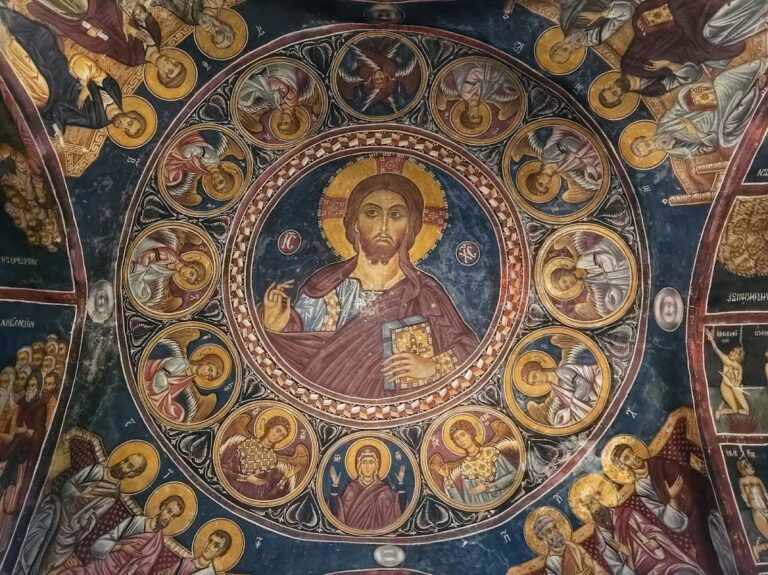
The monastery’s corridors, church, baptismal area, chapel, entrance, and courtyards were decorated mainly between 1991 and 1993. Cypriot icon painters, including the Kepola brothers, and artists from Greece and Romania created the frescoes and mosaics that form part of the complex’s present appearance.
Nearby sites