Lutheran Church in Koceľovce: A Gothic Evangelical Church in Slovakia


Site at a Glance
- Rating
- 4.8
- Popularity
- Very Low
- Country
- Slovakia
- Primary era
- Medieval
- External website
- Open
- Eras represented
- Medieval, Early Modern, Modern
- Civilizations
- Habsburg, Hungarian
- Site type
- Religious
- Remains
- Church
On this page11 sections
History
The Lutheran church in Koceľovce, Slovakia, was probably built in the first half of the 14th century as a Gothic church dedicated to Saint Bartholomew, one of the Twelve Apostles in Christian tradition. Its interior received frescoes, paintings made on wet plaster, between 1360 and 1370. The church is valued for preserving this medieval decoration alongside later changes made during its long religious and architectural history.
Medieval enlargement
The original building had a single nave and a polygonal presbytery, the part surrounding the main altar and traditionally reserved for clergy. Toward the end of the 14th century, the church was enlarged and raised, and a new vault was installed. This work altered the earlier building while retaining its central medieval arrangement.
Lutheran use and later rebuilding
After the Reformation, the 16th-century movement through which many Western European churches separated from Roman Catholic authority, the church passed to the Evangelical Church of the Augsburg Confession, the Lutheran church in Slovakia. The Protestant congregation adapted the interior for its worship and added elevated galleries, or emporia, along the west and north sides.
The medieval paintings were whitewashed in 1736. A major rebuilding in 1819 gave the nave two bays of Prussian vaulting, a form of groin vault, and added an entrance vestibule on the south. The frescoes were rediscovered and restored in 1896–1897 by István Gróh, a Hungarian restorer. At the beginning of the 20th century, the tower was altered and received its unusual Art Nouveau sheet-metal roof cap. A later restoration survey took place in 1976.
Protection and preservation
The church became a Slovak national cultural monument on 6 May 1963. It is listed in the Central List of the Monument Fund under number 517, a status that reflects the importance of its architecture and medieval painted decoration.
Remains
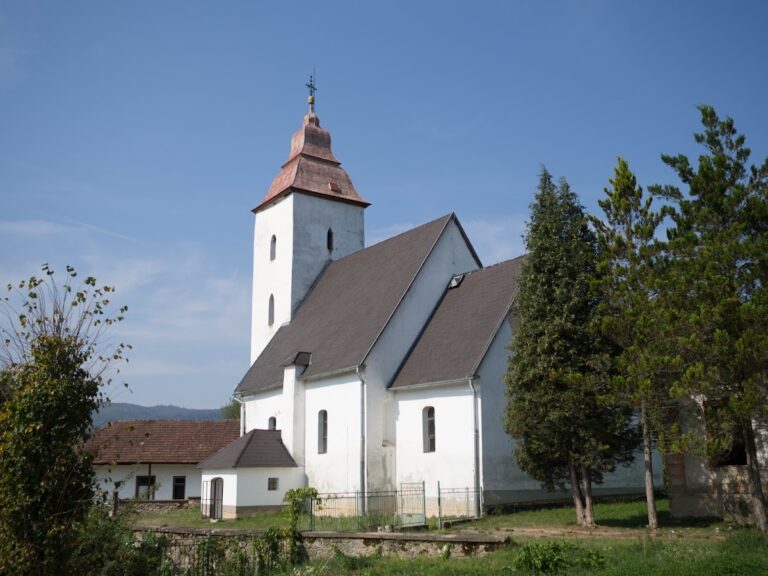
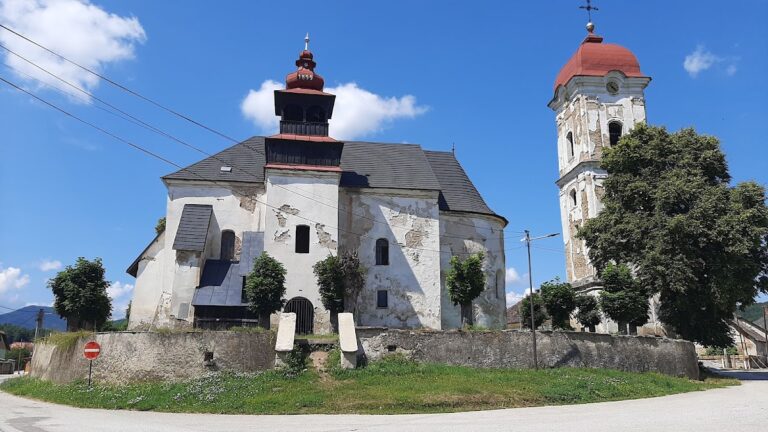
The church stands within a walled compound in the middle of Koceľovce. Its nearly intact Gothic form consists of a single nave, a polygonally ended presbytery, a projecting tower at the west, and a sacristy on the north. Together, these parts preserve the principal arrangement of the medieval building while also showing later alterations made for Lutheran worship and subsequent rebuilding.
Exterior structure and entrances
Western tower
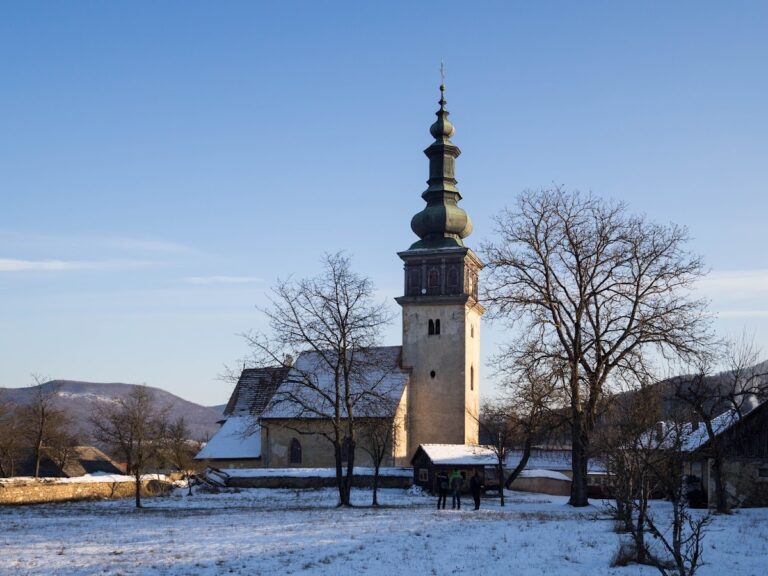
The western tower has a square ground plan and changes to an octagonal form higher up. Its upper section is finished with the unusual Art Nouveau sheet-metal roof cap added when the tower was altered at the beginning of the 20th century.
Gothic portals and windows
Three Gothic portals survive: the main entrance, the entrance leading to the sacristy, and the portal beneath the tower. The sacristy doors are wrought iron and date from the 14th century, while the main entrance doors date from the beginning of the 16th century. Gothic tracery, the stone framework dividing and ornamenting a Gothic window, remains in the presbytery windows.
Interior spaces and furnishings
Vaults, gallery, and liturgical furnishings
The sacristy has a barrel vault, a continuous semicircular or segmental ceiling. The presbytery retains a late-14th-century cross-ribbed vault supported by intersecting ribs. Inside the church are a partly wooden and masonry painted gallery, the galleries having been added during Lutheran use, a 17th-century baptismal font, and a wooden Baroque altar dated 1740.
Medieval frescoes
The presbytery walls and vaults carry frescoes dated to 1360–1370. Milan Togner associated them with an otherwise unidentified painter conventionally called the Master of the Ochtiná Presbytery. Their linear compositions, vigorous drawing, and lively gestures give the painted scenes a strongly expressive character. The continuous painted surface is described as the largest extent of continuous frescoes among the churches of the Gemer region.
The paintings form a Marian and Christological cycle, combining scenes from the life of the Virgin Mary with episodes from the life and Passion of Christ. The Marian sequence includes the Annunciation, Nativity, Visitation, Adoration of the Magi, Presentation in the Temple, the Twelve-Year-Old Jesus in the Temple, and the Coronation of the Virgin Mary. The Passion scenes show Christ’s Entry into Jerusalem, the Last Supper, prayer in Gethsemane, the Kiss of Judas, Christ before Herod and Caiaphas, the Flagellation, the Crowning with Thorns, the Carrying of the Cross, the Crucifixion, the Descent from the Cross, and the Entombment.
Further paintings have been revealed beneath the nave’s later surfaces through probes, adding to the evidence for the church’s wider medieval painted program. The presbytery frescoes remain the principal surviving expression of that program.
Nearby sites