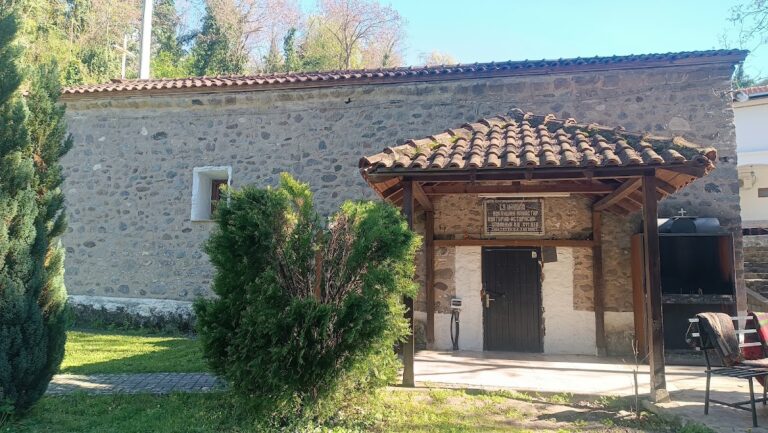
Vodoča Monastery: A Medieval Episcopal and Monastic Complex in North Macedonia


Site at a Glance
- Rating
- 4.9
- Popularity
- Low
- Country
- North Macedonia
- Primary era
- Medieval
- External website
- Open
- Eras represented
- Classical, Medieval
- Civilizations
- Bulgarian, Byzantine, Roman
- Site type
- Religious
- Remains
- Monastery
On this page14 sections
History
Vodoča Monastery, also known as the Monastery of Saint Leontius, is a medieval monastery and archaeological site in North Macedonia, in the village of Vodoča near Strumica. Built and expanded through successive Christian periods at the foot of Mount Elenica, it became an episcopal center and remains an active Orthodox church complex.
Early Christian foundations
The earliest Christian phase includes a basilica with marble decorative sculpture, dated to the fifth and sixth centuries and reused or developed during the seventh to ninth centuries. A later eastern church was built over the basilica’s ruins during the reign of Tsar Samuil, the ruler of the medieval state associated with his name.
The eastern church served as an episcopal church. It was damaged during the Samuil period and subsequently rebuilt. Its destruction is associated with the collapse of Samuil’s state and the Byzantine conquest of Strumica in 1018, when Basil II, the Byzantine emperor who defeated Samuil’s forces, brought the region under Byzantine rule. Charters issued by Basil II in 1018 record Vodoča as an episcopal seat.
Medieval episcopal center
Between 1018 and 1037, a western church was constructed and dedicated to the Virgin Mary Eleousa, the Virgin in her “Tenderness” or “Merciful” form, and to the Presentation of the Virgin. When the central church was erected in the early twelfth century, this building was converted into its narthex, an entrance or vestibular space at the west end of a church.
The central church, dedicated to Saint Leontius, was built in the early twelfth century and also functioned as an episcopal seat. Saint Leontius was a Christian martyr from Tripoli in Phoenicia who was killed during the reign of the Roman emperor Vespasian in the first century. The episcopal role of Vodoča appears again in a Hilandar document of 1376. In that document, Bishop Daniel of Vodoča and Bishop Gregory of Banja, together with secular representatives, settled disputes over the boundaries of Hilandar’s properties around Strumica. Hilandar is an Eastern Orthodox monastery on Mount Athos and a major Serbian monastic foundation.
The complex expanded during the twelfth and later centuries. A chapel was built south of the church of the Virgin Mary in the twelfth century, while a southern vestibule was added to the main church in the thirteenth century. A western annex and an open southern porch followed during the fourteenth and fifteenth centuries.
Later history and continuing religious use
Archaeological work revealed more than 1,000 graves containing jewellery and pottery dating from the fourteenth to the nineteenth century. The monastery is also traditionally associated with the story that 14,000 soldiers of Tsar Samuil were blinded after his defeat by Basil II at the Battle of Belasica. This tradition is linked to an explanation of the name Vodoča as meaning “take out the eyes.”
In 1896, the monastery possessed no property. During the First World War, the scholar Vasil Zlatarski visited Vodoča in the summer of 1916 as part of a military-organized scholarly reconnaissance mission in Macedonia and the Morava region. Today the monastery belongs to the Strumica Diocese of the Macedonian Orthodox Church-Ohrid Archbishopric, serves as the seat of the diocesan bishop Metropolitan Naum, and houses a female monastic sisterhood.
Remains
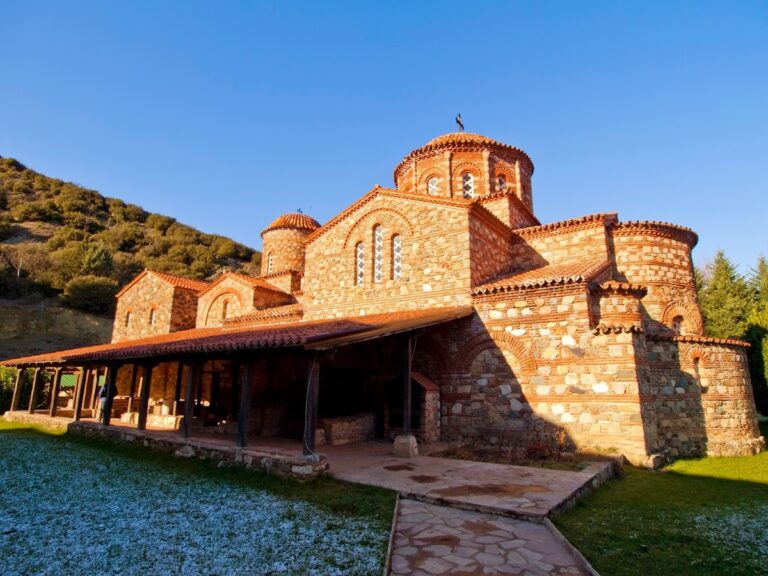
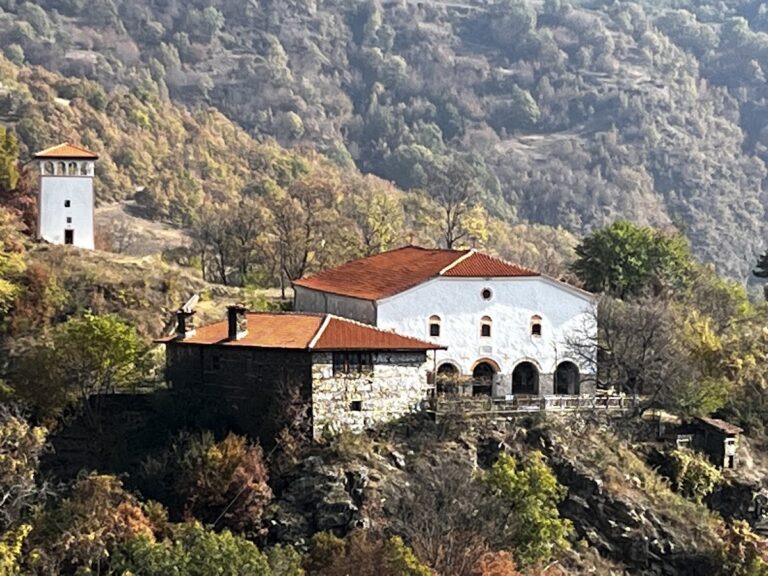
Vodoča preserves three medieval churches, monastic residential and economic buildings, a refectory, two bathhouses, and a multilayered Christian necropolis. The complex also incorporates remains of the early Christian basilica, including marble decorative elements. Two newer churches are dedicated to Saint Gregory Palamas and Joseph the Spileot, and to Saint Tryphon.
Medieval churches
Eastern church
The eastern church was a three-naved building with a dome. Its surviving remains include the altar apse, the prothesis, the side chamber used to prepare Eucharistic offerings, and the diaconicon, the corresponding chamber associated with liturgical service and storage. The original iconostasis, the screen separating the sanctuary from the main body of an Eastern Orthodox church, was made of marble, and the floor was paved with marble slabs.
Western church
The western church is a small cross-domed building dedicated to the Virgin Mary Eleousa and the Presentation of the Virgin. Its later conversion into the central church’s narthex changed its role within the complex while preserving its place in the medieval arrangement.
Central church of Saint Leontius
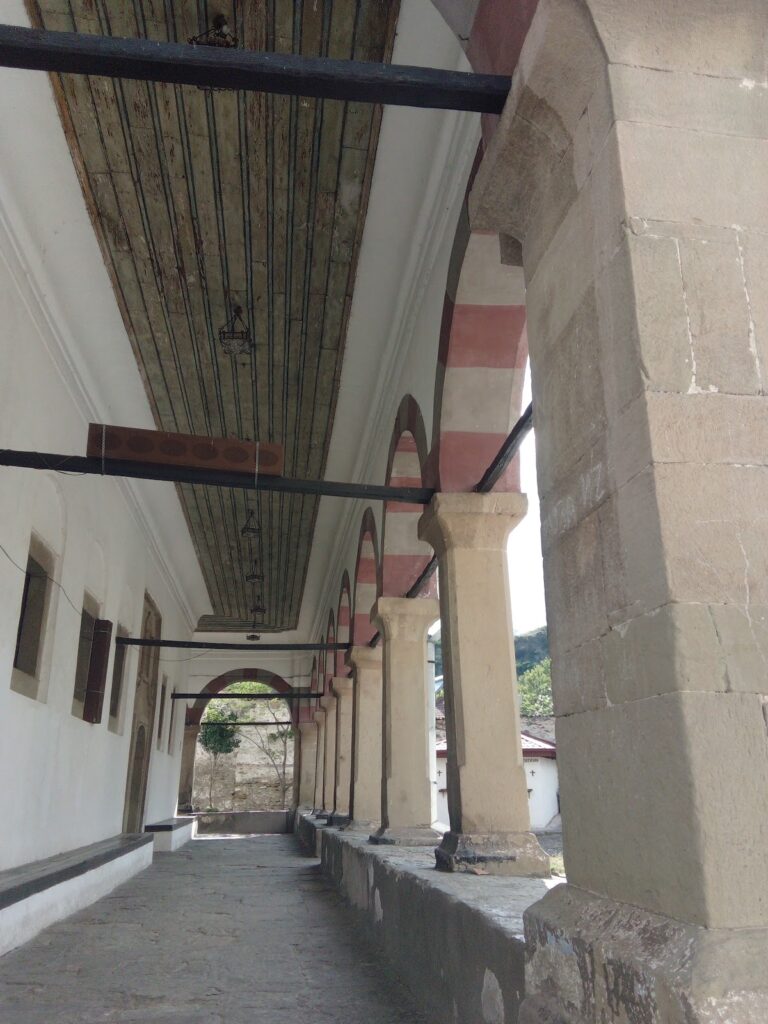
The central church is a cross-shaped, domed building. Its altar apse retains a synthronon, the tiered seating for clergy behind the altar, along with a western narthex. Open galleries or porches extend along the south side. The complex later received a western annex and an open southern porch.
Wall paintings
Eastern church painting
A small fragment in the earliest eastern church preserves a tenth-century depiction of an unidentified saint. The figure is modelled with broad strokes of pigment, with particular emphasis on the eyes, creating a dramatic intensity associated with ancient painting traditions.
Western church frescoes
The damaged frescoes of the western church include scenes from the life and childhood of the Virgin Mary, a cycle of church feasts, and full-length figures of Saints Isavrios and Euplos. Painted between 1018 and 1037, they use elongated bodies and firmly modelled heads. The paintings are regarded as outstanding examples of medieval Byzantine art, and their style has been compared with frescoes at Hagia Sophia in Ohrid, Saint Luke in Phocis, and Nea Moni on Chios.
The western church also contains what is described as the oldest medieval illustration on Macedonian territory of the apocryphal life of the Virgin Mary. An apocryphal life is a religious narrative outside the canonical scriptural texts.
Central church frescoes
The frescoes in the central church date from the first half of the twelfth century. They preserve representations of six hierarchs and scenes of the Sebastean Martyrs, Christian soldiers traditionally venerated as martyrs executed for their faith at Sebaste in the Roman province of Armenia.
Necropolis and archaeological layers
The Christian necropolis extends to the southwest and northwest of the complex. Excavation uncovered more than 1,000 burials with jewellery and pottery dating from the fourteenth to the nineteenth century. Beneath and around the medieval buildings, the remains of the early Christian basilica and its marble decorative elements preserve the site’s earlier architectural layer.
Nearby sites