Agia Triada Monastery, Sparmos: A Historic Greek Orthodox Monastery on Mount Olympus


Site at a Glance
- Rating
- 4.9
- Popularity
- Low
- Country
- Greece
- Primary era
- Early Modern
- External website
- Open
- Eras represented
- Early Modern
- Civilizations
- Ottoman
- Site type
- Religious
- Remains
- Fortified Monastery
On this page13 sections
History
Agia Triada Monastery, Sparmos, is a historic male Greek Orthodox monastery in Greece, standing above the village of Sparmos on the southwestern slopes of Mount Olympus. Also known as Sparmou Monastery, it was operating by 1386, although its foundation remains uncertain. One interpretation places its construction in the mid-sixteenth century, during the early Ottoman period. The monastery is dedicated to the Holy Trinity and the Theotokos, the Orthodox title for Mary, and celebrates the Feast of the Holy Spirit.
Origins and seventeenth-century development
Sparmos, then known as Sfarimon, appears in a 1336 chrysobull, an imperial charter sealed with a gold seal, issued by Emperor Andronikos III Palaiologos. A book of intentions shows that the monastery was functioning by 1386. Its activity is also documented in 1602, while the katholikon, the principal church of an Orthodox monastery, was renovated and painted in 1633. The monastery’s spiritual and economic prosperity grew during the seventeenth century and reached its height in the second half of the eighteenth century.
Before 1928, Agia Triada was stauropegic, meaning that it stood directly under the authority of the Patriarchate of Constantinople rather than under the ordinary jurisdiction of a local bishop. In 1928 it was transferred to the Church of Greece, the autocephalous Greek Orthodox church, and placed under the Metropolitan of Elassona.
Looting, punishment, and recovery
In 1774, amid unrest connected with the Russo-Turkish War, a conflict between Russia and the Ottoman Empire, and disorder caused by irregular Albanian forces, raiders looted the monastery. Local inhabitants subsequently restored it. The brotherhood then began building a metochi, a dependent monastic property or outlying establishment, without first obtaining authorization from Constantinople. Ottoman officials were bribed, but Ottoman troops burned the metochi on 2 February 1780.
The authorities arrested Bishop Parthenios, the abbot Gerasimos, village elders, and three Ottoman officials after these events. Parthenios and Gerasimos spent four years in exile. The monastery, the bishopric, and the village elders were also required to pay the Ottoman authorities approximately 40,000 Turkish groschen. The original monastery codex was lost during the 1774 looting, but a surviving codex written between 1800 and 1877 preserves information about the monastery and the history and economy of the region from 1602 to 1877.
Education and the Greek struggle for independence
Agia Triada became an important center of Orthodox education and Greek intellectual activity. Its library held theological works, manuscripts, and books on mathematics, geometry, philosophy, medicine, geography, mythology, and ancient Greek literature. The brotherhood copied texts, operated a bookbinding workshop, and published books. The monastery also supported the School of Tsaritsani financially and served as a place of education for clergy, scholars, and teachers.
The community and its staff sometimes numbered about 150 people. Its substantial movable and immovable property included metochia. Among those connected with its educational work was Ionas Sparmiotis, who briefly served as abbot in 1791 and later taught arithmetic and algebra in Ambelakia with the aid of treatises by Clairaut. Germanos Sparmiotis was also associated with the monastery’s teaching tradition.
During the Greek struggle for independence, the monastery supported Greek fighters. Its remote mountain position allowed the monks to shelter fighters and ammunition and to supply clothing and provisions. This role formed part of the monastery’s wider religious and intellectual importance in the region.
Decline and revival
A gradual decline began in the mid-nineteenth century. The last monks left during the second decade of the twentieth century, after which the monastery remained without a monastic community for approximately eighty years. Reconstruction began on the initiative of Basileios, Metropolitan of Elassona. Monks returned in 2000, and Agia Triada has since functioned again as a male monastic community under its abbot, Archimandrite Nikanor.
Agia Triada Monastery is a designated historic building in Greece. Its religious life also includes the keeping of relics associated with numerous saints, including John the Baptist, Lazarus, Charalambos, Panteleimon, John Chrysostom, Gregory the Theologian, Barbara, and Nektarios.
Remains
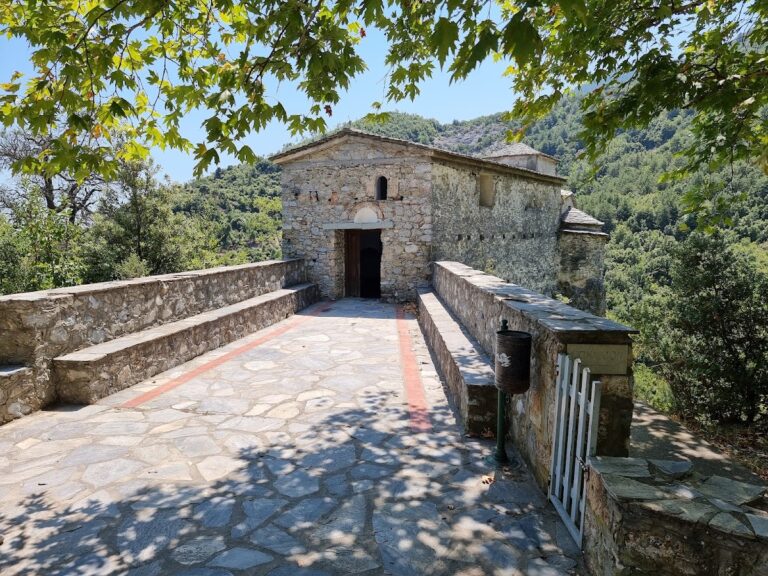
The monastery stands at approximately 990 to 1,000 metres above sea level at a place known as Skamniotikes Magoules, above Sparmos on the southwestern slope of Mount Olympus. Its rectangular complex is enclosed by high exterior walls and two-storey monastic cells. The katholikon occupies the center, while cells, a refectory, and other rooms are arranged around it. Interior columns support the upper rooms and create covered colonnades around the church, providing access to the museum, the monks’ shop, and areas closed to visitors.
Enclosure and associated buildings
Fortified enclosure
The outer wall is approximately one metre thick. Four substantial retaining walls reinforce the northern side, while the upper storeys have small barred windows. A wooden entrance door strengthened with iron forms the principal entry to the complex. The southwestern part contains the semantron, a wooden or metal instrument used to summon monks to prayer, together with the bell tower.
Wells, chapels, and cemetery
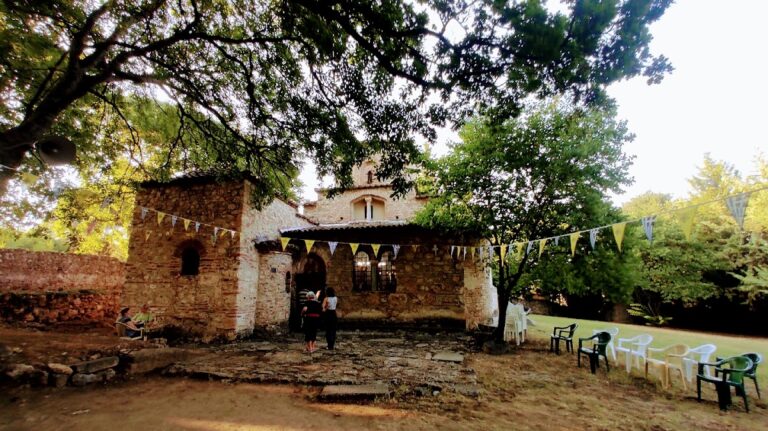
A small old well or covered spring on the southern side provides holy water. The complex also contains a metochi or guesthouse, the chapels of Saint Charalambos and Saint John the Baptist, and a holy-water basin. Outside the main enclosure to the northeast stands the cemetery chapel dedicated to All Saints. Other associated chapels are dedicated to Saint Kyriaki, Saint Methodios, and the Theotokos. The chapels of Saint Kyriaki and Saint Methodios stand approximately one kilometre before the monastery.
The katholikon
Structure and later alterations
The katholikon is a single-nave rectangular stone church approximately 23 metres long and 7 metres wide. Its exterior walls are about one metre thick and are faced with local stone and brick. The building has four sections: the exonarthex, or outer entrance hall; the liti, an inner narthex used in Orthodox worship; the main church; and the sanctuary, the altar area reserved primarily for clergy.
A pitched tiled roof was added later and conceals the upper parts of the wall paintings. Inside, a flat wooden ceiling is divided into patterned coffers by thin strips of wood. Descriptions from the early nineteenth century state that the church once had a dome, although the date and circumstances of its destruction are unknown. Small windows give the interior limited light. The marble floor contains inlays, and the sanctuary entrance has gilded woodcarving and icons. The iconostasis, the carved screen separating the sanctuary from the main church, carries carved wooden ornament. Some icons are later replacements for earlier originals that were stolen.
Inscription and wall paintings
An inscription above the western entrance records the renovation and painting of the church in 1633. The six-line foundation inscription, written in Modern Greek, identifies the church at that time as belonging to the Diocese of Petra and Sagodania, whose archbishop was Ieremias. It names Ioannes, a priest and master builder, and attributes the frescoes to Georgios and the priest Ioannes. The oldest well-preserved icons also belong to the 1633 period.
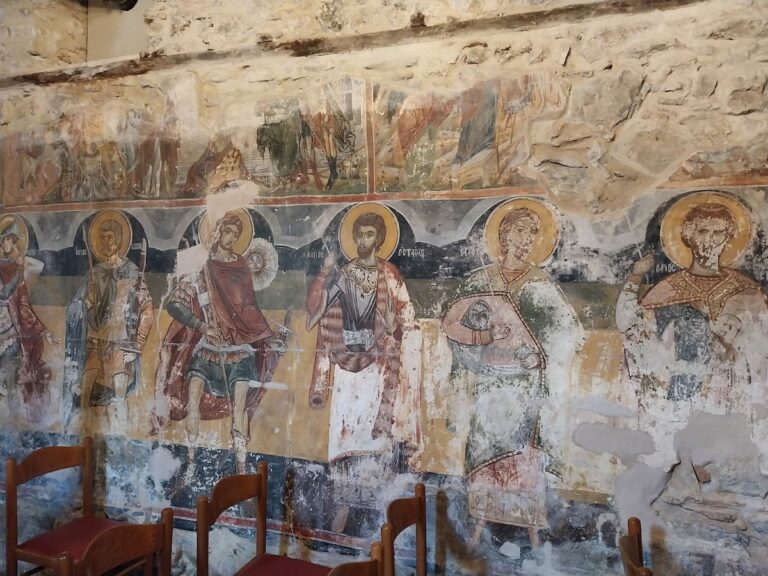
The wall paintings follow an ordered program across the church. The main church contains four painted zones, while the western wall has three. Its lowest zone shows saints, and the upper zone presents scenes from the life of the Theotokos, including the Nativity, Entry into the Temple, and Dormition. Other walls show full-length military saints, martyrs, and the Unmercenary Physicians, Christian saints traditionally associated with healing without payment. Higher zones contain bust-length martyrs in decorated circular frames and scenes from the life of Christ, extending from the Annunciation to the Ascension and Pentecost.
In the sanctuary apse, the paintings include the Platytera, the customary Marian image placed above the altar, together with the Divine Communion and hierarchs. The liti contains images of ascetic fathers and, in its upper zone, scenes of the martyrdoms of saints and apostles. A large Last Judgment occupies the eastern side of the partition wall between the liti and the main church.
Colored patterns decorate the wooden ceiling, while chandeliers with wax candles carry porcelain bowls and ostrich eggs. These interior features accompany the painted biblical and hagiographic scenes, the images of saints’ lives, that cover the church walls.
Museum and preserved objects
The monastery museum holds monastic robes, icons from the 1633 period, books partly bound at the monastery, old silver liturgical vessels, embroidered textiles, and documents concerning the monastery’s history. The relic collection includes objects associated with John the Baptist, Lazarus, Charalambos, Panteleimon, John Chrysostom, Gregory the Theologian, Barbara, and Nektarios.
Nearby sites