Assumption of Mary Church, Koper: Cathedral of the Diocese of Koper


Site at a Glance
- Rating
- 4.6
- Popularity
- Low
- Country
- Slovenia
- Primary era
- Medieval
- External website
- Open
- Eras represented
- Medieval, Early Modern
- Civilizations
- Holy Roman Empire, Venetian
- Site type
- Religious
- Remains
- Cathedral
On this page23 sections
History
The Assumption of Mary Church, Koper, is a Roman Catholic cathedral in Slovenia and the parish church of the Koper–Assumption of Mary parish. Built in the Romanesque tradition during the second half of the twelfth century, it is the cathedral of the Diocese of Koper and one of that diocese’s two cathedrals. The church is dedicated to the Assumption of Mary, while Saint Nazarius is also associated with its cathedral dedication.
Early Christian and medieval origins
Tradition and archival claims place a basilica near the Elijah Rotunda as early as the end of the fourth century. Archaeological investigations have not confirmed that identification. Bishops may have been seated in Koper from around 520, although little is known about the cathedral before the year 1000.
The earliest archival reference to a Romanesque Marian church dates from the late eleventh century. By the medieval period, it was regarded as Koper’s principal church. It had a Marian altar and an open atrium or loggia in front of the facade. Construction of the church took place in the second half of the twelfth century, while extensions continued until 1392.
Genoese destruction and rebuilding
Genoese forces looted and devastated Koper in 1380. They removed the relics of the city’s patrons, Saints Nazarius and Alexander, and burned the church and the atrium before its facade. The church was enlarged westward after the attack, and restoration continued for more than a century.
Koper’s citizens recovered Saint Nazarius’s relics from Genoa in 1422 and returned them amid major celebrations. They placed the relics beneath a baldachin altar, a canopy structure over an altar. An earthquake in 1460 damaged the facade, which was partly rebuilt by 1488 with Renaissance elements. During the fifteenth-century enlargement, the church was also connected to the Romanesque bell tower, which had originally stood separately.
Venetian transformation
In the early eighteenth century, while Koper was under Venetian influence, the cathedral was transformed in a Venetian Baroque-classical manner. Giorgio Massari directed the work dated 1738–1751. The earlier underground chapel beneath the present presbytery, or sanctuary area, was demolished and filled in during the 1716 renovation. It had contained an altar dedicated to Saint Elijah, with stairs descending from both sides of the main altar.
Bishop Paolo Naldini described the cathedral’s three-aisled form in his 1700 work on the city and Diocese of Koper. The present church retains elements of that long development, including the surviving south wall, while its interior and furnishings reflect later reconstruction and decoration.
Modern use and preservation
The church remains an active cathedral and parish church within the Diocese of Koper, the Koper deanery, the Archdiocese of Ljubljana, and the Ljubljana ecclesiastical province. It was entered in Slovenia’s Register of Cultural Heritage as a locally important immovable monument on 3 February 1993.
The cathedral’s musical history includes a 1773 organ made by Gaetano Callido of Venice. It replaced an instrument destroyed by lightning in 1771. Giorgio Bencz altered it in 1940, removing its historically important case and original facade pipes and changing some stops. These interventions changed the instrument’s original sound, and it was subsequently intended for relocation to the Church of Saint Bassus in Koper.
A large organ built by Kleuker and Steinmeyer in 1988 for Zurich’s Tonhalle was transferred to Koper after the concert hall decided to replace it. The Orglarska delavnica Maribor installed it, and the instrument was blessed on 6 November 2021 and inaugurated the following day. Designed according to plans by the French organist and composer Jean Guillou, it has four manuals, a pedalboard, 68 stops, approximately 5,420 pipes, electrically operated action, and a registration system with 1,000 combinations. It is described as Slovenia’s largest church organ and the country’s second-largest organ overall.
Remains
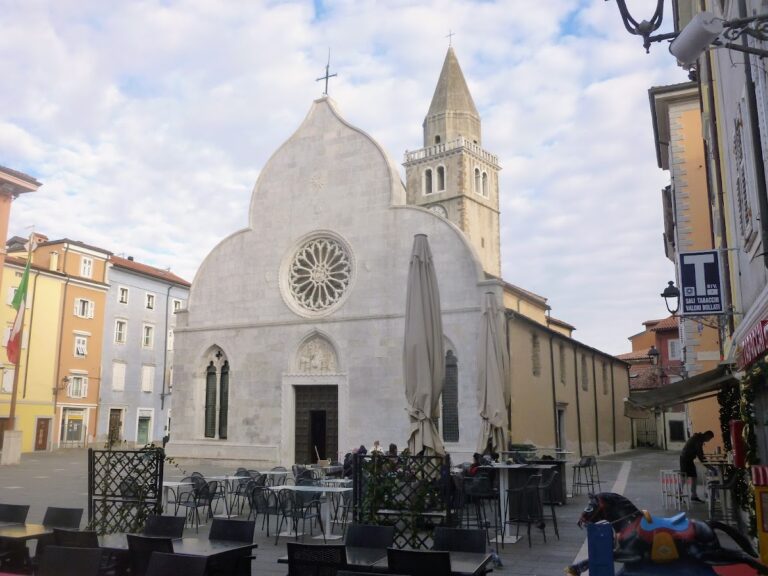
The cathedral and its bell tower form the eastern side of Tito Square. The church is approximately 70 metres long and 25 metres wide, with a nave about 24 metres wide. Stone is the principal construction material. Its surviving fabric brings together a Romanesque three-aisled plan, a facade with Venetian Gothic and Renaissance elements, and an eighteenth-century interior shaped by Baroque-classical design.
Romanesque fabric and exterior structures
South wall and Romanesque portal
The south wall preserves Romanesque fabric from the medieval church, including blocked Romanesque windows. A partially reconstructed Romanesque portal survives in the atrium of the Provincial Museum. These elements belong to the architectural phase associated with the church’s construction in the second half of the twelfth century.
Bell tower
The bell tower is a four-storey Romanesque structure approximately 53 metres high, with some descriptions giving a height of about 54 metres. It began as a freestanding urban and defensive tower in the twelfth century. The tower was connected to the church during the fifteenth-century enlargement and was rebuilt or modified between 1418 and 1480. Its octagonal pyramidal cap, an Aquileian-type form, was completed in 1644.
The tower contains several bells, including one cast in 1333 by Nicholas and Martin, sons of the Venetian master Jacob. The bell bears an inscription naming its makers, the date, the Koper commander Peter de Canali, and Saints Mark and Nazarius. It is believed to be among the oldest bells in Slovenia.
Former baptistery
A round Romanesque building stands on the north, or left, side of the cathedral. Dating from the second half of the twelfth century, it was originally designed as a baptistery dedicated to Saint John the Baptist.
Facade
The eastern facade combines a Venetian Gothic lower level with a Renaissance upper level associated with the Lombardi family’s architectural and sculptural style. Three blind arches shape the lower level, while Renaissance details are especially visible around the portal. Statues set in facade niches have individual canopies. They were probably installed later and may originally have formed part of the baldachin altar made after 1422. Other parts of that altar are preserved in the lapidarium of the Provincial Museum.
Interior architecture and altars
Three-aisled interior
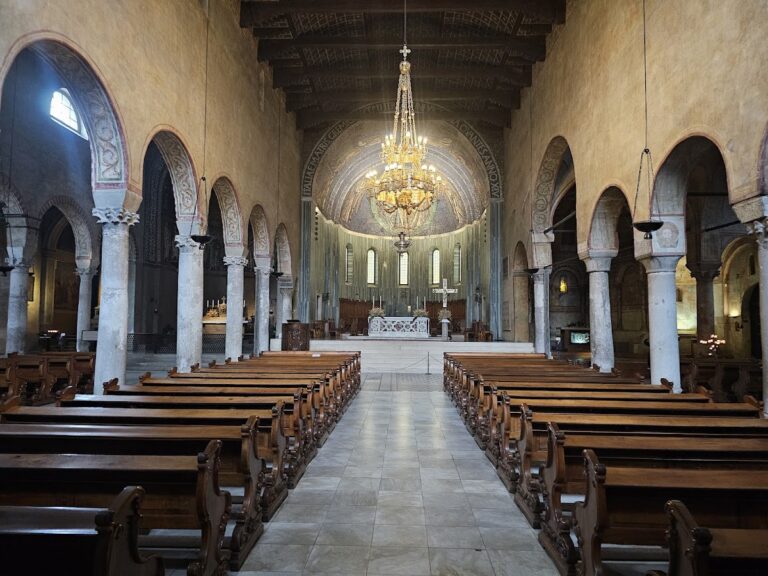
The interior retains a three-aisled arrangement, with each aisle ending in an apse, a curved or semicircular termination. Pilasters divide the walls, and a strongly profiled cornice is repeated on the piers separating the aisles. The cornice visually divides the interior into two parts and continues toward the presbytery, which forms the spatial centre of the cathedral.
The eighteenth-century interior contains compound architectural elements and cross vaults associated with the tradition of Andrea Palladio, the sixteenth-century Italian architect whose classical principles influenced later Venetian design. Francesco Schiavi created the stucco decoration in 1749.
Main altar
The main altar is a baldachin, or ciborium, altar. Its altarpiece represents the Assumption of Mary into heaven in the presence of saints and prophets.
Side altars
Four side altars stand within the church. Most of these altars and their paintings date from the seventeenth century. Some of the paintings have been attributed, possibly, to the Venetian artists Pietro Liberi and Andrea Celesti.
Paintings and sculpture
Works by Vittore Carpaccio
Vittore Carpaccio’s Madonna and Child with Six Saints, dated 1516, is regarded as the cathedral’s most important artwork. Following conservation and restoration at the Ljubljana Restoration Centre from 2019 to 2024, it returned to Koper in October 2024 and was placed on the right wall of the transept.
Another painting by Carpaccio from 1516, Madonna Enthroned with Saints, hangs on the left side of the transept. Saint Nazarius holds a model of Koper in the scene, which is described as the oldest known depiction of the city. Two further Carpaccio paintings, The Massacre of the Innocents and The Presentation of Jesus in the Temple, date from 1523. They formerly formed part of the decoration of the organ case and are regarded as the artist’s last known works.
Other paintings
The presbytery contains Antonio Zanchi’s The Marriage at Cana in Galilee. Together with the seventeenth-century side-altarpieces and the Carpaccio paintings, it forms part of the cathedral’s collection of Italian and Venetian religious art.
Sarcophagus of Saint Nazarius
The marble sarcophagus of Saint Nazarius is a Venetian Gothic tomb monument for the sixth-century bishop of Koper and patron saint of the city. The Venetian Republic donated it to Koper around 1350, and it remained for decades in a niche behind the main altar. The sculpture is most often attributed to Filippo de Santis.
The recumbent figure represents the deceased in episcopal robes. Reliefs on the sides show Pope Alexander, Saint Nazarius holding a model of Koper, the deacon Elijah, and disabled people appealing to the saint for miraculous healing.
Woodwork, treasury, and organ
Choir stalls and pulpit
Richly carved choir stalls surround the presbytery. Stefano Bandesi Tedesco made them in Koper in 1686–1687 from olive wood. They bear the coat of arms of their patron and payer, Bishop Agostino Konta de Bruti. A large book stand in the corner belongs to the same period.
Lorenzo Farolli made the wooden pulpit in 1758 in the Rococo style, a later eighteenth-century decorative language known for lighter, more ornate, and more curving forms. Large enclosed wooden candle stands called fanali were carved and gilded in Venice by Paolo De Mori in 1750. Most of the other candlesticks also came from Venice.
Treasury
The cathedral treasury contains a Byzantine-period ivory casket and an antiphonary, a liturgical book containing chants, associated with the Koper miniaturist Nazarius. It also holds jewellery dating from the fifteenth and sixteenth centuries.
Organs
The former Callido organ was built in the Italian Baroque style in 1773. Its original case and facade pipes were removed in 1940, and the instrument’s original tonal character was altered. The present organ required a new choir area for its installation. It has four manuals and a pedalboard, 68 stops, approximately 5,420 pipes, including about 5,141 metal and 279 wooden pipes, and an electrically operated mechanism.