Războieni Monastery: A Memorial Church of the Valea Albă Battle in Romania


Site at a Glance
- Rating
- 4.8
- Popularity
- Low
- Country
- Romania
- Primary era
- Medieval
- External website
- Open
- Eras represented
- Medieval, Modern
- Civilizations
- Principality of Moldavia
- Site type
- Religious
- Remains
- Monastery
On this page13 sections
History
Războieni monastery is a Romanian Orthodox monastery in Războieni village, Romania, founded under Stephen the Great, ruler of Moldavia from 1457 to 1504. Its church, built in 1496 in the late medieval Moldavian tradition, is dedicated to the Holy Archangels Michael and Gabriel, also called the Holy Voivodes, whose feast is celebrated on 8 November. The church commemorates the Moldavian soldiers killed at the Battle of Valea Albă and stands over their burial place.
The Battle of Valea Albă
The battle took place on 26 July 1476 in a large forest clearing identified with present-day Războieni. Sultan Mehmed II, the Ottoman ruler who had captured Constantinople in 1453, invaded Moldavia with a large army. His forces were joined by a Wallachian contingent led by Basarab Laiotă, while Crimean Tatar raids forced Stephen the Great to divert part of his army.
Stephen withdrew toward the mountains and fortified the clearing by cutting down large trees, digging a deep ditch, and covering the fallen trunks with earth. The Ottoman army was given as 150,000 strong, while approximately 10,000 Moldavian soldiers defended the position. The battle ended in an Ottoman victory. The stated losses were 30,000 Ottoman dead, 200 Moldavian dead, and 800 Moldavian prisoners. Stephen fell from his horse during the fighting but was not injured.
The victory did not bring Moldavia under Ottoman control. Moldavian forces continued to harass the invaders, whose army withdrew in disorder with its weaponry destroyed. The Ottomans also failed to capture Suceava Fortress, defended by the hetman Șendrea, or Neamț Fortress, defended by the castellan Luca Arbore the Elder.
Foundation and monastic development
Stephen the Great founded the church in 1496, twenty years after the battle, over the burial place of the fallen soldiers. A long inscription in Slavonic on the south wall of the porch also recounts the circumstances of its construction. The duration of the building work is not stated in the inscription or in the chronicle of Grigore Ureche. Historian Constantin Turcu proposed that work began on 26 July 1496, the twentieth anniversary of the battle, partly on the basis of the church’s relatively small dimensions.
The church functioned as a parish church until 1734, when a monastery for monks was established there. In 1803, Metropolitan Veniamin Costachi transformed it into a women’s monastery. Suzana Ștefănescu, a nun and sister of Bishop Melchisedec Ștefănescu of Roman, served as abbess from 1906 to 1925. When she died, more than 50 nuns belonged to the community.
Dissolution and reopening
Decree No. 410/1959 dissolved the monastery during the communist period. The church became a parish church, elderly nuns were sent to Agapia, Văratec, and Slatina monasteries, and younger women were removed from monastic life. Four nuns remained at Războieni, formally giving up their monastic dress, while most of the monastic cells were demolished.
Restoration of the church took place from 1975 to 1977. Archaeological excavations carried out during the work uncovered pits containing the disordered remains of soldiers killed in the battle. The absence of skulls led to the supposition that they had been placed beneath the altar. The monastery reopened in 1990 after the fall of the communist regime, when nuns and sisters from Văratec joined the four women who had remained at Războieni. The community was led by Abbess Glicheria Mănăstireanu from 1990 to 1994, Abbess Olimpiada Neagu from 1994 to 1998, and Stavrophore Abbess Acachia Căuș from 1998 onward. A stavrophore is a senior monastic title associated with permission to wear a cross as part of the monastic habit.
The monastery now has a community of 26 nuns and sisters, with workshops for tailoring, sculpture, icon lithography, carpet-weaving, and carpentry. In 2015, Războieni was included in Neamț County’s register of historic monuments under code NT-II-a-A-10647. The protected ensemble includes the Church of the Holy Voivodes, the bell tower built in 1862, the twentieth-century abbess’s residence, and cells dating from the nineteenth and twentieth centuries.
Memory of the monastery
The monastery also became a place associated with later remembrance of the battle. At the end of the nineteenth century, officers of the 15th Dorobanți Regiment, stationed at Piatra Neamț, initiated a memorial to Valea Albă. A committee led by Professor V. A. Urechia raised funds, and the Alsatian sculptor Visenberger created the monument, which was inaugurated at the monastery on 27 October 1897.
The poet and diplomat Dimitrie Bolintineanu visited Războieni in autumn 1857 and described the monastery in travel memoirs published in 1859. Abbess Iustina Patrașca and the nun Agafia received him, and he stayed overnight with Agafia. His account noted the nuns’ patriotism and their prayers for the political union of the Romanian principalities.
Remains
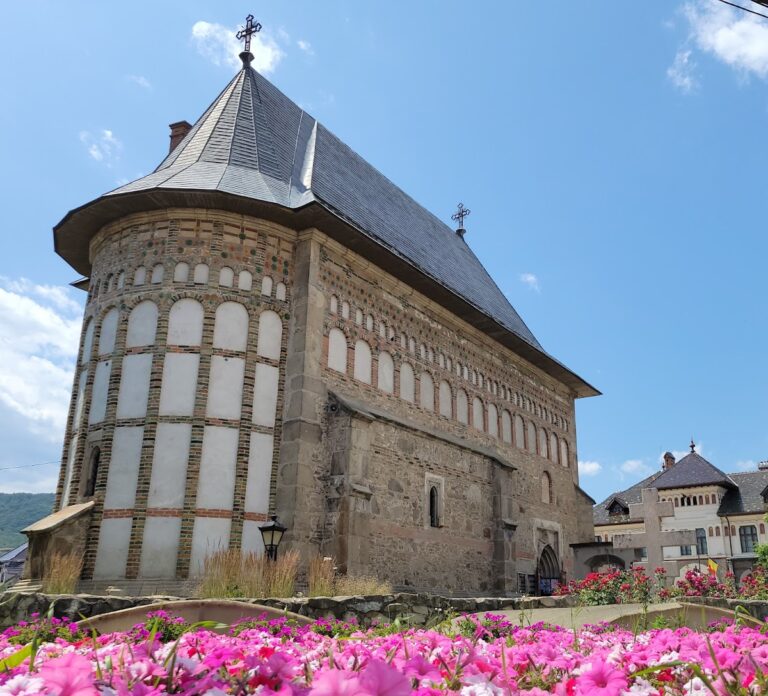
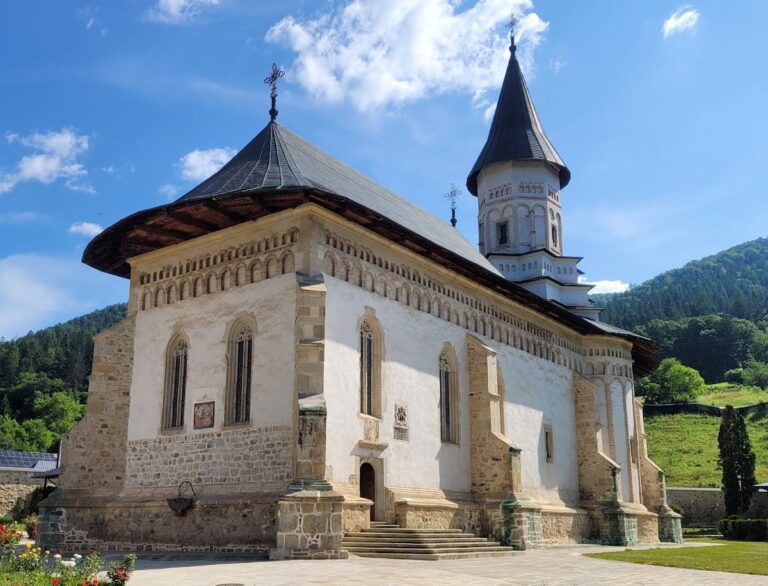
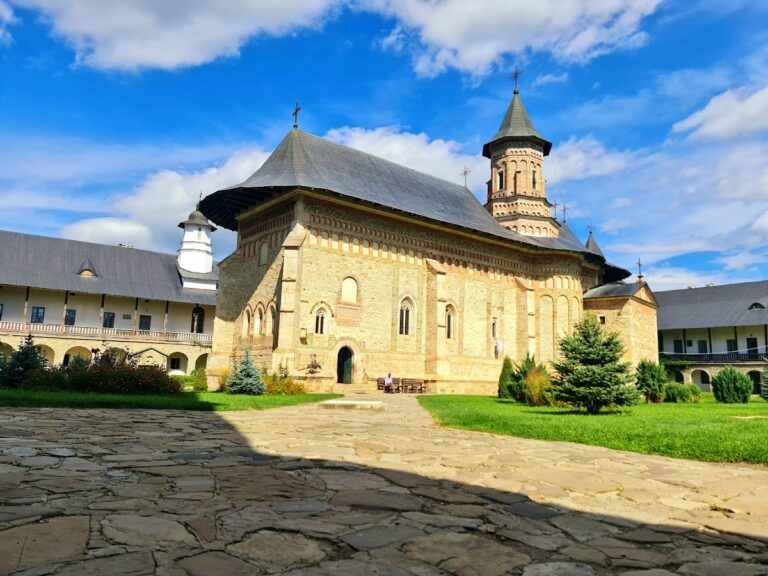
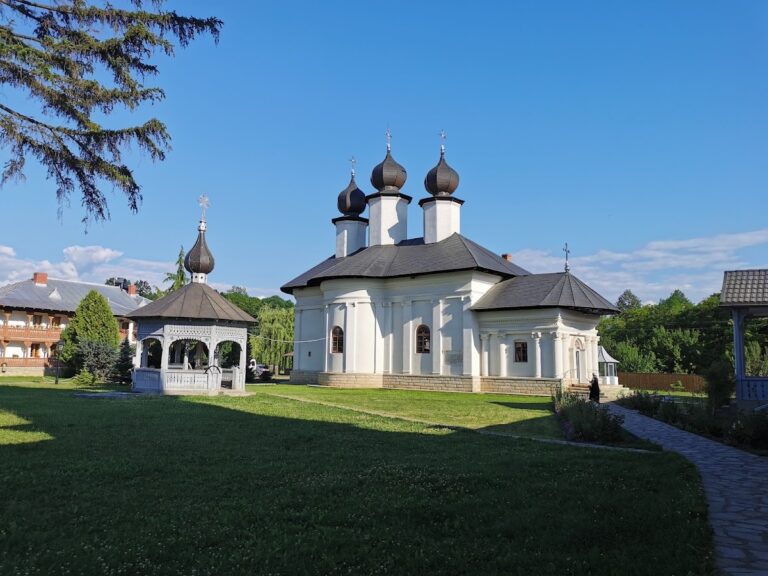
The monastery ensemble is organized around the stone Church of the Holy Voivodes, the entrance bell tower, the abbess’s residence, and the monastic cells. The church has very thick walls, a dressed-stone base, a steep four-sided roof with broad eaves, and exterior decoration formed by glazed bricks and polychrome disks with raised bosses. Its rectangular plan resembles Stephen the Great’s churches at Piatra Neamț and Borzești.
Memorial church
Exterior form
The altar end is polygonal inside and semicircular outside. Nine elongated niches cover its exterior, while two buttresses stand obliquely where the apse meets the nave walls. Another buttress-like support lies beneath the altar window. Two rows of niches run below the cornice, with two upper niches corresponding to each lower niche. These elements combine with the decorated brickwork and colored disks to form the church’s principal exterior ornament.
Windows and interior spaces
Five windows light the building. Two large windows open in the pronaos, the entrance hall, one in the south wall and one in the west wall; both have Gothic pointed-arch ornament. Two small, narrow windows illuminate the nave, the main worship space, and another narrow window is placed on the axis of the altar apse. The latter three windows have frames with intersecting mouldings at their corners. An original window in the north wall of the pronaos is now blocked.
The interior follows the traditional division into pronaos, nave, and altar. The entrance passes through the south wall of the pronaos and is framed by moulded pointed arches. Two spherical vaults cover the pronaos, separated by a transverse arch. A partition wall divides it from the nave, whose portal has a rectangular surround with intersecting mouldings. Four diagonal arches support the nave cupola. The altar contains two small wall niches, and its present paintings date from the nineteenth century.
Burial deposit and later restoration
The church stands over the burial deposit associated with the soldiers killed at Valea Albă. Beneath the stone slabs, the deposit extends from the nave toward the altar for approximately 10 metres, with a width of 3.5 metres and a thickness of about 30 centimetres. Excavations during the 1975 to 1977 restoration also revealed pits containing disordered human remains connected with the battle.
Two small towers were added in the nineteenth century without structural connections to the vaults, and a small porch was built around the south entrance. The façades were then plastered and whitewashed. The restoration removed these towers, the porch, and other later additions, returning the exterior to its original appearance.
Monastery buildings and memorial
Bell tower and monastic buildings
The monastery entrance passes beneath the bell tower, constructed in 1862. The ensemble also contains an abbess’s residence from the twentieth century and monastic cells dating from the nineteenth and twentieth centuries. Most of the cells were demolished after the monastery’s dissolution in 1959, while the surviving buildings form part of the protected historic ensemble.
Battle memorial
The memorial to the Battle of Valea Albă stands within the monastery ensemble. Visenberger made the monument, which was inaugurated on 27 October 1897 after the fund-raising initiative of officers from the 15th Dorobanți Regiment and the committee led by V. A. Urechia.
Nearby sites