Pantanassa Church: A Byzantine Monastery Church in Athens


Site at a Glance
- Rating
- 4.7
- Popularity
- Low
- Country
- Greece
- Primary era
- Early Modern
- Eras represented
- Medieval, Early Modern, Modern
- Civilizations
- Byzantine, Greek, Ottoman
- Site type
- Religious
- Remains
- Church
On this page9 sections
History
Pantanassa Church, also known as Panagia Pantanassa, is an Eastern Orthodox Byzantine church in central Athens, Greece, dedicated to the Dormition of Mary, the Orthodox commemoration of her death and glorification in heaven. Often dated to the tenth century, it served as the principal church, or katholikon, of a monastery that later disappeared, although the date of its original structure remains uncertain.
Early Byzantine and Frankish periods
Proposed dates for the earliest church range from the seventh or eighth century to the eleventh or twelfth century. Geórgios Sotiríou placed it in the seventh or eighth century, Oskar Wulff in the eighth or ninth, and Anastásios Orlándos and Andréas Xyngópoulos in the tenth. Gabriel Millet proposed the eleventh or twelfth century. John Freely rejected such an early dating because the historical and architectural evidence extends little beyond oral tradition.
During the Frankish period of the Duchy of Athens, from 1205 to 1311, the site depended on the Kaisarianí monastery. A post-Byzantine church with a wooden roof was built over the earlier ruins during the fifteenth century.
The Great Monastery and Monastiráki
A new structure broadly resembling the present church was probably erected at the beginning of the seventeenth century. In 1678, a decree issued by Dionysios IV, Patriarch of Constantinople, identified it as the katholikon of the “Great Monastery,” a women’s monastery owned by Nicolas Bonefaci. The monastery prospered through textile production and the many shops it owned in the surrounding area.
From 1690, the monastery church also served as a parish church alongside the Kaisarianí monastery. The former Great Monastery gradually became known popularly as the “Little Monastery,” or Monastiráki, and this name later passed to the surrounding district.
Modern transformation and restoration
Excavations around 1885 led to the demolition of the buildings that formed the monastic complex. The inauguration of Monastiráki railway station about a decade later further altered the declining monastery, whose fortunes had deteriorated after Greek independence. The church was renovated again in 1890, while redevelopment of the square in 1907 gave the area a more modern public-space character.
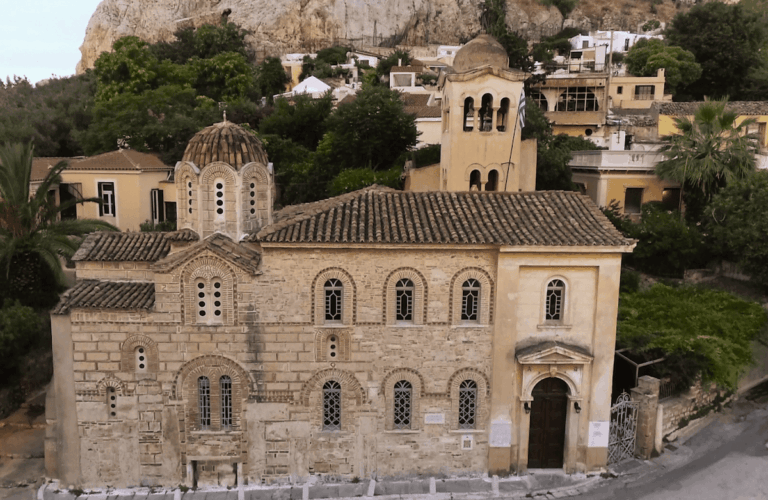
In 1911, architect Ioánnis Kolliniátis directed the construction of a Neoclassical bell tower, replacing the earlier tower. Late-twentieth-century restoration aimed to recover the appearance the church was thought to have had in the seventeenth century while retaining the Neoclassical bell tower. Damage caused by the 1999 earthquake and construction of Line 3 of the Athens Metro, inaugurated in 2003, led to a twelve-year closure. The church reopened for worship in 2011.
Religious and cultural associations
Around 912, Luke of Steiris is believed to have entered monastic life at the church as a fifteen-year-old novice. He later founded the Hosios Loukas monastery. Around 1551, Philothei of Athens is said to have been made a nun there by Kallistos, Metropolitan of Athens. Nectarios of Aegina served as its deacon from 1881 to 1885. The writers Alexandros Papadiamantis and his cousin Alexandros Moraitidis also attended the church. Pantanassa is protected in Greece as a historic building and archaeological site.
Remains
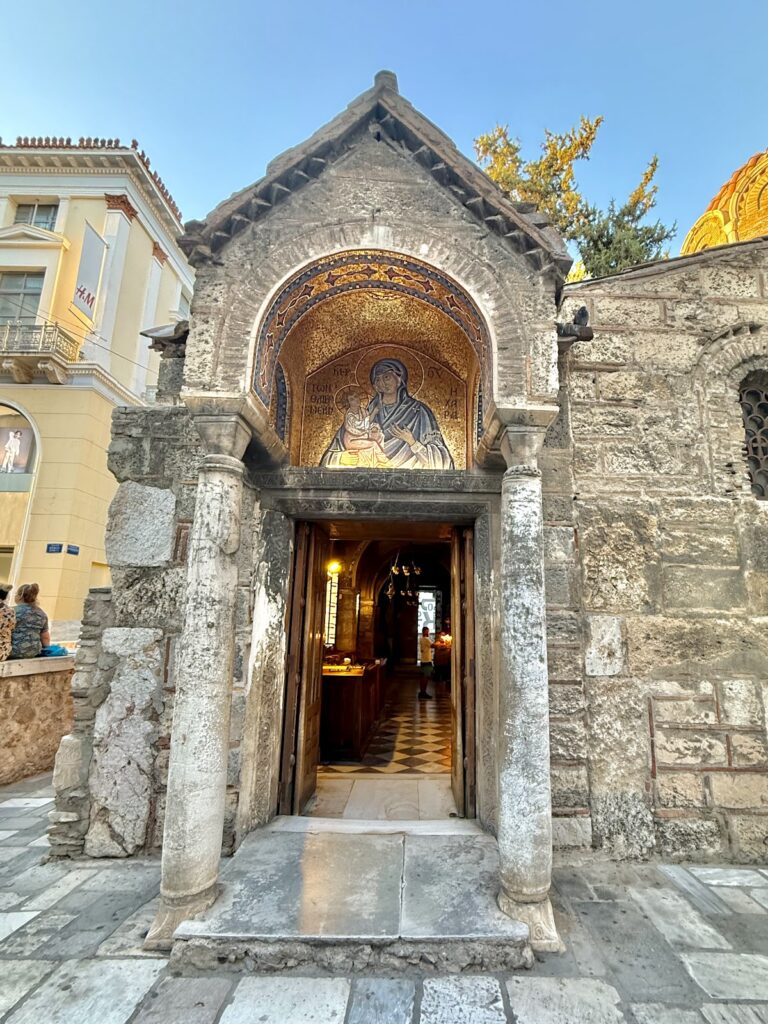
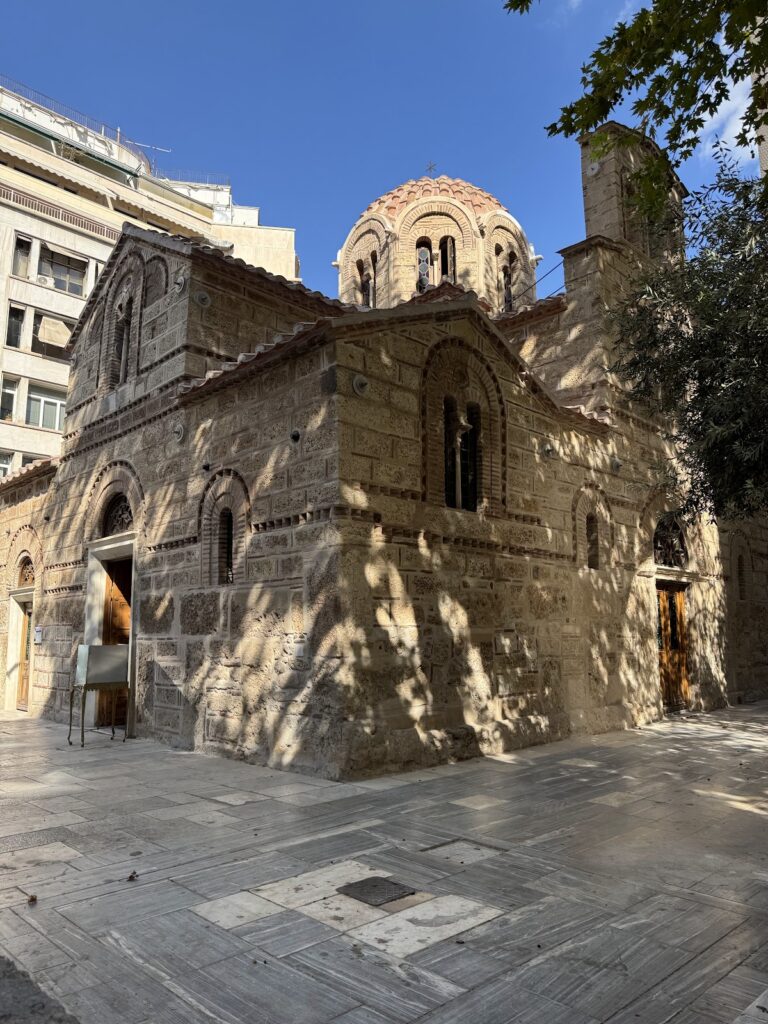
Pantanassa Church stands on Monastiráki Square between Athinas and Mitropoleos Streets, facing Monastiráki station. The building lies below the present level of the square. Its three-aisled basilical plan has no narthex, or entrance vestibule, and measures approximately 16 by 11.2 metres. The walls are between 0.85 and 0.90 metres thick.
Vaults and plan
The central nave is covered by a barrel vault, a continuous semicircular or segmental ceiling, extending from the facade to the sanctuary. Two rows of three columns divide it from the side aisles, which have groin vaults formed by the intersection of two vaults. Arcades connect the columns. At the eastern and western ends, the central vault terminates in lateral apses.
Masonry and archaeological remains
The exterior walls are built of limestone and incorporate numerous reused elements. Ancient capitals appear at the corners, while two marble column drums date from the fourth century BC. Other reused pieces bear crosses. Excavations beneath and around the church revealed remains of two Middle Byzantine architectural phases, several tombs, and a fifth-century mosaic. The function of these earlier remains cannot be established with certainty.
Decoration and sacred images
The present interior includes frescoes painted by Spyrídon Chatzigiannópoulos during the late-nineteenth-century renovations. Some icons on the iconostasis, the screen separating the sanctuary from the nave, were painted by Fótis Kóntoglou.
Since 2015, the church has housed a copy of an icon of Panagía Gorgoepíkoos. The original may have been venerated at Pantanassa during the Byzantine period and is now held in the museum of the Church of Saint George in Cairo.
Nearby sites