Sveta Marija na Škriljinah: A Gothic Marian Sanctuary in Croatia


Site at a Glance
- Rating
- 4.6
- Popularity
- Low
- Country
- Croatia
- Primary era
- Medieval
- Eras represented
- Medieval, Early Modern
- Civilizations
- Habsburg, Holy Roman Empire
- Site type
- Religious
- Remains
- Church
On this page14 sections
History
Sveta Marija na Škriljinah is a Roman Catholic Marian sanctuary and cemetery church in Croatia, about 1 kilometre northeast of Beram in Istria. Built as a Gothic branch church in the thirteenth century, it stands on layers of rock that gave the church its name. Its importance is chiefly associated with the extensive fifteenth-century fresco cycle that survives on its interior walls.
Monastic beginnings and medieval development
A Benedictine abbey occupied the site around the year 1000. Benedictines belonged to the Order of Saint Benedict, a major Western Christian monastic order whose communities commonly lived in monasteries and abbeys. The date when this community left is not known, but its abandonment is thought to have taken place during the twelfth or thirteenth century, when Benedictine communities largely disappeared from the surrounding area.
After the abbey’s decline, the church served as a Marian shrine and as a cemetery sanctuary. The cemetery behind it is enclosed by a high limestone wall, preserving the close relationship between worship and burial that has remained central to the site’s identity.
The 1474 frescoes
In 1474, Vincent de Kastav painted the church’s interior frescoes. An inscription above the southern side door gives the date and names the painter as Vincentius de Castua. Vincent was probably the father of Ivan de Kastav, who painted the Holy Trinity Church at Hrastovlje in 1490.
The cycle belongs to the Late Gothic period, while also incorporating elements of Gothic idealism and Renaissance realism. It combines Friulian characteristics with German, Tyrolean, and Carinthian influences, alongside Italian features associated with the fifteenth-century Quattrocento. The Italian Quattrocento refers to the artistic culture of the 1400s. At least two painters may have worked on the cycle, although differences in style could also reflect the use of different models or later alterations.
Several scenes draw on models associated with the Dutch painter conventionally called the Master of the Banderoles, an unidentified artist known through a group of related works. The Dance of Death and the Kiss of Judas show this connection particularly clearly, while the Nativity follows models by Master E. S. Errors in copying and sharply defined folds in the drapery help reveal the use of such models.
Alterations and rediscovery
Eighteenth-century building works changed the church substantially. A portico was added, new windows were opened in the west wall, and some paintings there were removed or damaged. The ribbed vault in the altar area was also taken out. A flat coffered ceiling, divided into recessed decorative panels, was installed in 1707, concealing the roof structure, while a painted wooden ceiling was added over the nave with the Assumption of Mary at its centre.
The wall paintings were later covered with plaster and uncovered again in 1913. Their early rediscovery is notable because comparable medieval frescoes in many other churches were not exposed until after the Second World War. France Stele discussed the paintings in a specialist publication in 1923. They are regarded as among the most important examples of medieval painting in Istria and as one of the best-known cultural monuments of the area.
Remains
Church layout and exterior
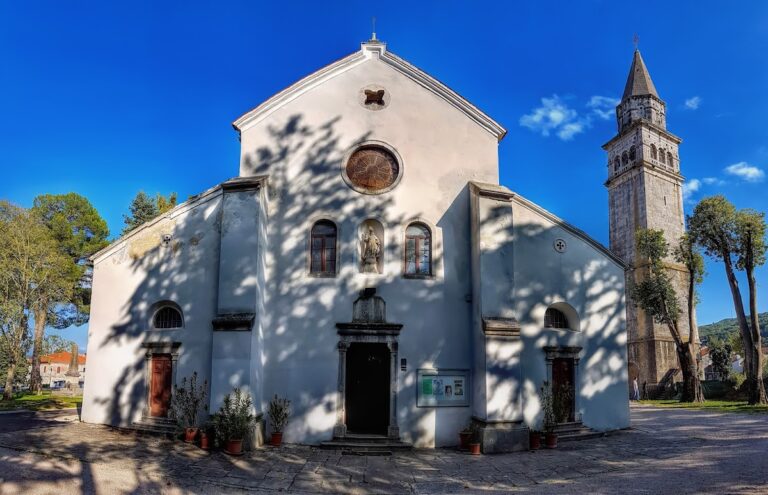
The church has an elongated plan, with a rectangular nave and a presbytery as wide as the nave. The nave is the principal longitudinal space used by the congregation, while the presbytery is the area surrounding the main altar. A portico, or covered entrance porch, stands before the doorway and has three arches beneath a timber roof structure. The bell tower contains a bifora, a window divided into two arched openings, and holds one bell. The church covers about 75 square metres.
Entrances and windows
The principal entrance is on the west side. Its red door ends in a semicircular curve, and a semicircular niche above it contains remnants of an image of the Virgin Mary. The side entrance is made from vertically placed monoliths within the wall, with horizontally laid stones above them. This arrangement is identified as Romanesque. Beside the side entrance, a holy-water basin carved from a single piece of limestone is built into the exterior wall.
The church receives light through round windows in the apse, two small windows at its sides, and additional openings in the west wall beside the main door. The openings also include narrow Gothic single-lancet windows and lunettes, semicircular openings or areas above doors or windows, above the apse. Inside, a round arch separates the nave from the presbytery, which contains a small altar. The floor is paved with rectangular limestone slabs, and the roof covering was remade with stone slabs during restoration.
Interior fresco cycle
The interior contains 46 Gothic frescoes from 1474. They comprise 38 larger figure compositions and eight smaller images, including three plant ornaments, a coat of arms, the Veil of Veronica, an inscription, and fragments. Together they cover about 75 square metres, extending across nearly all the nave walls and into smaller areas of the presbytery. The presbytery walls were originally painted throughout. The cycle is arranged in two horizontal rows on the south, north, and west walls, with further surviving images in the apse.
South wall scenes
The upper row on the south wall follows episodes from the life of Mary and the childhood of Christ. It includes the Birth of Mary, her Presentation in the Temple, her Betrothal, the Annunciation, the Visitation, the Nativity with the shepherds receiving the announcement, and the Presentation of Jesus in the Temple.
The lower row continues with the Massacre of the Innocents, the Flight into Egypt, Saint Sebastian, the Archangel Michael weighing souls, the twelve-year-old Jesus in the Temple, the Baptism of Jesus in the Jordan, Saint Florian, and Saint John the Evangelist. The order is not entirely chronological, since the Flight into Egypt would traditionally come before the Massacre of the Innocents. The reveals of the windows contain King David and a prophet above, with Saints Ursula and Catherine below. A window reveal is the inner side surface of an opening in a wall.
North wall scenes
The north wall includes the Adoration of the Magi and the Last Supper in its upper row. The Adoration extends for about 8 metres across six fields. In the Last Supper, Christ washes the feet of his disciples. The lower row presents the Temptation of Jesus in the Wilderness, Saint Apollonia, Saint Leonard, Saint Barbara, Saint Martin, Saint George, the Entry into Jerusalem, the Prayer on the Mount of Olives, and the Arrest of Jesus.
The Arrest includes Peter cutting off Malchus’s ear with a sword. The north window reveal contains the four Latin Church Fathers, Gregory the Great, Jerome, Augustine, and Ambrose. These influential Christian theologians shaped Western Latin Christianity through their writings.
Apse paintings
The cycle originally continued into the apse with scenes of Christ’s Passion and triumph. Surviving images on its north side include Saint Stephen and the prophets Moses, Elijah, and Daniel. Two saints remain on the south side. The vault probably carried the symbols of the four Evangelists and angels.
West wall and the Dance of Death
The west wall turns from biblical narrative to the briefness of human life. South of the entrance is the Fall of Man, while north of it is the Wheel of Life. More than half of both paintings was destroyed when windows were inserted. Above them, the Dance of Death stretches for about 7 metres. This artistic theme, also called the danse macabre, shows Death leading people from every social rank and expresses the idea that death overrides worldly status.
Skeletons lead a merchant, knight, cripple, child, innkeeper, queen, king, bishop, cardinal, and pope. The merchant points toward money on a table, hoping unsuccessfully to buy his release. A peasant does not appear, probably because of superstition, even though peasants were the church’s principal visitors. Musicians among the skeletons play a stringed instrument resembling a mandolin and wind instruments. Other figures carry a bow and arrows or a scythe, while Death plays a bagpipe above an open grave at the far right.
Style, space, and ornament
The paintings use a highly coloured palette and simple repeated ornaments. Stars in a daytime sky and decorations on garments were made with prepared stencils or stamps. Their style combines a direct, sometimes naive simplicity with elements drawn from popular art and the international Late Gothic.
Gothic idealism is especially apparent in representations of the Madonna. Late Gothic naturalism appears in Christ’s bloody sweat during the Prayer on the Mount of Olives and in the killing of the Innocents. Renaissance realism is particularly visible in the Flight into Egypt and in the procession of the dead. The pavement in the Saint Martin scene suggests an approach to perspective.
Most scenes use anachronism. Although the stories of Mary and Christ belong to the first century AD, figures other than Christ and the Apostles wear Late Gothic or Renaissance clothing, while medieval knights and buildings appear in the settings. Spatial depth is generally limited, although it is more evident in the Saint Martin scene. In the Flight into Egypt, three planes create an imperfect sense of depth: a foreground meadow with two pigs, a middle ground containing Mary and her companions, and a background landscape with two small towns. Elsewhere, projecting figures and objects, smaller distant figures, and repeated appearances of the same characters convey successive actions within one composition.
The Kiss of Judas is especially notable for figures and objects that break through the picture frame, giving the scene a satirical quality. The servant at the lower edge appears both pitiable and faintly ridiculous, while the formal kiss contrasts with the soldiers behind him.
The Adoration of the Magi
The large Adoration of the Magi provides a vivid contrast with the nearby Dance of Death. Riders in bright clothes, colourful hats, and flags travel on white horses through a flowering landscape, in opposition to the darker procession of the dead. The cavalcade also contains hunting scenes and animal fables, including the Fox and the Rooster and the Fox and the Stork. Glagolitic inscriptions, written in a medieval Slavic alphabet used for religious texts in parts of the eastern Adriatic region, are also present in the church.
Nearby sites