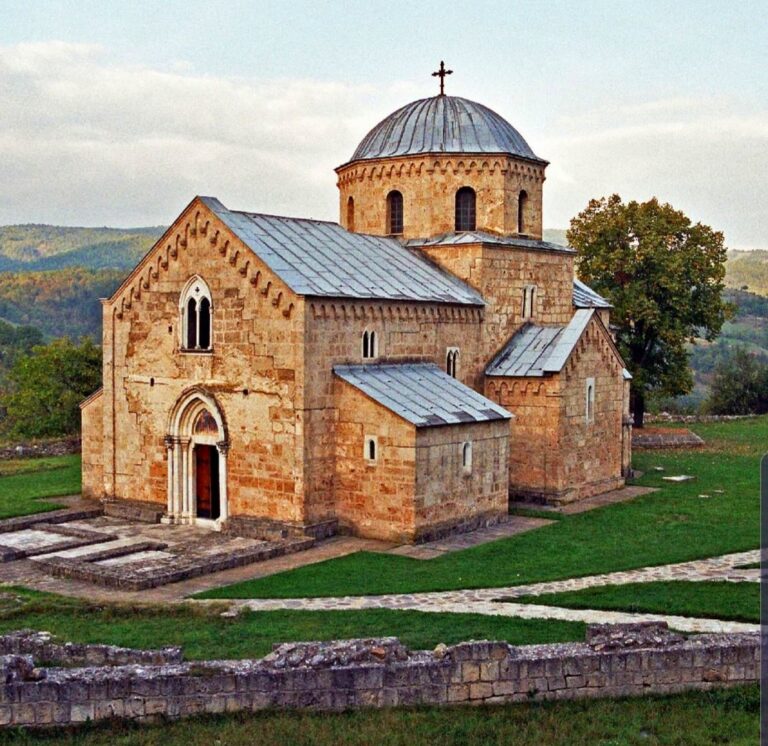
Church of Saint Apostles Peter and Paul: Episcopal Seat at Ras, Serbia


Site at a Glance
- Rating
- 4.9
- Popularity
- Medium
- Country
- Serbia
- Primary era
- Medieval
- Eras represented
- Medieval
- Civilizations
- Serbian
- Site type
- Religious
- Remains
- Cathedral
On this page9 sections
History
The Church of Saint Apostles Peter and Paul is the oldest surviving church in Serbia, standing at Ras near Novi Pazar in the country’s historic center of medieval Serbian power. Built in the early Byzantine period and commonly dated to around the ninth century, it became the original seat of the Eparchy of Ras, an Orthodox bishop’s administrative district, and served the political center of the Serbian Grand Principality.
Earlier foundations and the early medieval church
The precise foundation date remains uncertain. The present church is generally associated with the early Byzantine period and may have been built around AD 820 during the reign of Prince Radoslav of Serbia. Other interpretations have attributed its present form to the sixth century, while a seventh-century early Christian structure is reported on the same site. Repeated destruction and rebuilding left several construction phases within the building.
The church stands over an earlier princely burial mound from the fifth century BC. Excavations in the 1950s showed that the mound had been levelled when the church was constructed. The burial belonged to a high-ranking member of the local aristocracy. A seventeenth-century tradition instead attributed the church’s foundation to Titus, a disciple and associate of the Apostle Paul.
The early Rasian rulers substantially renewed the church, although the date of that work cannot be fixed precisely. Serbian ruler Mutimir is also associated with a restoration approximately six decades after the church’s construction. By the early tenth century, the building was an episcopal seat. A charter issued by Byzantine Emperor Basil II in 1020 names the Eparchy of Ras and identifies the Church of Saint Peter and Paul as its seat. During the tenth century, the eparchy was connected with the Bulgarian Church, although the circumstances and date of its foundation remain uncertain.
The Nemanjić period
Under the Nemanjić dynasty, the medieval Serbian ruling house that consolidated the state and its independent church, Peter’s Church became a baptismal church and a setting for state councils. It was one of the principal religious and political centers of the Serbian principality. Stefan Nemanja was baptized there according to the Orthodox rite and later married Ana at the church. Their sons, Rastko and Stefan Nemanjić, were also baptized there.
Stefan Nemanja held a council at the church to condemn and suppress the Bogumil movement, a medieval Christian movement regarded as heretical by the established Orthodox Church. On 25 March 1196, before the nobility, he transferred the throne to Stefan Nemanjić at Peter’s Church. The bishop of Ras then tonsured Nemanja and his wife Ana as monastics.
After Serbian ecclesiastical independence was established in 1219, Sava Nemanjić became the first archbishop of the independent Serbian Church, with his seat at Žiča. The Eparchy of Ras remained based at Peter’s Church. Its prominence gradually declined as larger ecclesiastical foundations, including Sopoćani, Đurđevi Stupovi, and Studenica, were established nearby.
Ottoman and modern transformations
By 1455, the church held metropolitan status, meaning that it was the center of a higher-ranking ecclesiastical jurisdiction headed by a metropolitan. It continued functioning after the Ottoman conquest and remained active through the sixteenth and seventeenth centuries, when nearby Novi Pazar grew as a commercial center.
The church was damaged in 1690 and restored in 1728 by Metropolitan Arsenije IV Jovanović Šakabenta. It retained metropolitan status during the eighteenth century, but after 1784 the Eparchy of Ras was incorporated into the Eparchy of Prizren. Extensions and repairs followed in the 1830s. Ottoman authorities later confiscated the church and converted it into a military storehouse or ammunition magazine. Its religious use was restored after the First Balkan War in 1912.
Extensive archaeological investigations took place in the 1950s, followed by conservation in 1960. Further excavations were conducted from 1984 to 1986 and continued in later years. The church and the wider Stari Ras and Sopoćani complex were added to the UNESCO World Heritage List in 1979 under criteria concerning artistic achievement and testimony to a cultural tradition. The church is also a Serbian Monument of Culture of Exceptional Importance. Restoration of the bell tower in the early twenty-first century enabled regular worship to be fully restored. On 6 April 2008, graffiti defaced the church walls; the perpetrator and motive were not officially established.
Remains
Plan and construction
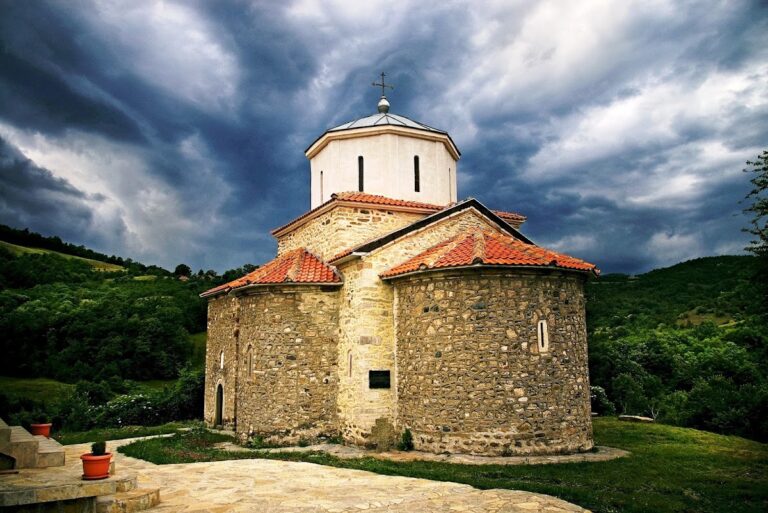
The church has a rotunda plan containing an inscribed quatrefoil. Four pilasters set diagonally within the building form a central cross-shaped composition. Conches, or curved recesses, of similar size project to the south, west, and north, while the eastern conch is deeper and contains the altar area.
An octagonal dome with unequal sides covers the central space. A ring-shaped gallery surrounds the dome on every side except the east, and the dome rises above it on squinches, structural devices that transfer a polygonal space to the circular base of a dome. The exterior walls are built of stone. Tufa, a light porous stone also known as siga, forms the inner gallery wall, gallery vaults, arches, dome drum, and dome shell. Shallow niches above the windows enliven the outside of the dome drum.
Earlier building phases
Earlier construction survives beneath and within the present church. The remains include a substantial circular foundation wall, foundations for a three-part opening toward the apse, one complete column, and parts of another column belonging to the altar arch. The columns between the conches probably supported an earlier circular dome.
The earlier design probably consisted of a circular central space surrounded by a passage. The church’s successive alterations and extensions produced its present distinctive composition. Its form and construction have parallels among early medieval monuments of the eastern Adriatic, Armenia, Georgia, and Italy, especially buildings dating from the seventh to the ninth centuries.
Fresco cycles
Four layers of fresco painting survive inside the church. Work in 1956 revealed approximately 114 square metres of paintings after plaster was removed from the interior surfaces. The oldest layer probably dates to the second half of the ninth century, while the other layers belong to the tenth, twelfth, and thirteenth centuries.
The badly damaged first layer remains in the dome drum, where four indistinct compositions appear against a yellow background. A figure of Christ in purple drapery occupies the north-eastern squinch, and further traces survive on the cubic base. The style has been associated with Carolingian painting and may reflect either a painter from Duklja or a provincial eastern painter.
The second layer, probably painted during the first decades of the tenth century, includes the Virgin Orans, shown in prayer with Christ in a medallion, together with fragments of apostles and two archangels. It also contains an image of the adoration of Christ as the Lamb. Saints Peter and Paul appear on the north and south pilasters beside the altar.
The twelfth-century layer includes the head of an archangel painted over an earlier image of the same subject behind the altar apse. In the north-eastern niche, a Byzantine-style image of the Archangel Michael appears with the bust of the prophet Aaron.
The best-preserved cycle dates from the thirteenth century. Christ Pantocrator, the Orthodox image of Christ as the all-ruling sovereign, occupies the dome with fourteen partly preserved figures, including four archangels and ten prophets. Inscriptions identify the Archangels Michael and Gabriel and the prophets Daniel and Elijah. A crowned figure beside Gabriel probably represents David.
Other thirteenth-century paintings include scenes of the Great Feasts above the windows, with a recognisable Palm Sunday scene and part of the Baptism of Christ. The Evangelists Matthew and John appear above the north-eastern and south-eastern pilasters. Further surviving figures include Christ, Saint Christopher, and Saint Ephrem the Syrian. The narthex, or entrance hall, contains Saint Nicholas and a fragment of the Dormition of the Virgin, the representation of Mary’s death and assumption into heavenly life.
Cemetery and burial finds
An Orthodox cemetery surrounds the church and contains gravestones from several periods. Low coffin-shaped monuments with outlines of human heads on their upper surfaces date from the twelfth and thirteenth centuries. Marble monuments associated with the Studenica school are especially numerous. Most are cross-shaped, while others are trapezoidal or rectangular.
Later gravestones, dating from the sixteenth to the nineteenth centuries, often combine representations of the deceased’s head with geometric or floral ornament. Earlier faces were carved as independent reliefs. In later examples, the ornament became increasingly stylised and eventually developed into purely geometric decoration drawn with a compass.
Excavation beneath the church uncovered a burial assemblage known as the Novi Pazar find, positioned near the center of the former mound. It includes gold ornaments, large engraved gold phalerae, which are round metal ornaments or ceremonial fittings, two belts made from hammered gold sheet, silver vessels, vases, glass and amber beads, and Greek pottery in the Black-Figure technique. This technique uses dark painted figures on the natural reddish surface of a vessel, with details incised into the paint.
The amber beads have forms and styles comparable to Greek sculpture of the seventh and sixth centuries BC. The gold belts and phalerae are characteristic of Illyrian jewellery. Together, the objects are interpreted as the grave inventory of a high-ranking local aristocrat from the fifth century BC. The finds are held by the National Museum in Belgrade.
Nearby sites