Castello Marchesale: A Norman Royal and Hunting Residence in Italy


Site at a Glance
- Rating
- 4.4
- Popularity
- Very Low
- Country
- Italy
- Primary era
- Medieval
- Eras represented
- Medieval
- Civilizations
- Kingdom of Sicily, Norman
- Site type
- Military
- Remains
- Castle
On this page7 sections
History
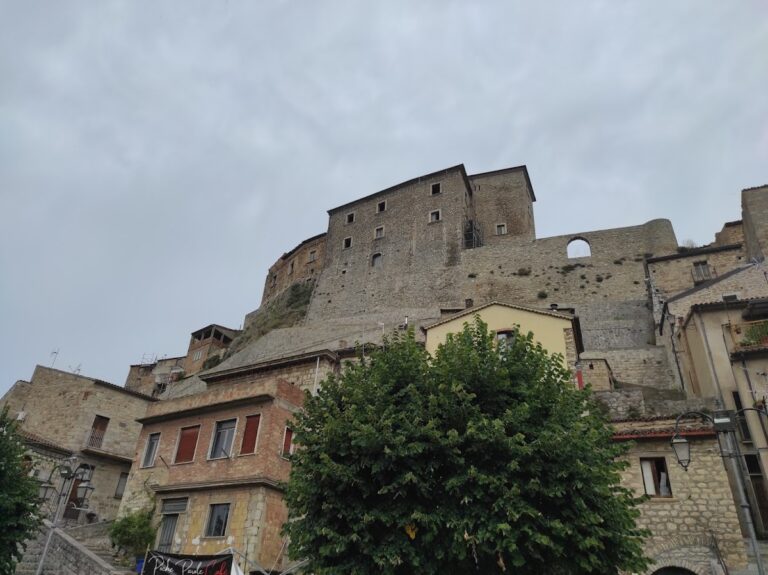
Castello Marchesale is a fortified medieval building in Palazzo San Gervasio, Italy, constructed by the Normans around 1050. Also known as Palatium Regium, or “Royal Palace,” it began as a rural residence for Norman princes and later became a retreat associated with the Hohenstaufen, the German dynasty that ruled the Kingdom of Sicily after the Norman period.
Norman foundation and the Santo Spirito settlement
The castle also served as a lookout and defensive position over a landscape rich in woodland and pasture. From there, the territory could be watched during conflicts involving Saracen groups active in nearby Apulia and Byzantine forces fighting the Normans. Small houses were later built around and beside the building for service personnel. Together, these dwellings formed the settlement that became known as Santo Spirito.
A small church dedicated to Gervasius, a Christian martyr and twin brother of Protasius, stood at the centre of Santo Spirito. Its foundation probably reflected the devotion of Lombards serving the Normans, although this attribution remains uncertain. The church appears in two papal bulls, formal documents issued by Pope Paschal II. The first, dated 22 May 1103, refers to the church of the martyrs Gervasius and Protasius at Bandusino spring near Venusia. A second bull, issued on 16 June 1106, placed it under the authority of the archbishop of Acerenza. The church had disappeared by the end of the sixteenth century.
Hohenstaufen adaptations
Emperor Frederick II, a thirteenth-century Hohenstaufen ruler and king of Sicily, almost certainly directed an extensive adaptation of the castle based on a design of his own. The building was first reshaped as a hunting residence and was then used for breeding Murgese horses, a breed associated with southern Italy, and Arabian horses favoured by Frederick. A magister aratiarum, an official responsible for supervising horse breeding, selected stallions for the elaborate processions of the imperial court.
Manfred’s residence
The castle saw more frequent use and gained greater renown under Manfred of Sicily, Frederick II’s son by Bianca Lancia. After Manfred’s victory at the Battle of Foggia in the summer of 1255, he remained at the castle for an extended period. He had withdrawn there with his retinue to recover from the demands of the war.
The site was valued for its healthy air, clear and plentiful water, nearby woodland, and hunting opportunities. Wild boar, deer, and fallow deer were found in the surrounding landscape. During his stay, Manfred became seriously ill, probably with bronchopneumonia, and came close to death. The surviving fabric of Castello Marchesale has since been restored.
Remains
The fortified building
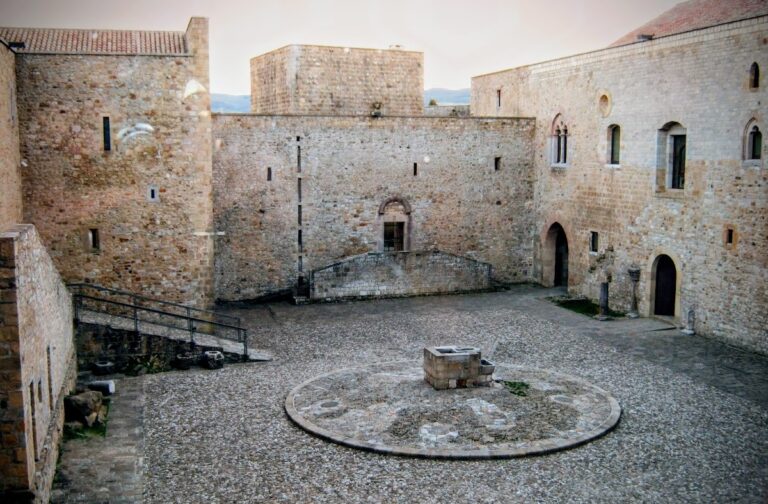
The original castle had a square plan, a form characteristic of Norman military buildings, with two large square towers placed at the sides. Both towers were later destroyed. The building was constructed in rubble stone, and its early design was subsequently altered completely.
The original elevation included four biforate windows, each divided into two openings, and a central triforate window divided into three. Together they were arranged in a form resembling a loggia, an open-sided gallery or balcony-like space. The windows were later blocked, but their outlines remain visible in the restored building.
Santo Spirito
The small houses built around and beside the castle created the later Santo Spirito settlement. Its central church, dedicated to Gervasius and Protasius, no longer survives. The church’s former existence and ecclesiastical connections are preserved through the papal records of 1103 and 1106.