King’s Manor: A Historic Administrative and Academic Building in York


Site at a Glance
- Rating
- 4.6
- Popularity
- Very Low
- Country
- United Kingdom
- Primary era
- Medieval
- External website
- Open
- Eras represented
- Medieval, Early Modern, Modern
- Civilizations
- British, English
- Site type
- Civic
- Remains
- Palace
On this page8 sections
History
King’s Manor is a historic building in York, United Kingdom, whose surviving fabric dates from the fifteenth century and whose site was associated with the abbots of St Mary’s Abbey from at least the eleventh century. It later became the seat of the Council of the North, a Tudor and Stuart body responsible for governing northern England for the Crown, before passing through several educational and university uses.
Abbey origins and royal administration
King’s Manor was first developed as a residence for the abbots of St Mary’s Abbey, a medieval Benedictine abbey in York. The abbots are believed to have occupied the site from the eleventh century, although the earliest surviving remains belong to the fifteenth century.
After Henry VIII’s government dissolved St Mary’s Abbey in 1539, the king ordered the building to become the seat of the Council of the North. King’s Manor continued in this administrative role until the council was abolished in 1641.
The building was used for a royal visit during the transition from Elizabeth I’s reign to that of James VI and I, who was king of Scotland as James VI and became king of England and Ireland as James I in 1603. Thomas Cecil, Lord Burghley, then President of the Council of the North, vacated the building and arranged supplies for the journey. James stayed at the Manor of St Mary’s from 16 to 19 April 1603, although the building had been unfurnished and in poor order before preparations were made.
Seventeenth-century changes
Thomas Wentworth, President of the North from 1628 to 1631, upgraded and embellished King’s Manor. His improvements included new doorways and coats of arms, adding visible marks of the building’s administrative status.
From 1667 to 1688, King’s Manor was the residence of the Governor of York. During the Glorious Revolution of 1688, the change of government that removed James II and brought William of Orange and Mary to the English throne, Governor Sir John Reresby remained loyal to James. An armed party led by Thomas Osborne, Earl of Danby, captured the manor and York for William of Orange.
School and university history
After 1688, private tenants leased the building until the nineteenth century. The Yorkshire School for the Blind then took over King’s Manor and expanded the complex. It constructed the Headmaster’s House in 1900.
The Blind School left in 1958, after which York City Council acquired King’s Manor. The council leased it to the University of York in 1963. Although the university later moved its main campus to Heslington, it continued to use the manor.
From 1966, the principal academic occupant was the Institute of Advanced Architectural Studies, a University of York institute devoted to advanced architectural research and study. The building also contained six university staff flats, while its Dining Room became an important meeting place for the university and the city, especially during the university’s early years.
After the institute closed in 1997, King’s Manor accommodated the University of York’s Department of Archaeology, including the Archaeology Data Service, together with the Centre for Medieval Studies and the Centre for Eighteenth Century Studies. In April 2022, several windows were broken in an incident of criminal damage, and blood found at the scene was presumed to have resulted from broken glass.
King’s Manor is a Grade I listed building, a designation in England for structures of exceptional architectural or historic interest. Its Grade I listing dates from 1954. In 2024, the University of York announced that it would leave the building by summer 2026 because of accessibility concerns and the high running and maintenance costs associated with its age. York St John University took over the site’s long-term leasehold on 20 July 2026, with plans for teaching and lecture spaces, public-facing Law and Business Clinics, business-incubation space, events facilities, and offices for up to 100 staff.
Remains
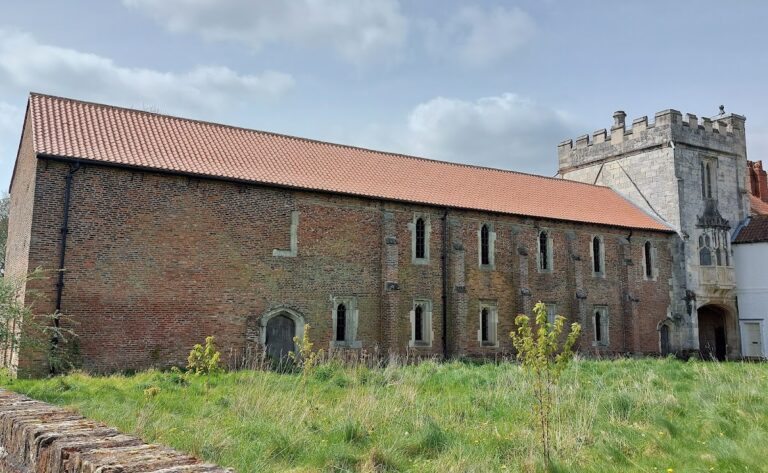
King’s Manor occupies a complex on Exhibition Square in York city centre. Its earliest surviving remains date from the fifteenth century, while later phases reflect its changing use as an abbey residence, an administrative building, a school, and a university facility. The complex includes the manor buildings, later additions made for the Yorkshire School for the Blind, and the Headmaster’s House constructed in 1900.
Manor buildings and university spaces
Early manor complex
The surviving manor complex incorporates the fifteenth-century remains associated with the former residence of the abbots of St Mary’s Abbey. Early-seventeenth-century alterations commissioned during Thomas Wentworth’s presidency included new doorways and coats of arms. Later university use included academic offices and facilities for archaeology, medieval studies, and eighteenth-century studies, as well as six staff flats and the Dining Room.
Headmaster’s House
The Yorkshire School for the Blind expanded King’s Manor during the nineteenth century and added the Headmaster’s House in 1900. The house now accommodates the University of York’s Centre for Medieval Studies, retaining the building’s connection with academic work within the wider complex.
Nearby sites