Manor in Niedźwiedź: a Neo-Renaissance Estate in Poland

Site at a Glance
- Rating
- 4.5
- Popularity
- Very Low
- Country
- Poland
- Primary era
- Modern
- Eras represented
- Modern
- Civilizations
- Kingdom of Prussia
- Site type
- Domestic
- Remains
- Manor House
On this page10 sections
History
The Manor in Niedźwiedź is a nineteenth-century Neo-Renaissance manor-and-park estate in Poland’s Kuyavian-Pomeranian Voivodeship. Jan Kucharski, heir of Niedźwiedź, began building the present manor during the second half of the nineteenth century and became its first owner.
The Kucharski and Mieczkowski families
From 1882, the estate belonged to Kucharski’s daughter, Zofia Mieczkowska, née Kucharska, and her husband Józef Mieczkowski. Zofia bore the Prawdzic coat of arms, while Józef bore the Zagłoba coat of arms. The Mieczkowski family lived at Niedźwiedź until 1939.
Jan Kucharski and Józef and Wacław Mieczkowski supported archaeology and the arts. Under their patronage, the estate developed one of the richer private art museums in the Chełmno region. Its collections were arranged in 12 rooms and included militaria, furniture from Oriental, English, Dutch, and French traditions, porcelain, and Italian and Polish paintings.
The museum and the Second World War
The collections were enlarged over time. Some objects came from Ciborz, including an old-weapons collection and an archaeological collection organized by Józef Mieczkowski. Works of art brought by Wacław Mieczkowski’s wife, Władysława Działowska of Działowo, added further depth to the holdings.
Before the Second World War, Wacław Mieczkowski opened the museum rooms to school groups and other excursions. During the war, the Niedźwiedź estate and museum appeared on a confiscation list. His identity card identified him as a Pole and the owner of a landed estate, which allowed him to remain at the manor.
Nationalization and protection
After the Second World War, the estate was nationalized, although Wacław Mieczkowski continued living in his home until his death. A state agricultural farm occupied the estate until 1986. In 1992, formal ownership passed to the State Agricultural Property Agency, a Polish institution responsible for managing agricultural estates nationalized after the war.
The manor entered the heritage register on 22 September 1960, followed by the park on 8 October 1984. The estate’s collections were valued for strengthening Polish national feeling during Prussian rule and for preserving archaeological evidence concerning the early history of the lands.
Remains
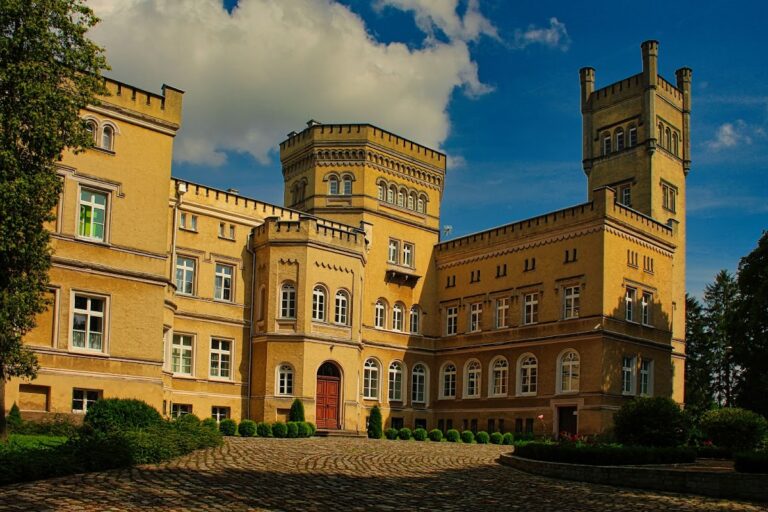
The estate combines a modestly decorated Neo-Renaissance manor with two side pavilions, service buildings, and a varied park and garden. The principal building is one storey high, with a garden-side projecting section and an entrance porch finished with a decorative balustrade.
Manor and service buildings
Principal manor
The manor’s exterior uses pilasters, which are shallow wall-attached imitations of columns, together with arched frames around round oculi, or eye-shaped openings. Sculptures in the form of bears’ heads provide distinctive decorative details. Pavilions stand on the eastern and western sides of the main building.
Kitchen outbuilding
A kitchen outbuilding is joined to the manor by a one-storey passage. Added at the end of the nineteenth century, it originally carried a slender Neo-Gothic turret that no longer survives. Neo-Gothic design revives medieval Gothic forms and details.
Park and garden
The grounds were arranged in several different styles. An English-style park included a pond, while a French-style garden, a rosarium devoted chiefly to roses, and a chestnut avenue leading to the manor formed other parts of the estate. Another area was designed to imitate a natural forest. A kitchen garden and an orchard were also situated near the manor.
Museum collection
The museum holdings included a fourteenth-century rosary associated with Saint Jadwiga of Anjou, a Polish monarch of that century, and Wounded Nymph, a sculpture by Georg Eberlein. Other works included sketches by Jan Matejko, a major nineteenth-century Polish historical painter, and Marcello Baciarelli’s portrait of Stanisław August Poniatowski in coronation dress. The collection also contained paintings by Kossak and Suchodolski, Tadeusz Kościuszko’s snuffbox, Jan III Sobieski’s sabre, Napoleon I’s bed, the armour of Milan I, King of Serbia, and the porcelain service of Prince Józef Poniatowski.
Thirty objects from Wacław Mieczkowski’s collection were loaned to a 1917 exhibition devoted to Tadeusz Kościuszko in Poznań. The holdings had also been repeatedly described and catalogued, preserving information about the estate’s artistic, military, and archaeological interests.
Nearby sites