Parigala: A Cliff-Cut Fortress in Azerbaijan


Site at a Glance
- Rating
- 4.4
- Popularity
- Very Low
- Country
- Azerbaijan
- Primary era
- Medieval
- External website
- Open
- Eras represented
- Classical, Medieval
- Civilizations
- Caucasian Albania, Sassanid
- Site type
- Military
- Remains
- Fort
On this page6 sections
History
Parigala is a cliff-cut fortress in Azerbaijan, near Yuxarı Çardaxlar in Zaqatala District. Its construction date and original builders remain uncertain. Proposed dates range from the third or fourth centuries to the twelfth or thirteenth centuries and the late fourteenth century. Interpretations connect it either with the Sasanian Empire, the Iranian dynasty that ruled much of the region from the third to the seventh century, or with Caucasian Albania, an ancient kingdom in the eastern Caucasus during the early Christian period.
Possible origins
One tradition places Parigala in the Sasanian period, specifically the fourth or fifth century. Another associates it with Caucasian Albania between the fourth and eighth centuries. The fortress may have served as a monastery or refuge for monks when Christianity was becoming established across the Caucasus. Wear on the limestone has also been understood as evidence of prolonged habitation. Archaeological research into the site remains limited, and its origins have not been firmly established.
Name and local traditions
The name Parigala means “Fairy Castle,” while Pari is also a woman’s name. A local legend tells of a woman called Pari who sought refuge in the fortress while fleeing foreign invaders and leapt from the cliff rather than surrender. Another tradition connects the site with the late fourteenth-century campaigns of Emir Timur, the Central Asian conqueror who founded the Timurid Empire. In this version, Pari commanded the defenders, resisted Timur’s forces for a prolonged period, and leapt from the cliff after the fortress was captured. The name “Pari Fortress” has also been tentatively linked with the eighth century, during the Arab conquests of the Caucasus. A grave once stood at the foot of the fortress but was later destroyed.
Interpretations of the nearby village name Chardakhlar have likewise been connected with Parigala. They associate it either with upper shelters or structures, or with a rock-top fire temple. Parigala is officially recognized as a nationally significant architectural monument.
Remains
Setting and structure
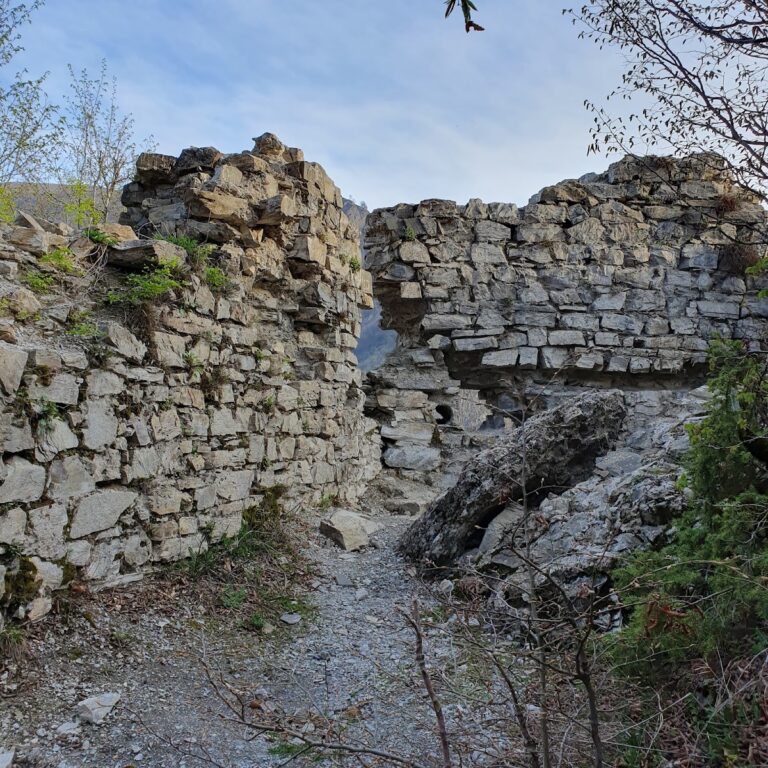
Parigala is carved into limestone on a steep mountain section in the Caucasus foothills, about 300 metres northwest of Yuxarı Çardaxlar. The fortress occupies approximately 30 square metres and stands around 150 to 200 metres above the ground. Its limestone-brick structure is cut directly into the mountain. Inside are three rooms and a window. The limestone surface shows wear associated with long habitation, while the main structure remains in relatively good repair.
Access and water supply
Approach to the fortress followed a path cut into the rock, approximately 1 to 1.5 metres wide, whose surviving sections can still be seen. The route is also described as a stairway about 40 metres long, reinforced with oak beams and accompanied by a covered walkway. Historical steps within the fortress later deteriorated, and the upper part of the stairway became separated from the rock, possibly because of an earthquake. Water channels were reportedly carried into the fortress through reed pipes. The access system is now more deteriorated than the rooms and main carved structure.
Nearby sites