Amberd: A Medieval Armenian Fortress on Mount Aragats


Site at a Glance
- Rating
- 4.8
- Popularity
- Low
- Country
- Armenia
- Primary era
- Medieval
- External website
- Open
- Eras represented
- Bronze Age, Iron Age, Medieval
- Civilizations
- Armenian, Urartian
- Site type
- Military
- Remains
- Castle
On this page13 sections
History
Amberd is a medieval Armenian fortress in Armenia, developed mainly during the tenth century as part of the fortified landscape of the Bagratuni period. It stands on a rocky site at the meeting of the Arkashen and Amberd rivers, overlooking the surrounding plain. The location had already been occupied during the Stone Age, while Bronze Age and Urartian communities built large stone structures and placed vishap stones, prehistoric monuments associated with springs and water, near the local sources.
Early Stronghold and Bagratuni Rule
Amberd remained an active military stronghold during the Hellenistic period. The earliest fortress layers are generally associated with the Kamsarakan noble family in the seventh century, although the principal configuration that survives is also described as a tenth-century fortress. During the ninth to eleventh centuries, the eastern entrance was restored and heavily fortified. It had earlier served as an unfortified summer residence. Popular tradition connects the wider defensive program with King Ashot II Yerkat, known as “the Iron,” but the claim that Amberd itself served as a royal summer residence remains uncertain.
In 1020, King Gagik I Bagratuni divided his kingdom among his sons. Hovhannes-Smbat received Ani, the Ararat Plain, Shirak, and Amberd. The Bagratuni dynasty was the Armenian royal house that ruled much of Armenia during the medieval period and developed networks of fortified sites for regional defense. During the tenth century, the Bagratuni kings transferred Amberd to the Pahlavuni princes.
Under Vahram Pahlavuni, an Armenian prince and military leader, Amberd became a major center in the defensive system of Shirak and the kingdom of Ani. Vahram rebuilt its walls, added thicker stone defenses, and established the castle church in 1026. Three bastions were constructed along the ridge of the Arkashen gorge. Around 1040 to 1050, Grigor Magistros Pahlavuni stayed at Amberd while carrying out an assignment for King Gagik II, and Sargis Vardapet, an Armenian Christian cleric with a learned theological or teaching role, visited him there. Vahram Pahlavuni and his son Grigor died in battle near Dvin in 1045.
Seljuk Conquest and Zakarian Restoration
After the emir Shaddadid seized Amberd, Byzantine forces captured it around 1050. The Seljuk ruler Alp Arslan reconquered the fortress in 1064 and partially destroyed it. Seljuk forces later used Amberd as a military base during the eleventh century.
In 1196, the brothers Ivane and Zakare Zakarian liberated Amberd from Seljuk rule, together with Ani and other regional cities. The Zakarian family restored and completed the fortress during the twelfth century. Because of its stronger defensive position, the archbishop’s see was transferred from Byurakan to Amberd. Zakare Sipahsalar, general of the Georgian and Armenian armies, was commemorated for the liberation by a khachkar, an Armenian cross-stone raised to mark religious or historical events, at Norashen Church in Iraklou.
Vachutian Residence and Decline
In 1215, Vache Vachutyan purchased Amberd from Ivane Zakarian. The fortress then became a principal defensive center and, later, the dynastic residence of the Vachutian family. Vache was appointed governor of Aragatsotn and Amberd by Zakare Sipahsalar. In 1254, King Hethum of Armenian Cilicia stayed at Amberd as the guest of Kurd II Vachutyan while traveling to the Mongol khan’s court to negotiate an alliance.
The Mongols conquered and nearly demolished Amberd in 1236. The Vachutians partially rebuilt it in the late thirteenth century and continued to use it as their family residence, while religious authorities were based at Hovhannavank. A manuscript from 1335 describes Prince Kurd, the son of Tayir and grandson of Kurd, defending the region against enemy incursions and helping it prosper peacefully. Inscriptions from 1338 commemorate Theodoros Chrkin, son of Prince Kurd, at Karbi Church and Hovhannavank.
The Vachutian family disappears from the documentary record during the fourteenth century. Amberd was abandoned and gradually fell into ruin between about 1300 and 1350, although people from the plain continued to use it periodically as a refuge during times of danger. A seventeenth-century reference later names Davit Kanakertsi as governor of Kote and Amberd under the Persian governor of Yerevan.
Archaeological Investigation and Preservation
Archaeological investigation began in 1936 through cooperation between the Hermitage Museum and the Academy of Sciences of Soviet Armenia, directed by Joseph Orbeli. Further surveys and excavations took place from 1963 to 1968 through the Archaeological and Ethnographic Institute of Soviet Armenia. These campaigns revealed additional fortress structures, domestic and service buildings, sections of Bagratuni and Zakarian walls, the oldest entrance, and many other remains. N. M. Tokarski proposed that some sections and walls belonged to the seventh-century Kamsarakan phase.
Amberd was included by Europa Nostra in 2024 among the seven most endangered European monuments and heritage sites. Its buildings remain vulnerable to collapse because of age, erosion, earthquakes, and inadequate funding for structural reinforcement.
Remains
Amberd occupies approximately 1,500 square metres at an elevation of about 2,300 metres on the slopes of Mount Aragats, where the Arkashen and Amberd rivers meet. The fortress was placed on difficult rocky terrain between the two rivers and formed part of a defensive system overlooking the plain. Roughly hewn basalt blocks set in mortar form the surviving walls. Large sections of the fortifications, the castle, the bathhouse, and the church remain substantially intact, although deterioration threatens the complex.
Fortifications and Castle
Walls, Towers, and Entrances
The defensive walls follow the rocky ridge, with three bastions along the Arkashen gorge. The tower walls slope inward in a form thought to have helped defenders fire at attackers below. Medieval rebuilding strengthened the eastern entrance, while excavations in 1968 uncovered the oldest known entrance north of the church, along with sections of the southern fortress wall and connected buildings. Excavation also exposed Bagratuni-period and later Zakarian sections within the outer fortified wall.
Interior Rooms
The castle interior had three storeys, separated by wooden planks fastened over logs. Five rooms on each of the first two floors were arranged in a row, with access passing from one room through the preceding room. An irregular entrance hall was divided from three interior rooms by an internal wall. Reception spaces and private rooms for royal or noble residents occupied the third storey. The arrangement is thought to have remained substantially unchanged since the fortress’s principal tenth-century construction phase.
Excavations indicate that the interior was richly furnished. Carved decoration, oil lamps, incense holders, silk and brocade wall coverings, and bronze, gold, and silver ornaments formed part of its furnishings and decoration. The 1963 survey also exposed foundations of houses, workshops, and service rooms in the upper part of the fortress.
Water System
Amberd’s main water supply used a terracotta pipeline extending approximately 4 to 5 kilometres from the fortress to dammed reservoirs. The reservoirs gathered spring water from higher elevations and meltwater from snow. A separate and more concealed route offered an alternative during an attack. A covered passage ran from the fortifications down a steep path through a cleft in the rocks to the Arkashen River.
Bathhouse and Church
Bathhouse
A bathhouse south of the fortress was built between the tenth and eleventh centuries and remains moderately intact. It contained two bathing rooms, each covered by a single dome. Its heating system used a hypocaust, an arrangement in which fire heats air beneath floors or inside wall channels. Fires under the floors warmed pipes running through the floors and walls, while metal pipes supplied hot water. Work in 1936 uncovered rooms connected with the bathhouse and a water cistern between the fortress walls.
Vahramashen Church
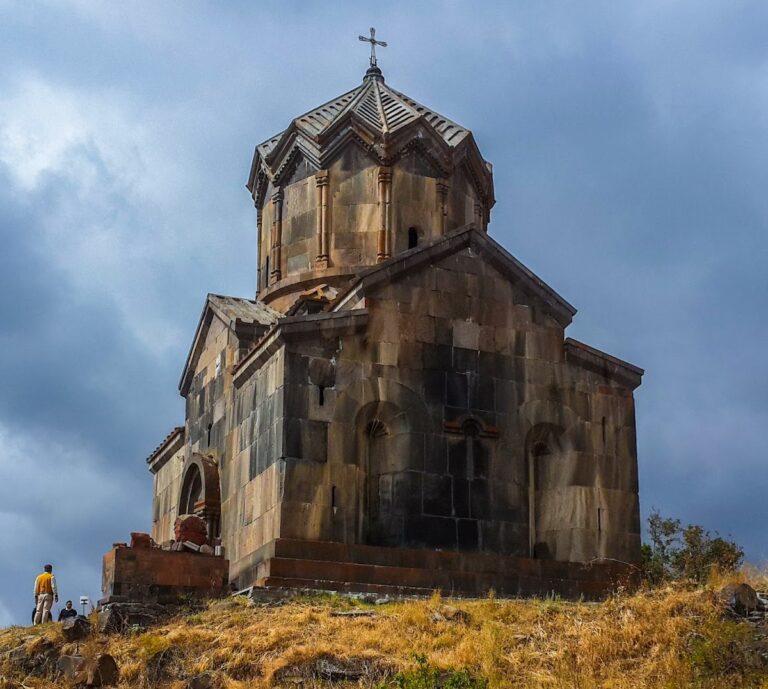
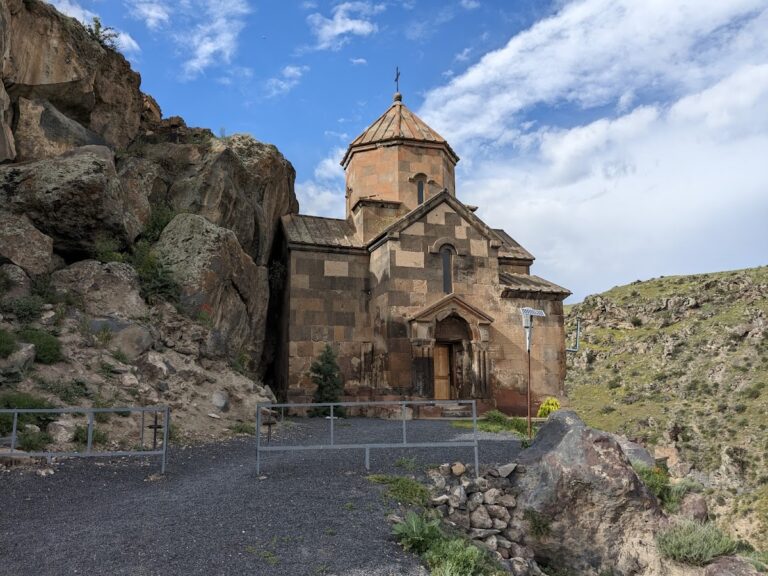
The nearby Armenian church Vahramashen was built by Vahram Pahlavuni in 1026. The church is associated with the medieval rebuilding of Amberd, although the name Amberd is sometimes incorrectly applied to the building itself. Excavations between 1965 and 1968 exposed its northern part and the foundations of Bagratuni-period buildings. The grounds around the church were cleared in 1966, and a plastered building was uncovered approximately 100 metres to its north.
Nearby sites