Kaffa Genoese Fortress: Citadel of a Black Sea Trading Colony


Site at a Glance
- Rating
- 4.5
- Popularity
- Medium
- Country
- Ukraine
- Primary era
- Medieval
- Eras represented
- Medieval, Early Modern
- Civilizations
- Armenian, Genoese, Golden Horde
- Site type
- Military
- Remains
- Citadel
On this page9 sections
History
Kaffa Genoese Fortress is a medieval Genoese fortress in Feodosia, Ukraine, built to protect Caffa, a fortified trading colony established by the Republic of Genoa in 1266. The city occupied a major logistical junction between Asian and Mediterranean markets and later became Genoa’s principal commercial port on the Black Sea. Its name, Caffa, was the medieval Genoese name for Feodosia.
Foundation and Genoese Expansion
Genoa established Caffa with the agreement of the Mongol khans Möngke and Berké. At that time, Crimea was controlled by the Golden Horde, the western division of the Mongol Empire. The colony served both as a trading settlement and as a fortified base within a wider network of Genoese ports and commercial posts.
The Genoese were expelled from Caffa by Khan Toqtaï in 1308, but returned in 1316 under Özbeg. Their restoration was connected with Genoa’s support for the Golden Horde’s commercial route toward the Ilkhanate, another Mongol realm. Caffa then expanded through the fourteenth and fifteenth centuries. By the late thirteenth century, the city also had a substantial Armenian community. In 1316, Armenian residents were assigned an area beyond the southern walls, later known as the Quarantine district, and they took an active part in building the city’s defenses. An Armenian bishop also constructed a water-supply system for Caffa in the early fourteenth century.
The Citadel and the Siege of Caffa
The Genoese built the citadel around Quarantine Hill between 1340 and 1343 to defend their largest possession in Crimea. Work continued for approximately another decade. A citadel was the fortified core of a larger settlement, providing a stronger defensive and administrative center than the surrounding city.
Khan Djanibeg besieged Caffa from 1343 to 1346. Disease spread among the Mongol forces, and infected corpses were reportedly thrown over the walls by catapults. An older theory connected this episode with the later spread of plague to Genoa and Europe, but that explanation remains uncertain.
Caffa as a Commercial Center
During the fifteenth century, Caffa remained an important commercial center. Its population is estimated at approximately 70,000, and its port could receive more than 200 ships. The Ottoman capture of Constantinople in 1453 weakened Genoese control of Black Sea trade.
In 1475, after the Ottoman conquest of the Principality of Theodoro, the Genoese abandoned Caffa and their other Crimean and Black Sea colonies. This ended Genoese rule in the region. Crimea subsequently remained within the Ottoman Empire until its annexation by Russia in 1783.
Later Preservation
Most of the fortress structures were dismantled during the nineteenth century. The surviving citadel, sections of the wider urban fortifications, and associated religious and civic buildings are preserved as the Kaffa Genoese Fortress historical and architectural reserve. The complex is listed as a nationally significant cultural monument in Ukraine and as a federal-level cultural heritage site in Russia.
Remains
Citadel on Quarantine Hill
The fortress consisted of two defensive lines, an inner citadel and the outer walls of the city. Together they formed an amphitheater-shaped plan facing the Bay of Feodosia. The citadel occupied Quarantine Hill, where steep slopes toward the sea strengthened the defenses. Its limestone walls were laid in lime mortar with carefully smoothed joints. Building material came from exposed rock on nearby mountain slopes and from the seabed.
The citadel walls originally extended for 718 metres, stood about 11 metres high, and were approximately 2 metres thick. Around 469 metres survive. The preserved masonry contains traces of several construction phases, and some sections retain indications of fighting platforms. The citadel had twelve towers and six gates. The southern wall includes the Tower of Saint Clement and the Crisco Tower, while part of the western wall and the gate pylons also remain.
Within the citadel were the consular palace, treasury, residence of the Latin bishop, and courthouse. The Latin bishop belonged to the Roman Catholic church tradition. A balcony on the courthouse served for announcing consular decrees, while other spaces housed offices for checking weights, warehouses, and shops dealing in valuable goods such as precious stones, furs, and silk. Genoese consuls were colonial officials with administrative and judicial authority in overseas trading settlements.
Outer City Fortifications
The outer defensive circuit had a perimeter of nearly 5.5 kilometres and included more than thirty towers. Individual towers were named either for the consul under whom they were built or for a pope. The system also included landing places and a deep, water-filled moat. Besides strengthening the defenses, the moat separated Caffa from the mountain slopes and carried stormwater toward the sea.
Walls extended from Constantine Tower southward and eastward. The southern line curved around the city toward Mount Mithridates, then continued toward the citadel and eastward to Dock Tower. Thomas Tower survives at the southern end of this line. Constantine Tower, which protected the city’s northernmost point, dates from 1382 to 1448. Thomas Tower dates to 1373, while the Tower of Consul Giovanni di Scaffa dates to 1342 and stands south of the citadel. These towers survive in different parts of the modern city.
East of the citadel, surviving wall sections and the moat are accompanied by the remains of a corner tower and a bastion, a projecting gun platform. The preserved walls and towers are distributed through the urban area, including sections of the sea defenses and the approaches around the citadel.
Churches and Civic Features
Several associated structures survive near the citadel. They include a Genoese bridge, a Turkish bath dating from the fifteenth or sixteenth century, and an Armenian fountain dated to 1491. These remains reflect the civic infrastructure and the mixed communities that shaped medieval Caffa.
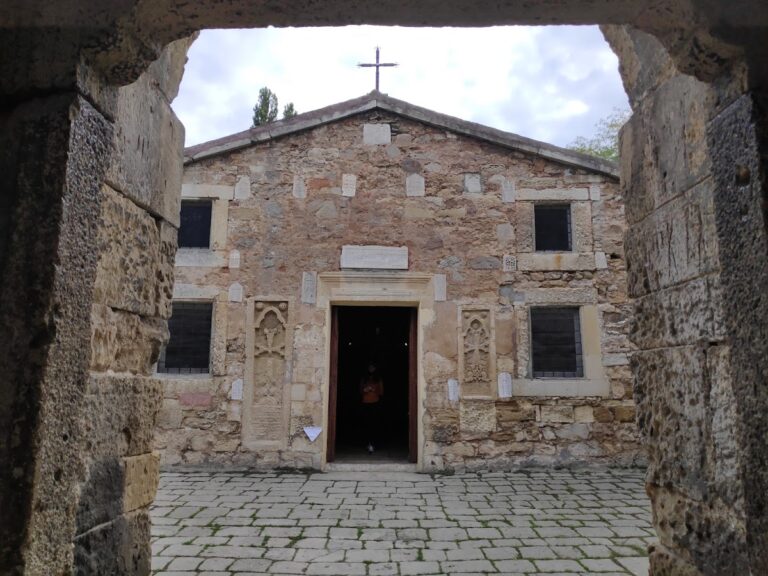
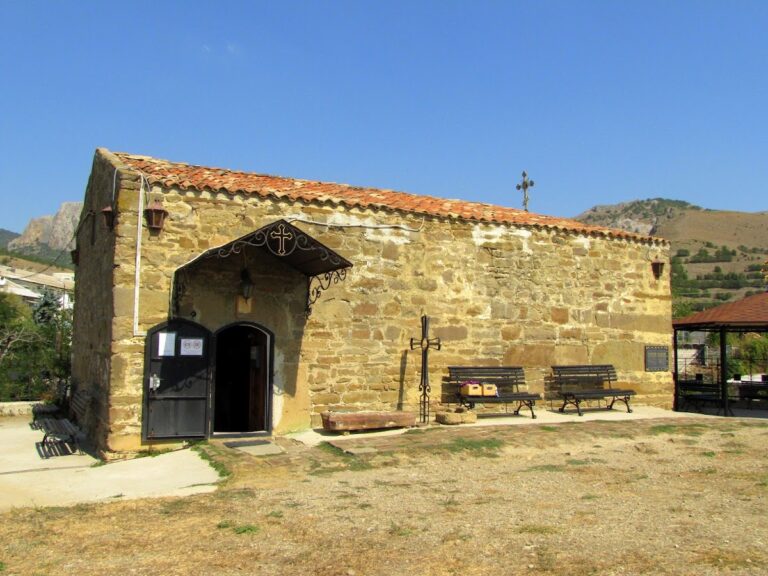
Religious buildings associated with the fortress complex include the Church of John the Baptist, dated to 1348, and the fourteenth-century churches of Saint John the Theologian and Saint George. The Church of Saint Stephen, associated also with Demetrius of Thessaloniki, dates to the thirteenth or fourteenth century and survives as ruins.
Other churches in the monument complex include the Church of Saint Demetrius, the Church of Sergius, and the Church of Gabriel and Michael, dated to 1408. Another Church of Saint George dates to 1385. These buildings stand in districts surrounding the former city fortifications, extending the surviving archaeological and architectural evidence beyond the citadel itself.