St. Sarkis Church in Feodosia: A Medieval Armenian Church and Cultural Center


Site at a Glance
- Rating
- 4.8
- Popularity
- Low
- Country
- Ukraine
- Primary era
- Medieval
- Eras represented
- Medieval, Modern
- Civilizations
- Armenian, Genoese, Russian
- Site type
- Religious
- Remains
- Church
On this page7 sections
History
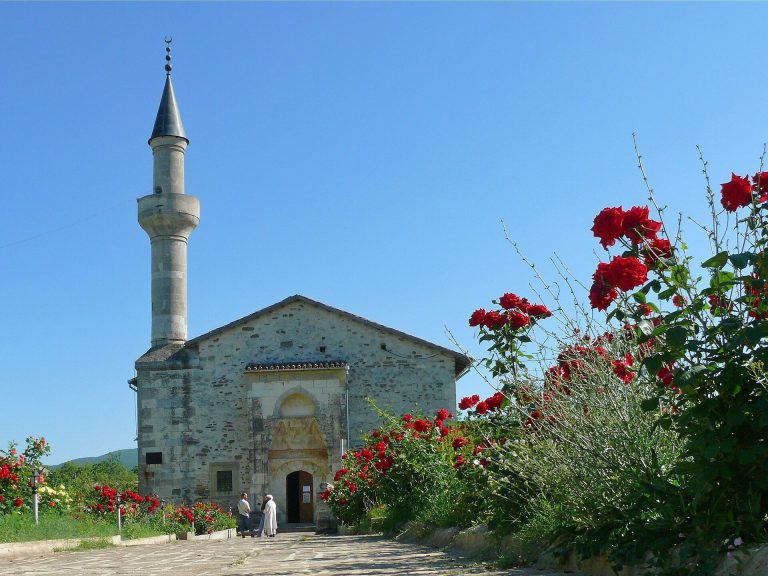
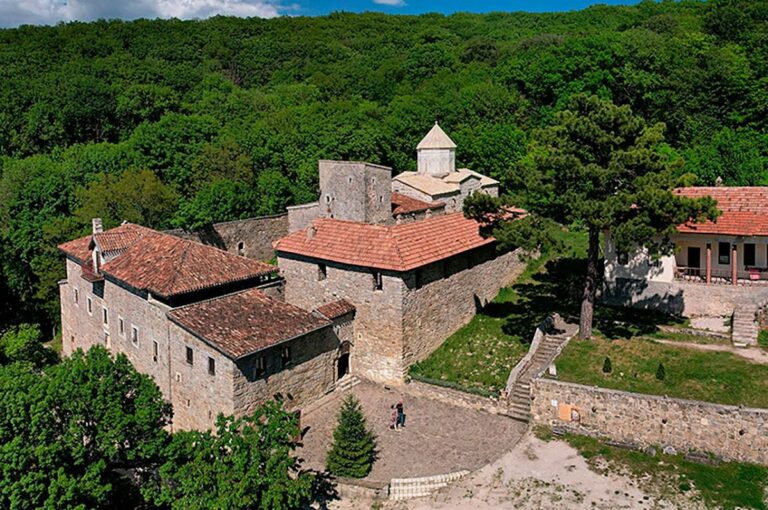
St. Sarkis Church is a medieval Armenian church in Feodosia, Ukraine, traditionally regarded as the city’s oldest Armenian church. Built by the Armenian-Gregorian community, a historical designation for Armenian Christians associated with the Armenian Apostolic Church, it belongs to that church and is associated with the Russian and New Nakhichevan Diocese. The church was established within Feodosia’s city citadel during the fourteenth century, although its exact construction date is uncertain. It is first mentioned in 1361.
Medieval Armenian scholarship
From the fourteenth through the sixteenth centuries, St. Sarkis was a center of Armenian learning and culture. One of the largest Armenian scriptoria of its period operated there. A scriptorium was a workshop for copying and producing manuscripts, and the activity at St. Sarkis supported calligraphy, illumination, scholarly writing, and book decoration. Artists, philosophers, poets, and historians connected with this work included Simeon Baberdetsi, Stepanos Karnetsi, Avetis, Arakel, Kristosatur, and Avraments.
Manuscripts produced at the church are now preserved in the National Library of France in Paris, the libraries of the Armenian Patriarchate in Jerusalem, the libraries of the Armenian Mekhitarists in Vienna, and the Matenadaran in Yerevan, a major repository and research institution for ancient Armenian manuscripts. The Matenadaran collections include 29 manuscripts signed by Nikogaios Tsakhkarar, who died in 1693, an eighteenth-century poem by Martiros Krymetsi titled The History of the Land of Crimea, and a handwritten Gospel dated 1649.
Fire, restoration, and Aivazovsky
In 1811, when the Feodosia Museum of Antiquities was founded, inscribed stone slabs began to accumulate at St. Sarkis. They later formed the basis of the museum’s lapidarium, a collection of important stone fragments. After flooding affected the church in autumn 1986, the slabs were transferred to the museum’s main premises.
A fire damaged St. Sarkis in 1888. The church was repaired with money supplied by its parishioner Ivan Aivazovsky, the nineteenth-century Armenian-Russian Romantic marine painter, who also painted inside the building. Aivazovsky was baptized at St. Sarkis in 1817, married there, and received his funeral service there. He was buried within the church enclosure in 1900, and his will left 50,000 rubles to the church and its parish school.
The church underwent restoration from 1965 to 1970 under Soviet rule. In 1970, residential construction on adjacent land damaged the old drainage system. Groundwater then flooded the building and destroyed the surviving fresco painting. Another restoration campaign began in the late 1980s and was still continuing in 2015. St. Sarkis remains an active place of worship and has national-level architectural-heritage status in Ukraine and federal-level cultural-heritage status in Russia.
On 26 December 2023, a missile attack on the Feodosia naval port damaged the church through its blast wave. Several stained-glass windows were broken.
Remains
Church plan and construction
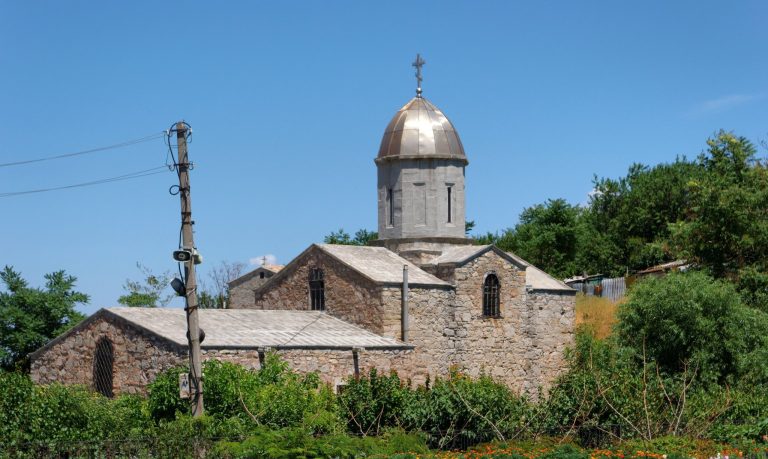
Repeated alterations and reconstructions have given St. Sarkis a complex interior plan and an intricate three-dimensional arrangement. Its central section is rectangular and contains three semicircular apses, recessed spaces commonly used at the liturgical eastern end of a church. The altar faces east, while a broad western arch opens into a rectangular narthex, or entrance vestibule. A northern adjoining room combines a smaller square section with a larger trapezoidal one.
Most of the church is covered by semicircular vaults carried on transverse arches. The square northern room has a ribbed vault instead. The walls consist of large limestone blocks whose joints were carefully smoothed or filled. Marble and limestone khachkars, carved Armenian stones bearing crosses and ornamental relief, are set into both the exterior and interior walls, and some are considerably older than the church. A tiled gabled roof covers the building.
Entrance and bell tower
The entrance is framed by two Armenian crosses and topped by a commemorative slab. Its inscription describes the rebuilding after the 1888 fire with funds supplied by Aivazovsky. The old walnut doors were divided into two sections; these are now held in the exhibition halls of the Hermitage and the Feodosia Museum of Local History.
A bell tower stands in front of the church. It was installed during the 1888 reconstruction within the surviving part of an entrance portal that had once formed a single structure with the church. The portal dates from the fifteenth century and follows an Armenian–Asia Minor architectural style. Designed as a kiosk-like ciborium, a canopy supported by columns, it has four massive columns joined by pointed arches and covered by a cross vault. Carved rosettes on the north and south friezes are linked into continuous bands.
Interior and burial ground
The interior was originally decorated with frescoes. Fragments that survived into the twentieth century were destroyed by groundwater flooding in 1970. A stone-carved baptismal font remains in the altar area.
The church enclosure and surrounding burial ground preserve the remains of prominent members of Feodosia’s Armenian community, whose burials beside the church began in the medieval period. The site includes the grave monument of the seventeenth-century miniaturist Nikogaios Tsakhkarar and the crypts of Ivan Aivazovsky and his wife, Anna Nikitichna, who died in 1944.