Burg Hossingen: A Medieval Spur Castle in Germany


Site at a Glance
- Rating
- 3.7
- Popularity
- Very Low
- Country
- Germany
- Primary era
- Medieval
- Eras represented
- Medieval, Early Modern
- Civilizations
- Duchy of Württemberg, Holy Roman Empire
- Site type
- Military
- Remains
- Castle
On this page10 sections
History
Burg Hossingen is a medieval spur castle in Germany, near Hossingen, now part of Meßstetten in Baden-Württemberg. Built during the first half of the twelfth century, it used the projecting ridge of a hilltop as a defensive position. The castle belonged to a network of fortifications connected with local noble lordships and protected routes and strategic crossings in the southern part of Württemberg.
Origins and Hohenberg Service
The castle lords were ministeriales of the Counts of Hohenberg. A ministerialis was a medieval service noble who performed administrative, military, or judicial duties for a more powerful lord. The nearby field names Hossenbühl and Hossenhalde preserve the association with the Hossingen ministerial family.
A record from the middle of the twelfth century mentions Richard of Dotternhausen and his sister Rilinda of Husingin. Albert der Hosse appears in documents from 1296 and 1306. He may have been the same person as Albrecht of Ozingen, identified with Hossingen, who appears in a document of 1311. These references connect the castle and its surrounding settlement with a family active in the local nobility.
Hohenberg and Tierberg Lordship
The ownership history is not completely clear. During the fourteenth century, Burg Hossingen belonged to the County of Hohenberg, a medieval comital territory in southwestern Germany. In 1345 and 1347, Hossingen, Tieringen, and Meßstetten were sold to Heinrich von Tierberg. The castle then became part of the Haiterbach line of the Lords of Tierberg.
The Tierbergs held both high and low judicial rights and became the local lords. Their several castles formed a connected territorial and defensive network in the southwestern Swabian Alb. Burg Hossingen belonged to this group of fortifications, which also included Meßstetten, Wildentierberg, Neuentierberg, and Altentierberg. Until the twentieth century, Gräbelesberg was also counted among the castles associated with Hossingen.
In 1418, Konrad von Hölstein sold Tieringen, Meßstetten, and Hossingen to Württemberg, a neighboring southwestern German territory that later became a duchy. He retained his house in Tieringen, but the sale transferred the wider territorial connection to Württemberg.
Defensive and Economic Functions
Burg Hossingen served as a forward defensive work within the Tierberg lordship. Its position was linked with historic routes running between Meßstetten, Hossingen, Oberdigisheim, the Lochen Pass, and the approaches to the Danube. From at least 1521, compulsory local militia guarded the castle and its associated barriers. A muster list from 1603 assigned troops from Meßstetten and Hossingen to secure obstructed defensive works at both places.
The castle’s lordly economy included farming and livestock raising. A land register from 1560 lists compulsory, unpaid transport of boards and building materials to the Schalksburg, together with duties connected with feeding the lords’ dogs. Duke Christoph converted these labor services into a tax in 1557. A road from Meßstetten to the castle was recorded in 1565, showing that the site remained connected with the surrounding settlement and its obligations.
Chapel and Religious Change
The castle chapel belonged, like Hossingen’s Chapel of St. Nicholas, to the parish of St. Martin’s Church in Ebingen until the Reformation. The inhabitants of Hossingen were historically subject to that parish. By 1564, however, a priest from Meßstetten was serving them, reflecting a change in the local organization of religious life.
War, Demolition, and Later Investigation
Oral tradition associates damage to the castle and its defensive works with the Peasants’ War of 1525, a widespread uprising that challenged lordly authority in parts of the German lands. During the Thirty Years’ War, the major seventeenth-century European conflict, fighting and troop movements affected nearby settlements. In the course of that war, the castle complex was completely demolished.
During the War of the Spanish Succession, an early eighteenth-century dynastic conflict that affected southwestern Germany, the defensive works at Hossingen were strengthened as part of a wider Württemberg line. Orders came from Duke Eberhard Ludwig, Field Marshal von Thüngen, and Prince Meinrad II of Hohenzollern-Sigmaringen. The work was completed in April 1704, but the defensive line did not prevent the Bavarian-French army from advancing into Tuttlingen.
Archaeological investigation began in 1916, when the teacher Bach and his pupils exposed parts of the foundations. Konrad Albert Koch recorded the excavation and prepared a complete artistic reconstruction drawing. From 2008, the measurements were repeated with greater precision and digitized by a team led by Franz Josef Häring. In 2017, the city of Meßstetten commissioned archival research from the University of Tübingen. These investigations shaped the modern understanding and presentation of the castle site.
Local legends connect the ruins with a vanished settlement called Wangen, a secret passage to a pleasure garden, and the ghostly Schimmelreiter, or white horseman. These stories belong to local tradition rather than confirmed historical events.
Remains
Hilltop Layout
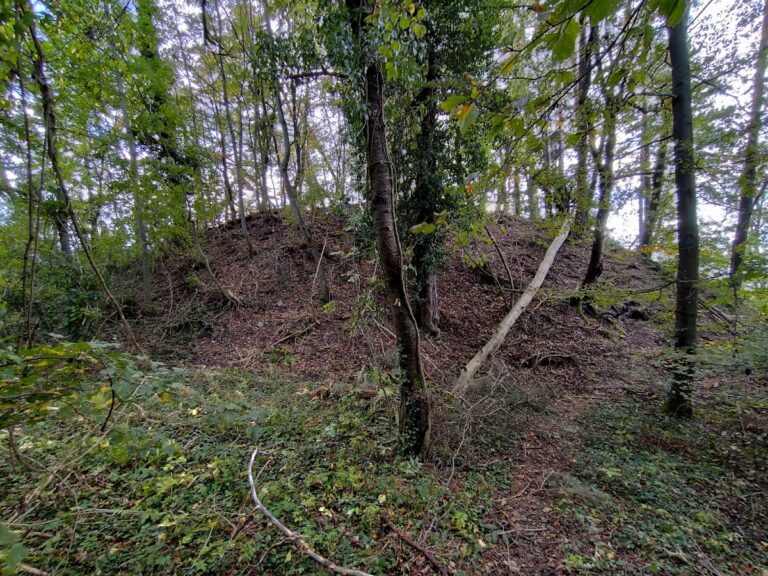
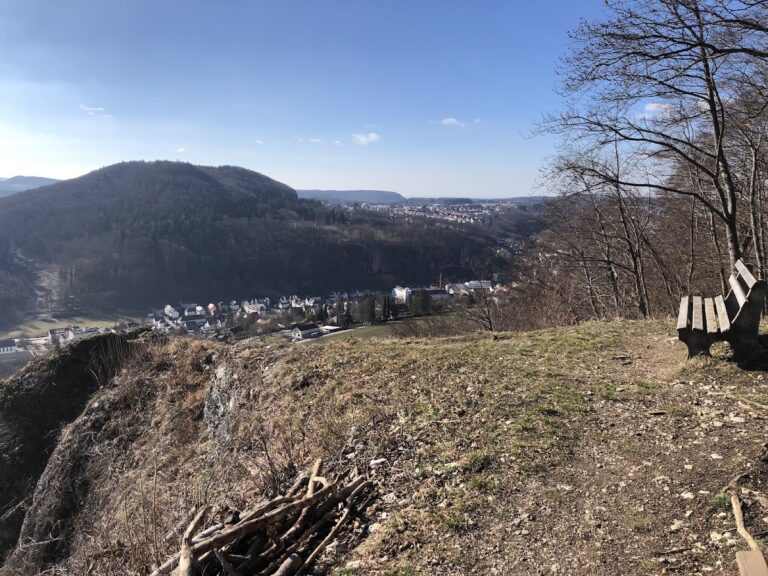
Burg Hossingen occupies a hilltop spur at approximately 830 metres above sea level, about 750 metres southwest of the Hossingen church. The complex comprised a main castle and probably a residential tower, together with an outer bailey measuring approximately 9 by 27 metres. An outer bailey was a secondary enclosed part of a castle used for additional buildings, storage, work, or defense. Barns supporting the castle’s economic yard probably stood behind the two castle areas.
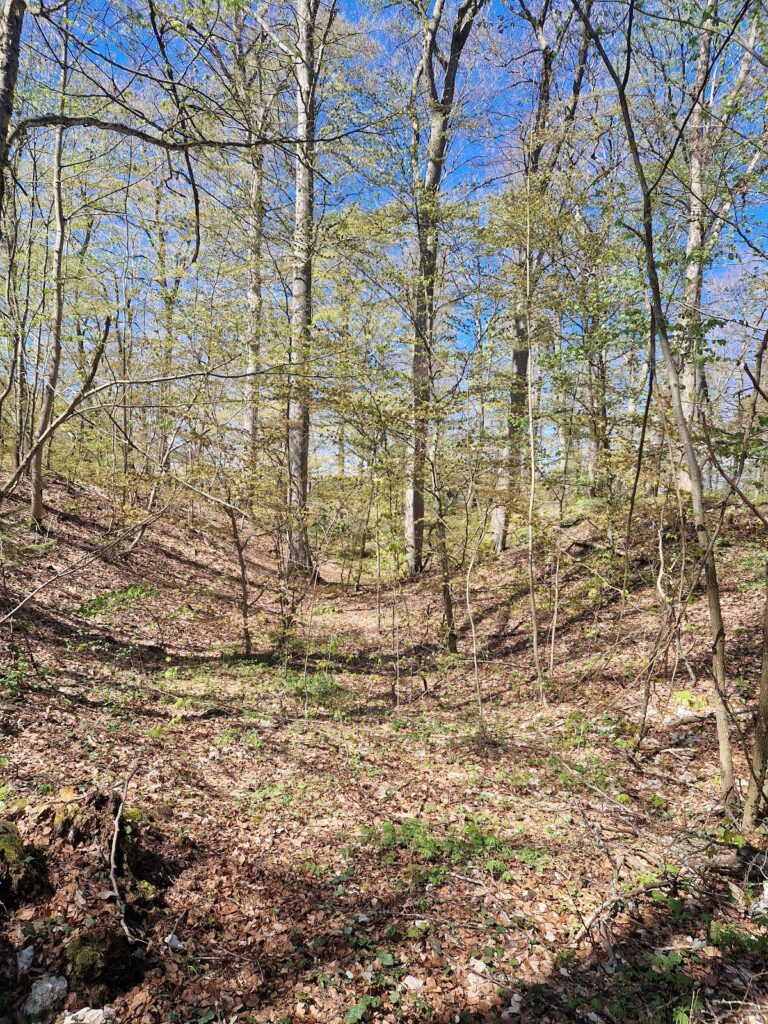
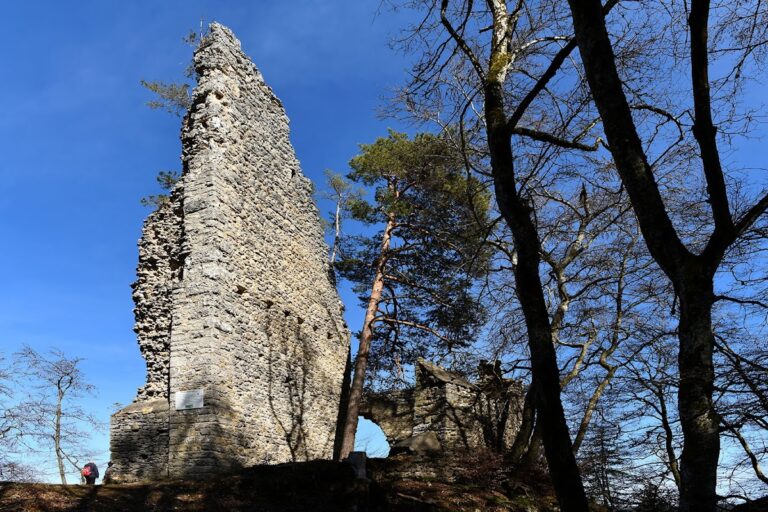
The castle was constructed from small ashlar masonry, meaning carefully cut stone blocks. The surviving physical evidence consists of a few wall remains and two neck ditches. A neck ditch is a trench cut across the ridge connecting a spur to higher ground, isolating the fortified area from approach along the ridge.
Defensive Works and Water Supply
Defensive barriers on the opposite side of the valley remain largely intact. Their latest recorded strengthening took place in 1704, when the Hossingen works formed part of the Württemberg defensive line. A modern access path crosses an additional ditch and leads toward the area identified as the former main tower.
Water was probably brought up from the valley and nearby springs in barrels. Rainwater was also collected in a cistern. Several small springs lie within approximately 700 metres of the ruins, providing a nearby source for the castle’s supply. Below the castle, a pond locally called the Weiherle was formed by a dam and is associated with the wider defensive landscape. Oral tradition further connects the water system with a sawmill water wheel.
Chapel and Archaeological Traces
A castle chapel formed part of the complex, although its architectural form is not described. The 1916 excavation exposed foundations and walls that stood up to two metres high at that time. The exposed masonry was later covered completely with earth to protect it.
The reconstructed drawbridge now uses galvanized steel with a weather-resistant larch-wood railing. The earlier bridge had smooth boards and no railing. After the surrounding woodland was removed, timber trunks and regularly planted hornbeams were intended to indicate the documented outlines of the castle and its economic yard. Information panels and a freely accessible shelter completed in 2014 provide further interpretation of the remains.
Nearby sites