Hamrštejn: A Gothic Administrative and Defensive Castle in Czechia

Site at a Glance
- Rating
- 4.5
- Popularity
- Very Low
- Country
- Czechia
- Primary era
- Medieval
- Eras represented
- Medieval
- Civilizations
- Holy Roman Empire, Kingdom of Bohemia
- Site type
- Military
- Remains
- Castle
On this page9 sections
History
Hamrštejn is a Gothic castle ruin in Czechia, located near Liberec, built by the Bieberstein family during the first half of the fourteenth century. Its exact foundation date is unknown, although it may have been established around 1300 or during the first third of that century. The castle is first documented in 1357, when it was already standing as a fief held by Bedřich of Bieberstein.
Bieberstein administration
Hamrštejn belonged to the Bieberstein estates centred on Frýdlant and administered their south-western sector, including the Liberec part of the domain. Its position at the western edge of Bieberstein territory probably helped protect the estate against the neighbouring Donín family at Grabštejn. The castle was held as a fief, meaning a lordship granted by a superior ruler in return for specified obligations.
The name Hamrštejn is generally associated with a nearby medieval ironworks that contained a water-powered forge hammer. The ironworks had disappeared by the end of the sixteenth century, and its location is unknown. An often-repeated explanation linking the castle to mines near Andělská hora is considered incorrect because those mines lay in Donín territory.
Several dozen men served at Hamrštejn under a burgrave, the officer responsible for administering and defending a castle. Known burgraves included Hans Dachs in 1409, Mikuláš Dachs in 1411, Fredemann of Gersdorf from 1414 to 1425, and Heinz Dachs from 1452 to 1486. Members of the Dachs family administered the castle for much of its existence while the Biebersteins lived at Frýdlant.
Hamrštejn during the Hussite Wars
The Hussite Wars were the religious and political conflicts in Bohemia from 1419 to 1434 between supporters of the reformer Jan Hus and forces aligned with the Catholic Church, the imperial authorities, and the royal government. The Biebersteins supported the anti-Hussite side. Hamrštejn occupied a difficult military position near Hussite-held Grabštejn, the Hussite garrison at the wooden fortress of Chrastava, and the unreliable garrison of nearby Roimund.
It remains uncertain whether Hamrštejn’s garrison undertook active operations against the Hussites, but the castle served as a source of valuable intelligence for Lusatia. Mikuláš Dachs supplied information, and messengers from Zittau visited the castle.
In 1433, about 400 cavalry under Jan Čapek of Sány, a Hussite military commander, advanced against Hamrštejn. Bieberstein troops had defeated part of the Hussite garrison from Grabštejn and burned the fortress at Chrastava. Under pressure from the much larger force, the defenders apparently surrendered, and the Hussites occupied the castle. Hamrštejn was recovered in 1435 and returned to Dachs control, with Siegmund of Wartenberg associated with its liberation.
The castle was captured again in 1445, although the attackers are unknown, and returned to Mikuláš Dachs in 1448. During wider conflicts between the Biebersteins and Doníns, Mikuláš Dachs attacked Chrastava in 1467. The Doníns then temporarily seized Hamrštejn.
Ownership disputes and abandonment
From 1454, Hamrštejn belonged to Oldřich, Václav, and Bedřich of Bieberstein, although Václav later prevailed in the dispute over ownership. After Václav and Bedřich failed to promptly recognize King Vladislaus II Jagiellon, following their support for Matthias, the king of Hungary, Hamrštejn was declared a forfeited fief. Hanuš of Rechenberg then became its burgrave.
Hanuš of Rechenberg was accused by Jan of Donín of illegally holding the villages of Machnín, Krásná Studánka, Svárov, and Molberk. Machnín passed to the Doníns, while the other villages were considered to belong to Hamrštejn. The Biebersteins nevertheless remained the region’s superior lords. In 1517, King Louis Jagiellon restored all of Oldřich of Bieberstein’s estates, including Hamrštejn. The castle was briefly pledged to Ulrich Gotsch in the early sixteenth century before returning to the Biebersteins.
A further dispute over Machnín ended in 1545 with a Donín victory, leaving Hamrštejn completely isolated. The judgment stated that the castle possessed only the land where water falling from its roof reached the ground. The Frýdlant branch of the Biebersteins ended with the death of Kryštof of Bieberstein in 1551, and its property reverted to the Bohemian Crown as an escheated fief. Hamrštejn was described as abandoned when the former Bieberstein estates were sold to Bedřich of Redern on 1 April 1558, so the ruin had been abandoned by the middle of the sixteenth century.
Protection and conservation
Part of the southern wall, including the castle gate, collapsed into the valley on 9 September 1882. The ruins received legal protection as a cultural monument in 1958 and have been listed among the most endangered cultural monuments in the Czech Republic since 2008. Stabilization and conservation work in 2010 and 2011 helped halt the degradation of the ruin. Hamrštejn lies within the Hamrštejn nature reserve, established in the 1970s, and is regarded as the oldest surviving building in Liberec.
Remains
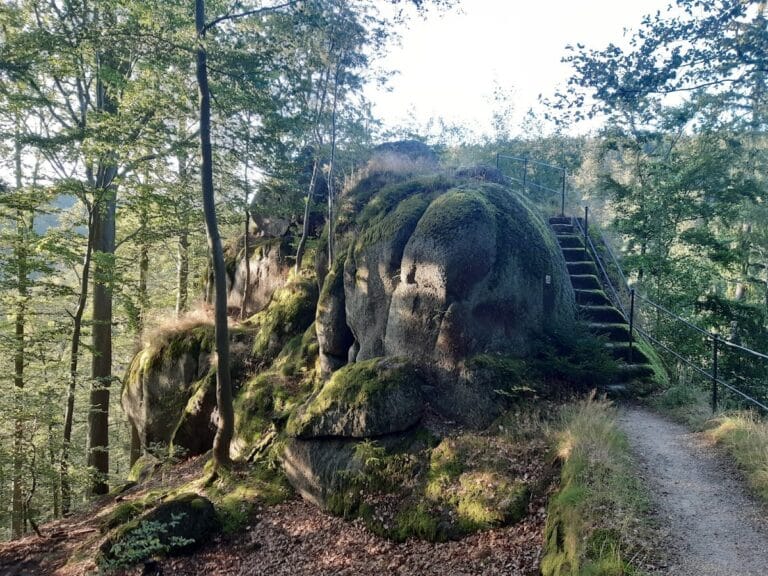
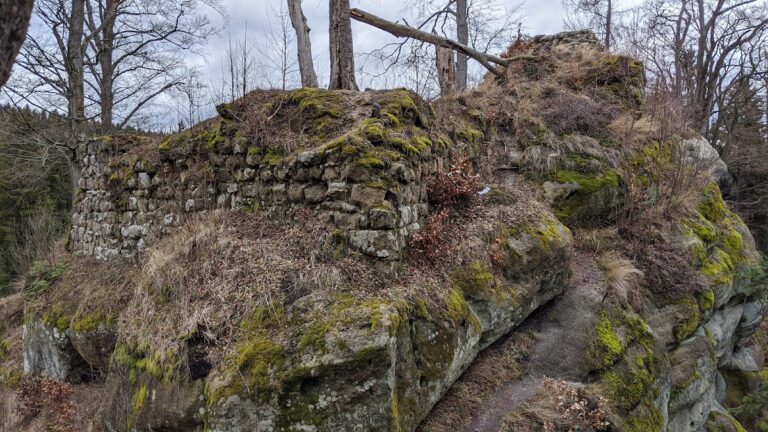
Hamrštejn occupies a rocky ridge of Ovčí hora, at about 496 metres, at a point known as Zámecký kopec, about 375 metres above sea level. The promontory rises above a meander of the Lusatian Neisse, while steep slopes on three sides strengthened its defensive position. The castle formed a rounded, oblong enclosure about 67 metres long and 26 metres wide, aligned roughly from north to south. A stone curtain wall, the defensive wall linking fortified points, enclosed its uneven, saddle-shaped interior, which included two projecting promontories. A moat strengthened the southern side.
Defensive enclosure
The surviving curtain wall is fragmentary and measures less than 2 metres in height in places. The entrance was probably at the northern end, although the medieval gate and its approach no longer survive. The gate and part of the southern wall fell into the valley in 1882. The present entrance is thought to lie approximately where the medieval entrance once stood.
Towers and residential buildings
Cylindrical towers once stood at opposite ends of the fortified area. The larger north-eastern tower had a diameter of about 10.5 metres and walls between 1.5 and 2 metres thick. It served as a residential tower, and a fragment of its above-ground structure survives to about 5 metres high. The masonry is seriously undermined and remains at risk of collapsing into the courtyard.
The smaller tower probably served as a watchtower and observation post. It is comparatively well preserved and can be reached by steps cut into the rock. Together with fragments of the larger tower, it preserves the arrangement of the principal fortified points within the enclosure.
Fragments of a residential building and cellars cut into the rock also survive. The interior probably contained a smaller timber structure built against the curtain wall between the towers. At least one tower and this timber building had residential functions. Hamrštejn belonged to the group of single-unit castles, whose principal buildings occupied one unified fortified enclosure rather than separate wards. Additional structures, including a possible castle palace, were probably built from wood or from timber and clay.
Construction and conservation
Hamrštejn was constructed in stone, but its surviving masonry is fragmentary. Conservation work in 2010 and 2011 secured the above-ground masonry of the northern tower with traditional masonry techniques. The work also used procedures intended to prevent water penetration and damage caused by freezing.
Nearby sites