Cathedral of the Nativity in Suzdal: Principal Church of Medieval Suzdal

Site at a Glance
- Rating
- 4.9
- Popularity
- Very Low
- Country
- Russia
- Primary era
- Medieval
- Eras represented
- Medieval, Early Modern
- Civilizations
- Russian
- Site type
- Religious
- Remains
- Cathedral
On this page9 sections
History
The Cathedral of the Nativity in Suzdal, Russia, is the principal church of medieval Suzdal and the oldest surviving building in the city. Built within the Vladimir-Suzdal architectural tradition, its present form combines a white-stone lower structure completed in 1225 with a brick upper section rebuilt in the sixteenth century.
Early churches and the thirteenth-century rebuilding
The first cathedral or predecessor church was founded during the reign of Vladimir Monomakh, the Grand Prince of Kyiv whose rule was associated with major political and ecclesiastical building projects in medieval Rus. Its construction belongs to the eleventh or early twelfth century, and craftsmen from Kyiv built it of thin fired brick. One interpretation proposes that this church was dismantled and rebuilt in 1148, although the existence of a cathedral from that date remains disputed.
A predecessor dedicated to the Dormition of the Mother of God was reportedly dismantled because its foundations were weak during the rule of Yuri Dolgoruky, a prince of the Vladimir-Suzdal line traditionally regarded as the founder of Moscow. Its foundations were later found beside the cathedral. In 1222, the Laurentian Chronicle records, Yuri Dolgoruky’s dynastic successor Yuri Vsevolodovich ordered the dilapidated building to be taken down and a new cathedral to be erected on the site.
The new white-stone cathedral was completed in 1225. At its consecration, Bishop Simeon changed its dedication from the Dormition to the Nativity of the Mother of God. The construction of this and other major white-stone churches during Yuri Vsevolodovich’s period was directed, according to Sergei Zagraevsky, by Svyatoslav Vsevolodovich, an appanage prince associated with Yuryev-Polsky. The cathedral served both Suzdal’s inhabitants and the princely family. Its sanctuary was not directly joined to the princely apartments, and the galleries were reached from within the church.
Fire and sixteenth-century reconstruction
In 1445, a Tatar raid burned Suzdal, and the cathedral’s upper section collapsed. Several other fires affected the building during its history. In 1528, Bishop Gennady of Suzdal received permission from Vasily III, Grand Prince of Moscow from 1505 to 1533, to rebuild it. The old upper walls were dismantled down to the arcade belt and replaced with brick. The original three-domed completion was changed to a five-domed arrangement by adding two domes. The building consequently preserves a thirteenth-century lower part beneath a sixteenth-century upper section.
Later religious use and conservation
The interior was repainted in the seventeenth century. In 1634, Bishop Serapion ordered a new ensemble of wall paintings and added a chapel dedicated to Saints Theodore and John. The cathedral remained an active church until the 1930s. Conservation and archaeological work began in 1938 and continued through later decades, while restoration completed by the 1960s sought to recover its sixteenth-century appearance.
Solemn services resumed in 1991, and in February 1992 the Vladimir-Suzdal Museum-Reserve and the Vladimir Eparchy, an administrative diocese of an Orthodox church, agreed to share use of the building. It returned to liturgical use in 2005 and continues to function as both a church and a museum. The cathedral became a cultural-heritage monument of federal importance in 1960. In 1992, it was included with the Suzdal Kremlin in the UNESCO World Heritage property called the White Monuments of Vladimir and Suzdal, under cultural criteria (i), (ii), and (iv).
The cathedral contains burials of sons of Yuri Dolgoruky, members of the Shuysky princely family, and others. Nikita Dobrynin served there before joining the Old Believer movement, whose followers rejected seventeenth-century reforms to Orthodox rites and religious texts, and being expelled from the Russian Orthodox Church. The liturgical feast associated with the cathedral’s dedication is observed on September 8/21.
Remains
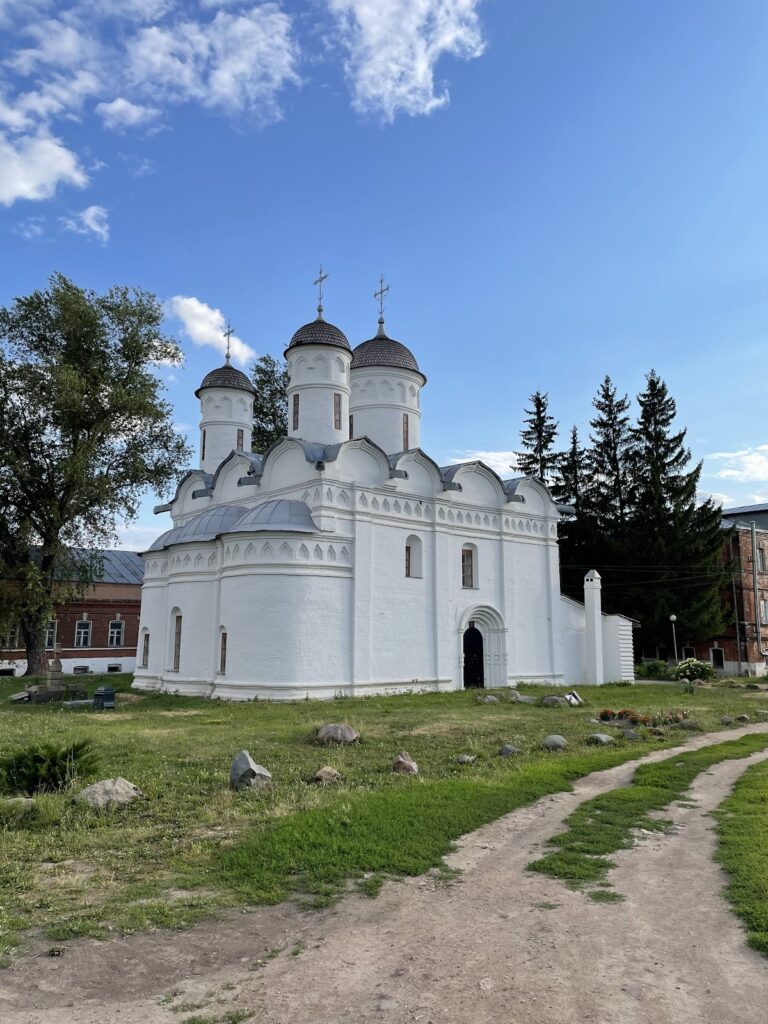
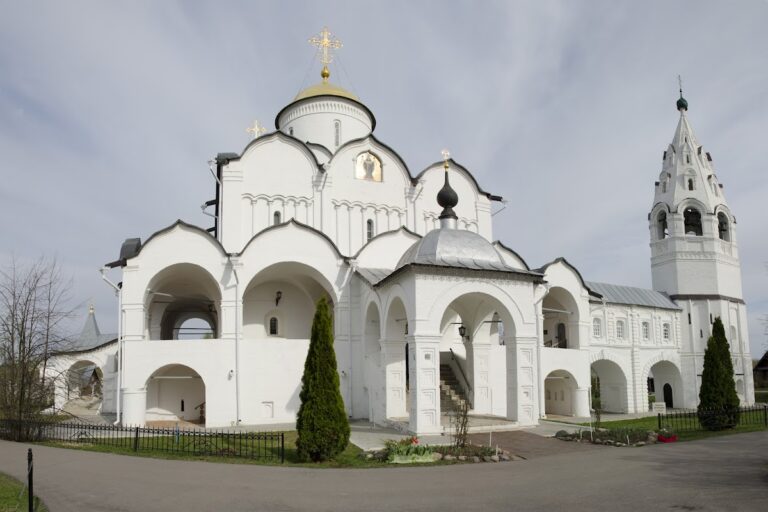
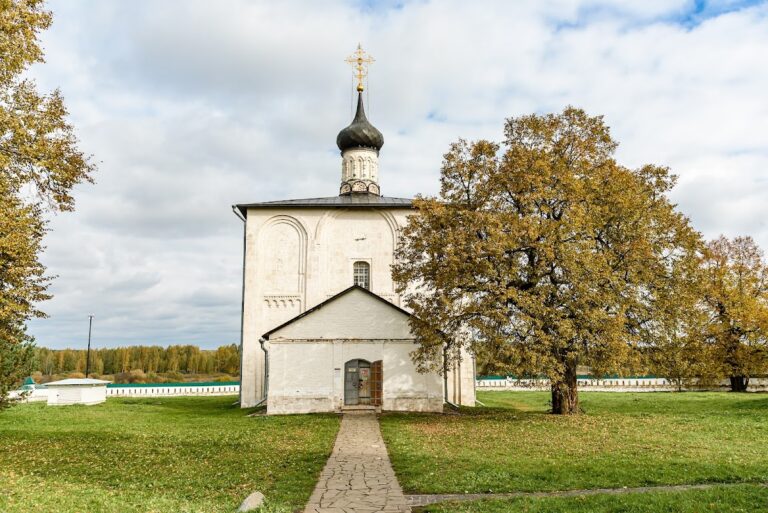
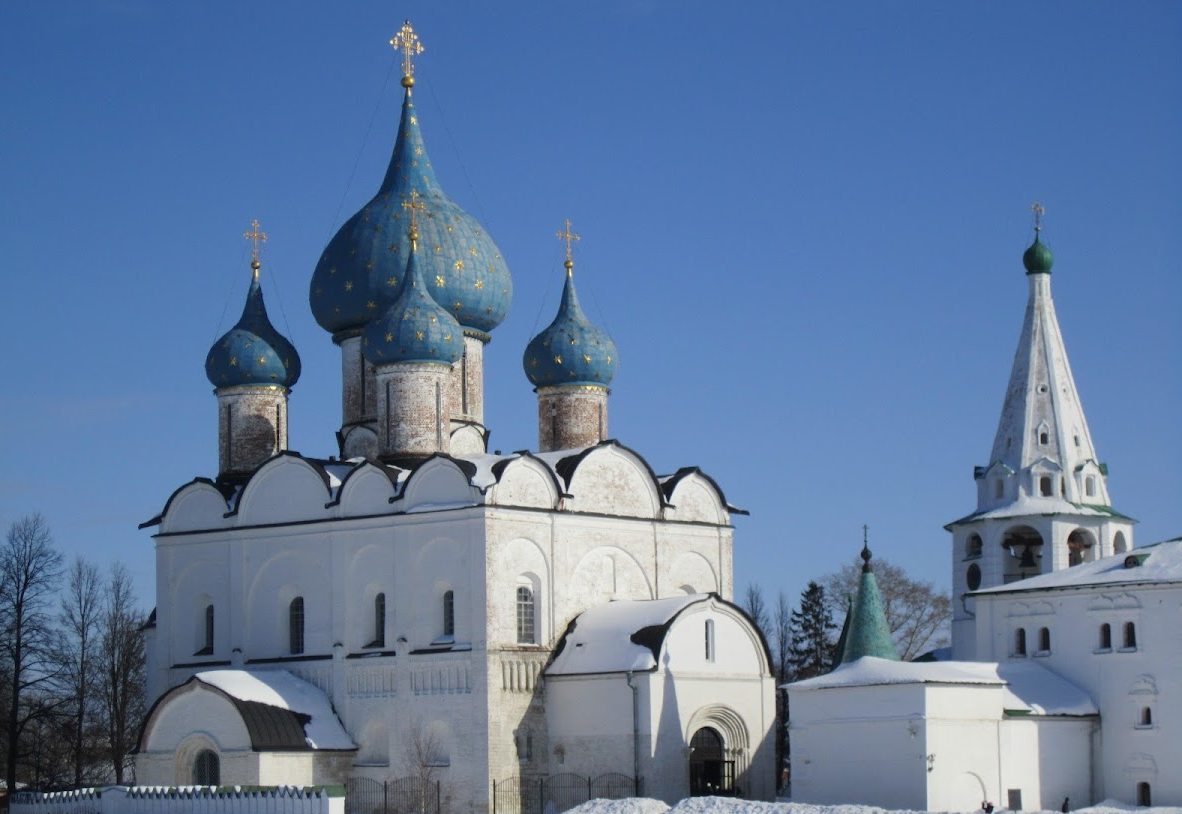
The cathedral stands inside the Suzdal Kremlin, at the center of a ring of earthworks in a bend of the Kamenka River, a tributary of the Nerl. It is a white-stone, cross-domed church, meaning that a central dome rises above vaulted arms arranged in a cross-shaped structural plan. Its surviving fabric shows the contrast between the thirteenth-century stone base and the brick upper walls introduced during the sixteenth-century rebuilding.
Cathedral structure
The lower church follows a quadrangular plan and is organized as a three-aisled, six-pillared building with three apses, the semicircular eastern ends of the sanctuary. Three vestibules extend from the main body. The exterior was enriched with carved reliefs, including masks, arches, and half-columns. The lower walls are white stone, while the upper walls are brick. The brick section replaced the earlier white-stone walls above the arcade belt, which is decorated with female masks. The original cathedral had three domes; the addition of two more during the sixteenth century created the five-domed arrangement visible today.
Paintings and floor
The interior preserves wall paintings from the thirteenth, fifteenth, and seventeenth centuries. Rostov or Suzdal masters associated with Bishop Kirill produced frescoes in 1233, and fragments of this earliest decoration were uncovered in 1938. One important surviving fragment in the upper part of the southern apse depicts two elders. A terracotta floor was also installed inside the cathedral in 1233. The seventeenth-century chapel of Saints Theodore and John is attached to the main body of the church.
Medieval gates
The western and southern gates are major examples of Russian applied art from the first third of the thirteenth century. Each gate has a wooden core covered with copper sheets. Their imagery was gilded by fire gilding, a process that fixes gold to heated metal, and the copper surfaces bear scenes etched into the sheets before gilding. The western gates present scenes from the cycle of Christ’s life and, in part, from the cycle associated with the Virgin Mary. The southern gates chiefly show the deeds of angels, especially those of the archangel Michael.
Bell tower and adjoining complex
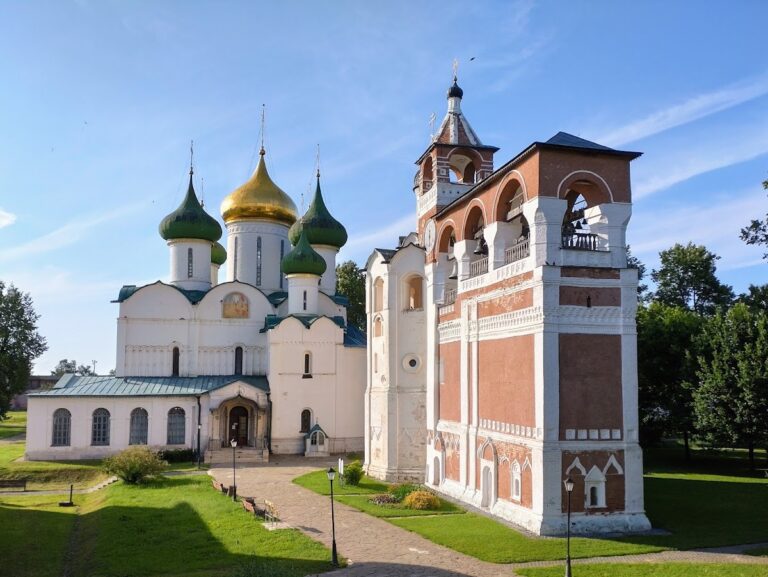
A freestanding bell tower from the seventeenth century stands near the cathedral. A porch connects it to the complex of the bishop’s palace, giving the bell tower a physical relationship with the adjoining ecclesiastical buildings while leaving it separate from the cathedral’s main body.
Nearby sites