Nardò Cathedral: A Roman Catholic Cathedral in Italy


Site at a Glance
- Rating
- 4.7
- Popularity
- Low
- Country
- Italy
- Primary era
- Medieval
- External website
- Open
- Eras represented
- Medieval, Early Modern, Modern
- Civilizations
- Habsburg, Italian, Kingdom of Naples, Norman, Spanish
- Site type
- Religious
- Remains
- Cathedral
On this page14 sections
History
Nardò Cathedral is a Roman Catholic cathedral in Nardò, Italy, built under the Norman conquerors around 1080 during the medieval period. Dedicated to the Assumption of the Virgin Mary, it is the principal church of the Diocese of Nardò-Gallipoli and contains the bishop’s official seat.
Early foundations and cathedral status
The cathedral probably occupies the site of an early Christian place of worship and may also stand on the site of the former church of Sancta Maria de Neritorio. Tradition connects that church with Eastern monks who fled Byzantine iconoclasm, the religious and political disputes over sacred images in the Byzantine Empire, during the seventh century. A monastery dedicated to the Assumption was documented in 1088, soon after the church was built. The church became a cathedral in the early fifteenth century.
Earthquakes and medieval rebuilding
In 1354, Abbot Azzolino De Nestore rebuilt the façade after an earthquake caused its collapse. He also lengthened the nave by adding two chapels on each side, creating the lateral aisles. Further consolidation took place during the first half of the fifteenth century, probably following the earthquake of 1456.
Baroque reconstruction and later restoration
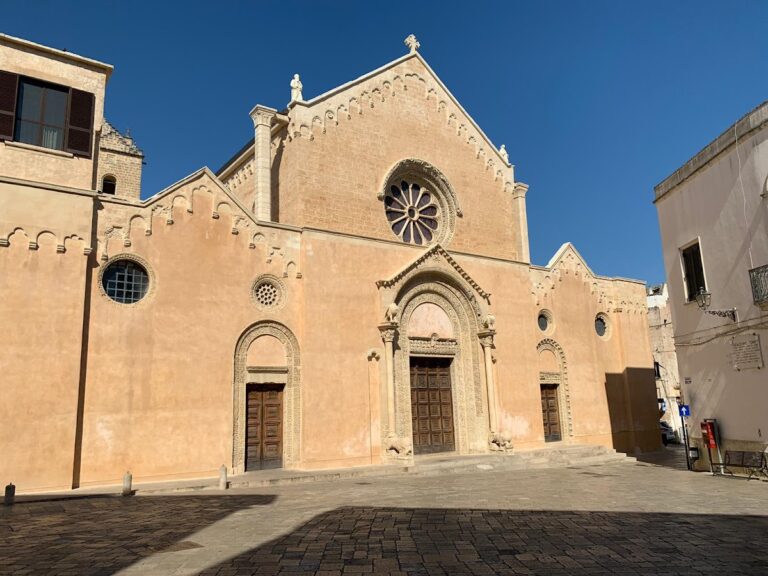
The façade was rebuilt in 1725 during the episcopate of Antonio Sanfelice. The work was directed by the architect Ferdinando Sanfelice, the bishop’s brother, who also led extensive reconstruction inside the church. This campaign included the construction of the baptistery in 1728.
Restoration and renovation between 1892 and 1899 produced the building’s present, more classical appearance. Baroque interior coverings were removed or scarified, exposing medieval masonry, pillars, and arches. The cathedral was declared an Italian national monument in 1879 and became a minor basilica in 1980, a Catholic title for a church of particular liturgical, historical, or devotional importance, during the episcopate of Antonio Rosario Mennonna. In 1986, it became the seat of the united Diocese of Nardò-Gallipoli.
Remains
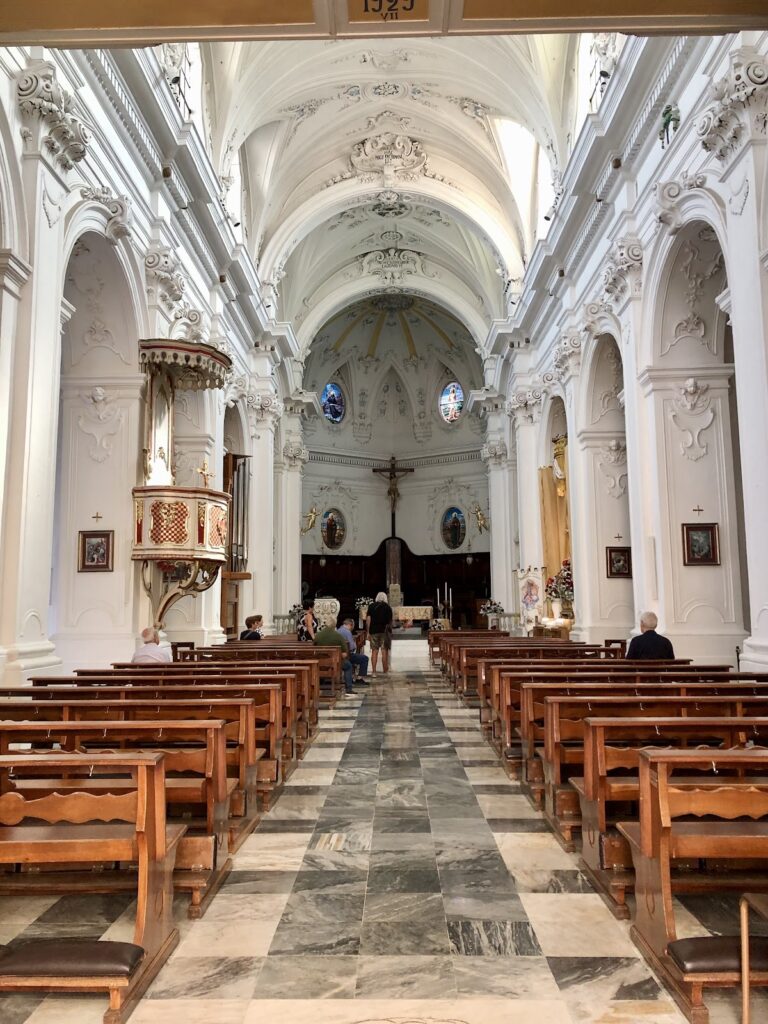
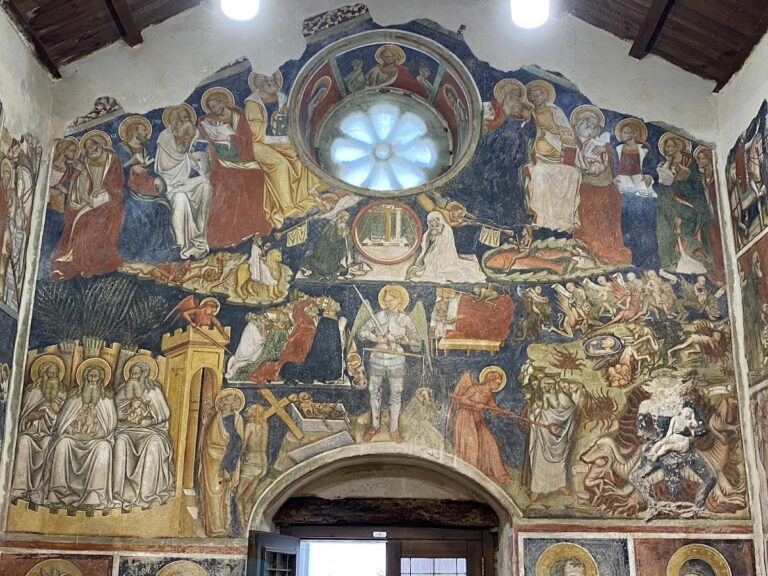
The surviving cathedral has a basilical plan, meaning that a central nave is flanked by parallel side aisles. Its interior combines medieval structural elements and painted decoration with Baroque altars, later frescoes, and furnishings from different periods. The bell tower retains a particularly medieval character in its lower and middle levels.
Plan and medieval fabric
Basilical interior
Two rows of round and pointed arches divide the three aisles. The arches rest on rectangular pillars faced with half-columns, while medieval masonry remains visible in parts of the interior after the nineteenth-century removal of later coverings.
Medieval bell tower
The bell tower remains notably medieval in character up to its penultimate level. Its corner elements carry a zigzag pattern associated with the Angevin period, the era of the House of Anjou’s rule in parts of southern Italy. Carved panels dating from the late fourteenth century decorate three sides.
Frescoes and medieval images
Wall paintings and icons
Medieval frescoes from the thirteenth, fourteenth, and fifteenth centuries survive on the columns and walls. They include a late twelfth-century Christ Pantocrator, an image of Christ represented as the universal ruler, an early fourteenth-century image of Saint Nicholas, and a late fourteenth-century image of Saint Augustine. A Madonna and Child attributed to the Angevin period also belongs to the painted decoration.
Triptych and Madonna della Sanità
Other medieval works include a triptych showing Saint Nicholas, the Madonna and Child, and Mary Magdalene, dated to around 1390. The Madonna della Sanità is dated 1234 and attributed to Bajlardo.
Choir, crucifix, and later decoration
Choir and Black Christ
At the end of the central nave, the main altar stands with the choir. Its walnut stalls were inlaid in 1590 by Monsignor Fabio Fornari. The wooden crucifix known as the Black Christ dates from the twelfth century, and its dark color is attributed to the cedar wood used for its construction.
Baroque altars and nineteenth-century frescoes
The Baroque furnishings include the Altar of the Souls in Purgatory, made by Placido Buffelli of Alessano in 1688, and the Altar of Saint Michael the Archangel, dated 1647, with an altarpiece attributed to Francesco Solimena. The Chapel of Saint Gregory the Armenian contains an altar made by Buffelli in 1680 and a late seventeenth-century altarpiece of Saint Gregory by Pietro Lucatelli.
Cesare Maccari frescoed the remaining nave walls and the vault sections above the altar between 1896 and 1899. During the same period, the main altar was rebuilt on the model of Romanesque altar canopies.
Nearby sites