Santa Aurea: Cathedral Church of the Diocese of Ostia in Italy


Site at a Glance
- Rating
- 4.6
- Popularity
- Low
- Country
- Italy
- Primary era
- Medieval
- External website
- Open
- Eras represented
- Medieval, Early Modern
- Civilizations
- Papal States
- Site type
- Religious
- Remains
- Cathedral
On this page8 sections
History
Santa Aurea is a Roman Catholic church in Italy, located at Ostia Antica in Rome, and serves as the cathedral of the suburbicarian Diocese of Ostia, one of the historic dioceses surrounding Rome traditionally assigned to senior cardinals. It is also the parish church of Santa Aurea. With its Renaissance character, the present building belongs to the late fifteenth century and was completed and consecrated in 1483.
Ostia’s Episcopal Tradition
Ostia had been an episcopal see since the third century. From approximately 1150, or the twelfth century, the Diocese of Ostia was assigned to the dean of the College of Cardinals. Santa Aurea remained the seat of the diocese until 1966, when responsibility for administering it passed to the cardinal vicar of Rome, the pope’s principal representative for the pastoral administration of the Diocese of Rome. The cardinal-bishop title of Ostia continues to be associated with the dean of the College of Cardinals.
Tradition connects the church and its surroundings with Saint Aurea, regarded as Ostia’s patron saint and martyr, whose burial is placed near the church. Another tradition states that Saint Monica was buried here before her remains were transferred to Rome, first to San Trifone in Posterula and later to the Basilica of Sant’Agostino in Campo Marzio. The Augustinian friars, members of the Catholic order shaped by the rule and spiritual tradition of Saint Augustine of Hippo, care for Santa Aurea.
Renaissance Foundation and Later History
The present church was initiated in the late fifteenth century by the French cardinal Guillaume d’Estouteville, an important ecclesiastical patron of the period. Construction was entrusted to the Florentine architect Baccio Pontelli and continued under Cardinal Giuliano della Rovere, who later became Pope Julius II and was a major patron of Renaissance architecture and the arts. The church was completed and consecrated in 1483.
It is uncertain whether the building replaced an earlier Early Christian church. Santa Aurea originally faced in the opposite direction from its present arrangement. Its facade was later turned toward the nearby castle commissioned by Giuliano della Rovere, changing the church’s relationship to the surrounding complex.
Several traditions and discoveries have shaped the interpretation of Santa Aurea. In 1981, a fragment of a Late Antique Christian funerary inscription was found near the church. The words, “Chryse hic dorm[it],” refer to a deceased Christian woman. The possible connection between the Greek name Chryse and the Latin name Aurea, and thus with Saint Aurea, remains uncertain. Chryse was also a common name among lower social classes, unlike the tradition that describes Aurea as a wealthy Christian martyr. The funerary stone associated with Saint Monica was rediscovered near the church in the summer of 1945. Santa Aurea also preserves relics associated with Saint Asterius of Ostia.
Remains
Facade and Church Setting
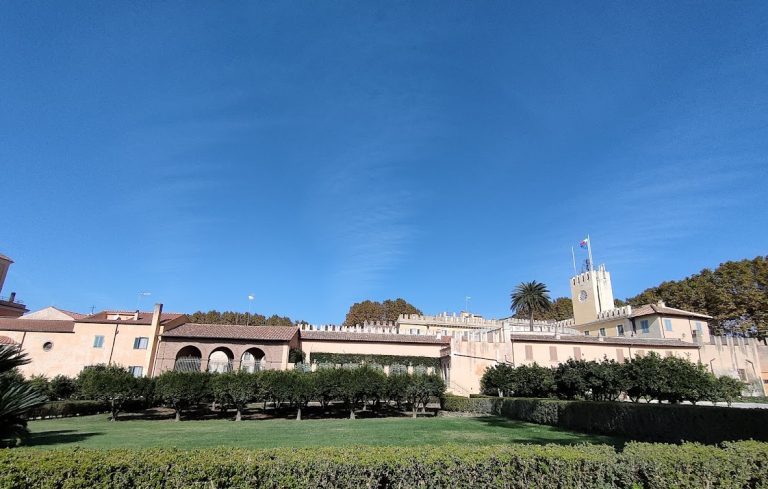
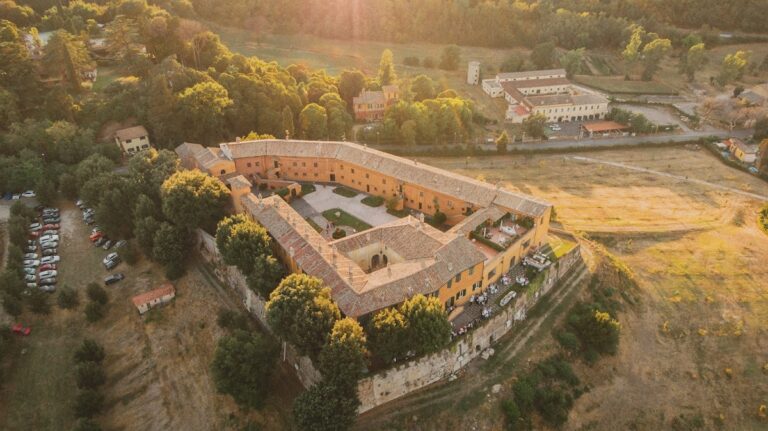
Santa Aurea is a narrow church with a single nave and a Renaissance architectural character. Four Corinthian pilasters rise from high pedestals decorated in relief and organize the facade around a central portal. A late Gothic rose window occupies the upper center, flanked by two round-arched windows. The triangular pediment carries a large coat of arms of Julius II, while the side walls continue the pilaster arrangement. A bell tower stands behind the church. Beyond it is a two-winged episcopal palace with a round tower at one corner, and a fountain occupies the square in front of a long building opposite Santa Aurea.
Nave and Sanctuary
The nave has a wooden ceiling decorated with lilies, a motif referring to the coat of arms of Guillaume d’Estouteville. Three round-arched windows line the left wall, alongside the fifteenth-century rose window and paired windows. In front of the apse, the rounded or polygonal end of the church, stands a bare-marble Renaissance triumphal arch. Its architrave carries an inscription naming the donor. The apse vault retains sixteenth-century frescoes, including figures of Saints Peter and Paul and a pope.
Doors with altar-like upper structures stand on both sides of the apse area and bear the coats of arms of cardinals. The modern main altar incorporates two reliefs from the early sixteenth century. The principal altarpiece is a tall oval painting by Andrea Sacchi, born in Nettuno, dated 1627, and showing the martyrdom of Saint Aurea. Three other seventeenth-century altarpieces and Baroque paintings, chiefly depicting saints of the Augustinian order, complete the church’s principal painted decoration.
Saint Monica Chapel
A chapel on the right is dedicated to Saint Monica. It contains Estasi di Santa Monica, or The Ecstasy of Saint Monica, attributed to Pietro da Cortona, an important Italian Baroque painter. The chapel also preserves the funerary stone associated with Saint Monica, which was rediscovered near the church in 1945.
Relics and Archaeological Evidence
The church keeps the relics of Saint Asterius of Ostia. The nearby fragment of the Late Antique Christian funerary inscription for Chryse provides archaeological evidence for Christian burial activity connected with the area, while its uncertain relationship to Saint Aurea leaves the identification of the deceased unresolved.
Nearby sites