Gualdo Tadino Cathedral: A Benedictine Abbey Church and Co-Cathedral in Italy


Site at a Glance
- Rating
- 4.8
- Popularity
- Very Low
- Country
- Italy
- Primary era
- Medieval
- Eras represented
- Medieval, Early Modern, Modern
- Civilizations
- Italian, Papal States
- Site type
- Religious
- Remains
- Cathedral
On this page8 sections
History
Gualdo Tadino Cathedral is a Roman Catholic church in Gualdo Tadino, Italy, dedicated to Saint Benedict of Nursia, the sixth-century monastic leader associated with the foundation of Western Christian monasticism. Formerly a Benedictine abbey church, it received the honorary status of cathedral in 1915 through Pope Benedict XV, commemorating the ancient town and episcopal see of Tadinum. Since 1986, it has served as a co-cathedral of the Diocese of Assisi-Nocera Umbra-Gualdo Tadino.
Relocation inside the city walls
The church is also known as San Benedetto nuovo, or New Saint Benedict, distinguishing it from San Benedetto vecchio, the Old Saint Benedict monastery established outside Gualdo Tadino’s walls after 1006. Because that earlier location was regarded as insecure, the monks moved the monastery inside the walls in 1256. The relocation led to the construction of the new abbey and its adjoining church in a combination of Romanesque and Gothic styles. A stone inscription set into the exterior wall preserves the memory of this move.
Later rebuilding and ecclesiastical status
The complex was altered during later centuries, particularly in the eighteenth and nineteenth centuries. The interior was completely refitted in the nineteenth century by the architect Virginio Vespignani. Donations from Monsignor Roberto Calai provided substantial support for the rebuilding, which continued after Vespignani’s death under his son Francesco and the architect Costantino Sneider, who had been his assistant.
The predecessor of the bell tower was demolished after an earthquake at the end of the eighteenth century had made it dangerous. A new campanile, or bell tower, was built in 1914. In January 1980, Pope John Paul II granted the church the title and privileges of a minor basilica, a special papal distinction for a church of religious and historical importance.
Remains
Façade and exterior features
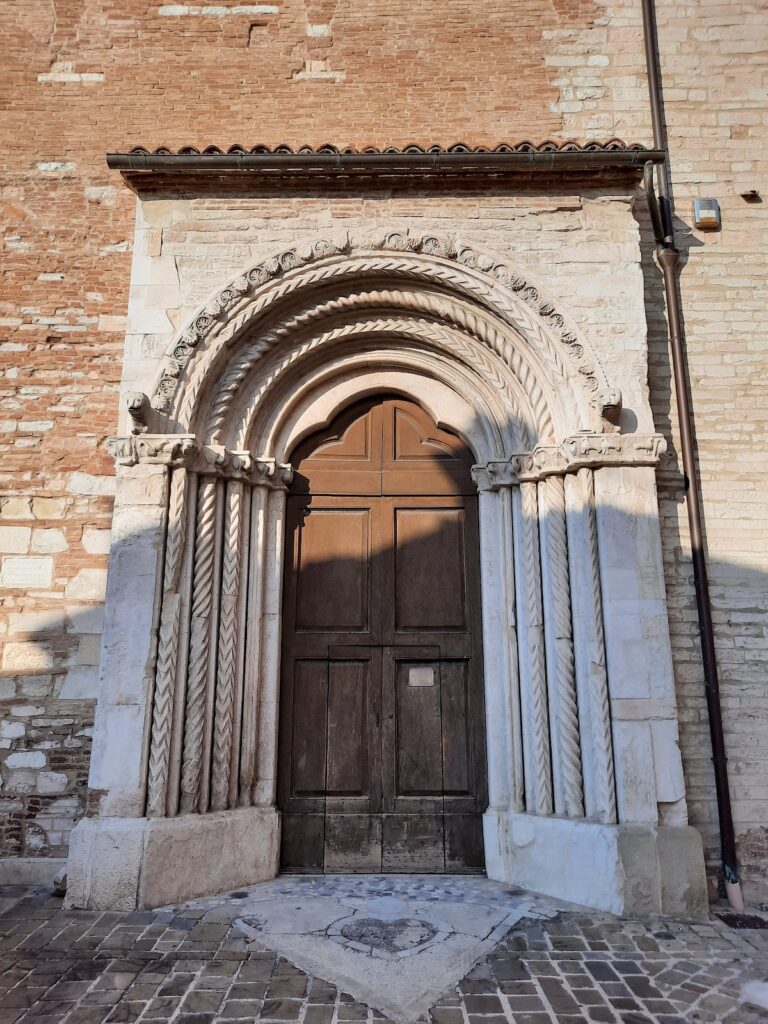
The west front is divided horizontally by a cornice. Its lower level contains three portals, with spiral columns and capitals framing the central entrance. Above them, a Romanesque rose window is set between two smaller round openings called oculi. These elements belong to the original Romanesque building and form the principal surviving medieval features of the façade.
The campanile beside the church dates from 1914. A stone near its entrance records the continuation of the building work by Francesco Vespignani and Costantino Sneider. On the south side of the cathedral stands a Renaissance fountain attributed to Antonio da Sangallo the Elder, an Italian architect and military engineer.
Interior arrangement
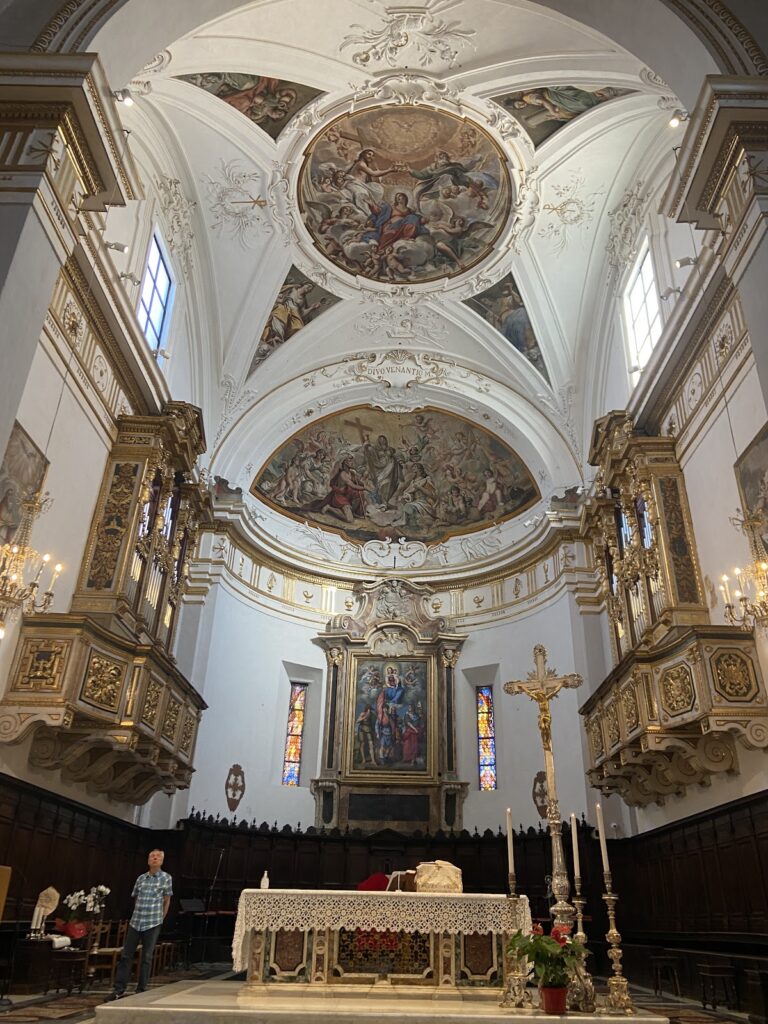
The interior is arranged in three aisles, with galleries above the side aisles. Groin vaults, formed by the crossing of two barrel vaults, cover the main interior spaces, while a semicircular apse closes the church. A crypt dating from the nineteenth century lies beneath the apse. Most of the painted decoration was executed in 1924 by the painter Ulisse Ribustini.
High altar
The high altar was rebuilt in its original position in 1965, incorporating fourteenth-century elements. Its bas-reliefs, made by Guglielmo Ciani of Perugia, depict episodes from the life of Saint Benedict of Nursia.
Chapel of Blessed Angelo
One side chapel is dedicated to Blessed Angelo, a hermit and one of Gualdo Tadino’s patron saints. His remains are preserved in an urn made of bronze and silver.