St Bavo’s Cathedral: Gothic Cathedral of Ghent, Belgium


Site at a Glance
- Rating
- 4.6
- Popularity
- High
- Country
- Belgium
- Primary era
- Medieval
- External website
- Open
- Eras represented
- Medieval, Early Modern, Modern
- Civilizations
- County of Flanders, Spanish
- Site type
- Religious
- Remains
- Cathedral
On this page20 sections
History
St Bavo’s Cathedral is a Roman Catholic cathedral in Ghent, Belgium, dedicated to Saint Bavo of Ghent and serving as the seat of the Diocese of Ghent. The present building developed from a chapel founded in the tenth century and was constructed mainly in the Gothic period, with Romanesque, Brabantine Gothic, Renaissance, Baroque, and Classicist elements. Its long building history reflects the changing religious and political importance of the site.
From chapel to Romanesque church
The cathedral occupies the site of the former Chapel of St John the Baptist, chiefly a wooden structure consecrated in 942 by Transmarus, Bishop of Tournai and Noyon. A Romanesque church gradually replaced the chapel, beginning a second phase of religious construction. Traces of both the earlier chapel and the Romanesque church survive in the crypt beneath the cathedral.
Gothic construction and completion
Work on the present Gothic church began around 1274. Expansion continued almost continuously from the fourteenth through the sixteenth centuries. The choir was renewed at the beginning of the fourteenth century under the influence of northern French Gothic and Scheldt Gothic. The ambulatory and radiating chapels followed at the beginning of the fifteenth century, while construction of the 89-metre western tower took place between 1462 and 1538 in the Brabantine Gothic style, a regional form of late Gothic church architecture associated with the historic Duchy of Brabant.
Construction of the nave began in 1533. During the broader building campaign, the church acquired a new choir, radiating chapels, enlarged transepts, chapter-house facilities, nave aisles, and a single-tower western section. Later additions introduced Renaissance, Baroque, and Classicist forms. The church was considered complete on 7 June 1569.
From collegiate church to cathedral
In 1539, after Ghent revolted against Emperor Charles V, the Abbey of St Bavo was dissolved. Charles V, the sixteenth-century Holy Roman Emperor and ruler of the Habsburg Netherlands, had been baptized in the church. The abbey’s abbot and monks became canons attached to the former Church of St John, which then became the collegiate Church of St Bavo. A collegiate church is administered by a chapter of canons rather than functioning solely as a monastic church.
The Diocese of Ghent was established in 1559, and the Church of St Bavo was elevated to cathedral status. A cathedral is the principal church of a diocese and contains the seat of its bishop. The building now serves as the cathedral church rather than as the parish church. The former Saint John, Saint Michael, and Saint Nicholas parishes were later combined under Saint Michael’s Church.
Reformation-era damage and continuing religious use
In the summer of 1566, Calvinist iconoclasts damaged stained-glass windows, statues, paintings, and other artworks they regarded as idolatrous. The Ghent Altarpiece was saved. The Chapter of Saint Bavo has remained housed in the cathedral since its foundation. Its members have included important prelates and members of noble families, and the canons sing Mass weekly with the bishop. The chapters of Haarlem and Ghent also maintain a friendship.
The cathedral contains the burials of Ghent bishops and other notable figures, including Cornelius Jansen, the first Bishop of Ghent; Pieter Damant; Karl van den Bosch; Karel Justinus Calewaert; Prince Ferdinand de Lobkowitz; Philippus Erardus van der Noot; Jan de Smet; Jan-Frans van de Velde; Gerard van Eersel; Ignace Schetz de Grobbendonk; and Michelle of Valois, Duchess of Burgundy.
Protection and conservation
St Bavo’s Cathedral was protected as heritage in Flanders in 1936. A large conservation campaign began in 2005 and was organized in eight phases over at least fifteen years, chiefly to preserve the monument. Urgent restoration of the tower began in 2013.
Remains
Gothic structure and tower
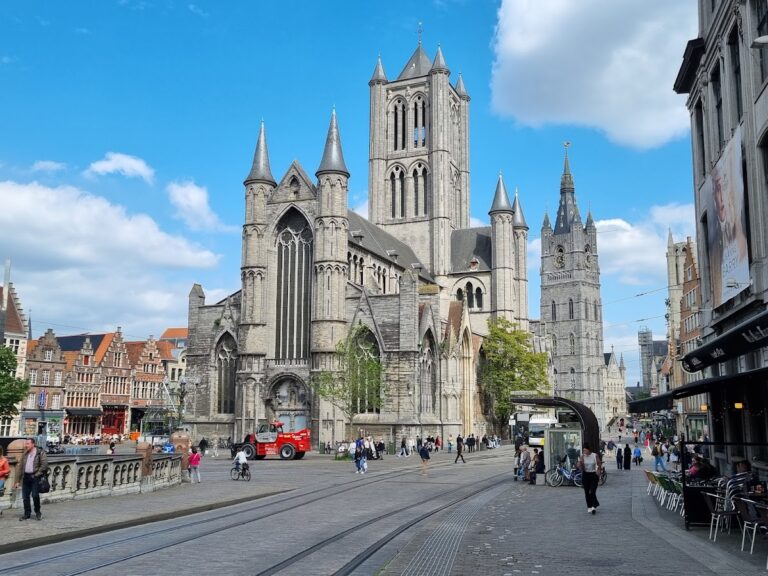
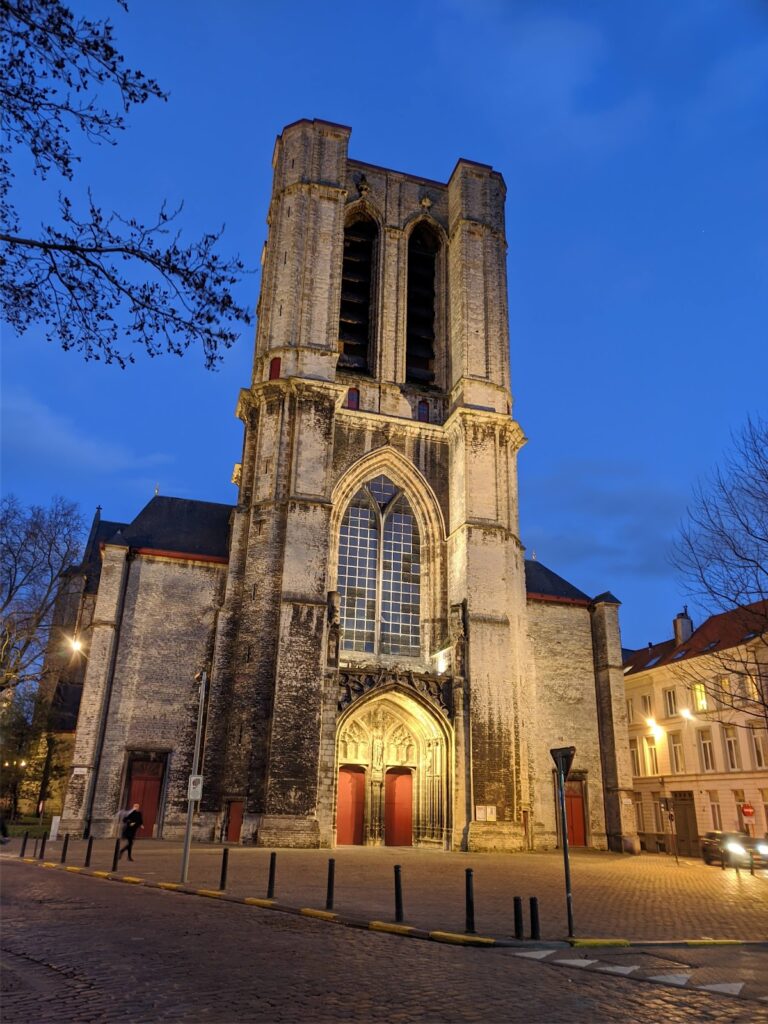
St Bavo’s Cathedral is an 89-metre-high Gothic building that incorporates Romanesque architecture and Brabantine Gothic. Pointed arches, large stained-glass windows, and strong vertical lines express its Gothic character. The western tower forms part of Ghent’s historic row of three towers, together with Saint Nicholas’s Church and the Belfry. It has four levels and four substantial pinnacles. A small original spire was later destroyed by fire.
Western tower and bells
Seven bells hang in the western tower. The largest, named Bavo, weighs 5,500 kilograms and was supplied by Florent Delcourt. The tower’s construction between 1462 and 1538 belongs to the cathedral’s Brabantine Gothic phase.
Romanesque crypt
The Romanesque crypt survives beneath the cathedral and preserves traces of the tenth-century chapel and the later Romanesque church. Its visible frescoes depict religious figures, providing a material link between the earliest place of worship and the later cathedral.
Choir and chapels
High choir and ambulatory
The high choir contains stalls for the Chapter of Saint Bavo, an episcopal throne bearing the bishop’s arms, and a gallery of painted coats of arms belonging to members of the Order of the Golden Fleece. This was a prestigious chivalric order founded in the fifteenth-century Burgundian Netherlands. The ambulatory is lined with chapels, portraits of bishops and honorary chapter members, and tomb monuments.
Altars and tomb monument
The Baroque high altar was made between 1702 and 1782 from white, black, and red flamed marble. The choir also contains a tomb monument to Bishop Antonius Triest, created in white and black marble between 1652 and 1654 by Jérôme Duquesnoy the Younger.
Nave and organs
Nave furnishings
The nave contains a Rococo pulpit made between 1741 and 1745 by Laurent Delvaux from oak, gilded wood, and white and black marble. Its wrought-iron railing was made by J. Arens. Contemporary chairs were designed by Maarten Van Severen, and the main altar stands between the nave and choir.
Historic organs
The cathedral’s four organs are used for liturgical celebrations. The older transept organ was built between 1653 and 1656 for Bishop Antonius Triest by Pierre Destré and Louis Bis of Lille. Lambertus Benoit Van Peteghem largely renewed it in 1767. Its carved organ front was probably made by a Ghent woodcarver or sculptor, and it retains an eighteenth-century Baroque case and registers from the earlier instrument.
In 1935, Bishop Coppieters ordered the installation of an organ by Johannes Klais that had originally been made for the Brussels World Exhibition. Its eighteenth-century case contains more than 6,000 pipes, while the instrument has five manuals and ninety registers. Built in two independent sections, the newer Klais organ extends along galleries above the choir stalls and frames the choir on both sides with pyramidal arrangements of pipes.
Painted works and the Ghent Altarpiece
The Ghent Altarpiece
The cathedral contains the Ghent Altarpiece, formally known as the Adoration of the Mystic Lamb. Hubert and Jan van Eyck painted the multi-panel work, or polyptych, and completed it in 1432. Originally installed in the Joost Vijd Chapel, it is regarded as a major work of the early Northern Renaissance and one of Belgium’s principal artistic masterpieces.
The lower-left panel, The Just Judges, was stolen in 1934 and has not been recovered. Jef Van der Veken made a facsimile to replace it. Since 2021, the altarpiece has been housed in the Sacrament Chapel, while a copy occupies its original chapel location. A monument beside the southern side of the sanctuary commemorates Hubert and Jan van Eyck.
Parts of the altarpiece were removed to Germany during the nineteenth and twentieth centuries. Panels acquired in 1816 by the collector Edward Solly and purchased in 1821 by King Frederick William III of Prussia were returned to Belgium under the Treaty of Versailles after the First World War. During the Second World War, the work was moved for protection from a museum in Pau to a Bavarian castle and then to galleries in a salt mine after Allied air raids endangered the castle. It returned to the cathedral after the war.
Other paintings
The choir contains Lucas de Heere’s 1559 painting The Queen of Sheba Visits King Solomon. It presents Philip II of Spain as Solomon and the Low Countries as the Queen of Sheba offering gifts in recognition of his prudent government. Philip II, who succeeded Charles V, ruled the Spanish Netherlands.
Other major works include Peter Paul Rubens’s Saint Bavo Enters the Convent at Ghent, also known as The Conversion of Saint Bavo, dated 1623–1624; Justus van Gent’s fifteenth-century Calvary Triptych; and Frans Pourbus the Elder’s Triptych of Viglius Aytta from 1571. Pourbus also painted fourteen panels showing the History of Saint Andrew in 1572.
Petrus Norbertus van Reysschoot painted eleven grisaille panels installed above the choir stalls between 1789 and 1791. Grisaille is monochrome painting in shades resembling grey stone. Five panels show scenes from the Old Testament and six depict episodes from the New Testament. The cathedral also holds Lucas de Heere’s View of Ghent, paintings by Caspar de Crayer including Saint Macarius of Ghent, The Beheading of Saint John the Baptist, and The Martyrdom of Saint Barbara, and works by Antoon van den Heuvel, Lucas van Uden, and Jan van Cleef.
Treasury and textiles
The cathedral treasury contains liturgical plate, reliquaries, and vessels dating from the fifteenth century onward. A reliquary is a container made to preserve or display a religious relic. The treasury includes the head of Saint John the Baptist and relics of Saint Macarius, as well as hand-embroidered and brocaded liturgical vestments and textiles dating from the fifteenth to the twentieth centuries.
Among the vestments is an older set from St Bavo’s Abbey that belonged to Lieven Hugenois. Its Renaissance embroidery depicts Mary’s Visitation to Elizabeth and the Annunciation. Another notable red vestment shows scenes from the Ghent Altarpiece and was made by Arte Grossé. Some vestments are displayed in the crypt, while others are kept in the episcopal sacristy adjoining the choir chapels.
Nearby sites