Legnica Cathedral: A Gothic and Neo-Gothic Cathedral in Poland


Site at a Glance
- Rating
- 4.8
- Popularity
- Medium
- Country
- Poland
- Primary era
- Medieval
- External website
- Open
- Eras represented
- Medieval, Early Modern, Modern
- Civilizations
- German, Holy Roman Empire, Kingdom of Bohemia, Kingdom of Prussia
- Site type
- Religious
- Remains
- Cathedral
On this page17 sections
History
Legnica Cathedral is a Gothic and Neo-Gothic church in Legnica, Poland, whose present building was constructed between 1333 and 1380. Dedicated to Saints Peter and Paul, it became the cathedral of the Diocese of Legnica in 1992 after a history of medieval expansion, Lutheran use, fire, Baroque alteration, and nineteenth-century rebuilding.
Origins and medieval development
The church was first mentioned in 1208, in a document issued by Henry the Bearded, a Silesian duke of the Piast dynasty who ruled in the early thirteenth century. A masonry church followed around 1225. That earlier building probably burned during the Mongol siege of Legnica in 1241.
Legnica received Magdeburg law in 1264. This medieval system of municipal law organized towns, regulated commerce, and defined urban privileges in Central Europe. As commercial activity became concentrated around the church, the Church of Saint Paul gained greater importance within the town.
The present church rose between 1333 and 1380. The masons included Wiland, probably the son of a Wrocław mason of the same name. Master Conrad of Kraków directed the construction from 1370 to 1378, and interior finishing continued from 1378 to 1390 under Master Klaus Parlirer. Vielkunst produced the Gothic window surrounds. During the fifteenth century, the church was enlarged by the addition of nine side chapels.
Religious change and rebuilding
In 1524 the church was transferred to the Lutherans. A major fire in 1648 destroyed the tower, the clock, and most of the furnishings, while also weakening the main nave. The tower was rebuilt by 1651, and a new clock began operating in 1652.
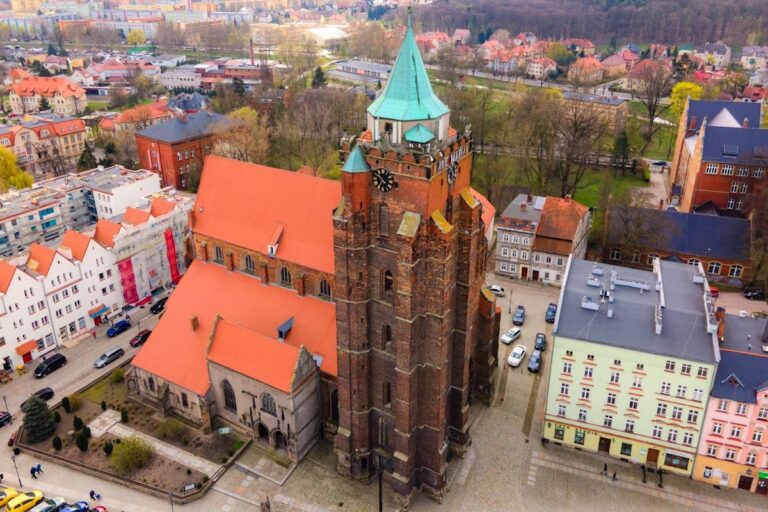
Repairs begun in 1743 introduced Baroque elements into the interior. The main altar was made between 1747 and 1764, adding a later layer to the medieval church. The building was subsequently rebuilt in the Neo-Gothic style, the nineteenth-century revival of medieval Gothic forms, between 1892 and 1894. The work followed a design by Johannes Otzen of Berlin, a German architect associated with Neo-Gothic church design. It added the south tower, reconstructed part of the exterior walls, and reworked architectural details.
Cathedral status and memorials
Roman Catholics regained the church in 1947, when Tadeusz Łączyński became its parish priest. On 25 March 1992, Pope John Paul II raised it to cathedral status through the bull Totus Tuus Poloniae Populus, making it the cathedral of the Diocese of Legnica. The pope visited the cathedral on 2 June 1997.
A memorial plaque to the victims of the Polish presidential Tu-154 crash at Smolensk was unveiled in the entrance vestibule on 10 April 2011. It bears the victims’ names and describes the late president as a target of ridicule for some people and as a hope for an independent and just Poland for many compatriots.
The cathedral’s burials also preserve memories of earlier religious and civic life. Captain-Lieutenant Joachim Friedrich of the Bilicer family of Prudnik was buried there in 1645. Sigismund Atcze, a canon of Wrocław and Legnica who died in 1482, was also buried in the church. Władysław Bochnak, a long-serving parish priest, was buried in the crypt on 5 November 2014, while Tadeusz Rybak, the first Bishop of Legnica, was buried in the underground area on 11 March 2017.
Remains
Legnica Cathedral stands on Cathedral Square as a brick church that combines medieval Gothic construction with nineteenth-century Neo-Gothic rebuilding. Its two towers frame the western front, while the surviving fabric and interior furnishings bring together features from the thirteenth through the twentieth centuries.
Exterior and entrances
Rose window and west portal
The round rose window between the towers is described as the oldest part of the church surviving today. A rose window is a large circular ornamental window, usually divided by tracery into radiating sections. Below it, the west portal was built between 1338 and 1341 and decorated with a Gothic stone statue of the Virgin and Child.
North portal
The north portal presents the Adoration of the Magi. This subject is described as rare in Gothic art, giving the entrance a distinctive place among the cathedral’s medieval sculptural features.
Chapels and medieval sculpture
The fifteenth-century enlargement created nine side chapels. Among them, the von der Heyde family chapel dates from 1420 and is distinguished by its star vaults. The interior also preserves a thirteenth-century sculpture group of the Apostles Peter and Paul, as well as another group of apostle sculptures from the first half of the fourteenth century.
The cathedral contains a Gothic tomb monument to Sigismund Atcze, the Wrocław and Legnica canon who died in 1482. A tomb slab commemorates Louis II, Duke of Legnica and Brzeg, and his wife Elizabeth of Brandenburg. The same slab has also been identified as belonging to Wenceslaus I of Legnica and Anna of Cieszyn.
Interior furnishings and artworks
Baptismal font and pulpit
The bronze baptismal font was made before 1300. Shaped like a chalice, it carries twelve biblical scenes. The Renaissance pulpit was produced from white sandstone between 1586 and 1588. The armorer Alexander Eckstein funded it, and the Legnica sculptor Kasper Berger executed the work.
Altar and choir stalls
The Baroque main altar was made between 1747 and 1764 and contains a painting of the Resurrected Christ by the Wrocław painter Jan Henryk Kynast. Renaissance choir stalls dated 1568 have a column-supported canopy bearing the city coat of arms and representations of Saints Peter and Paul.
Paintings and devotional sculpture
A sixteenth-century pentaptych in the north chapel is composed of five connected panels. It depicts Saint Anne in the Trinity, meaning Saint Anne with the Virgin Mary and the Christ Child, together with Saint Hedwig and scenes from the Passion of Christ. It is described as the building’s most valuable and only example of Gothic painting in the north chapel.
A stone Ecce Homo sculpture from the beginning of the sixteenth century shows Jesus and Pontius Pilate. The title refers to the Christian devotional image of Christ being presented to the people before his crucifixion.
Organ and bell installations
Organ
The organ prospect, the visible case and façade with its display pipes, dates from 1723 and was made by Ignatius Mentzel. The organ itself was built in 1894 by Schlag & Söhne of Świdnica, an organ-building firm based in that city. Gustav Heinze slightly rebuilt it in 1928, and the Broszko brothers’ firm of Bolesławiec extensively renovated it in 1991. The instrument has 53 stops and three manuals.
Carillons and bells
The first carillon was installed in the south tower in 1893. A carillon is a set of tuned bells played mechanically or from a keyboard. This one consisted of nineteen bells with a combined weight of 3,500 kilograms, cast by Franz Schilling’s foundry in Apolda. Connected to the clock, it played religious melodies hourly from 6:00 to 22:00 until Nazi authorities requisitioned it for military purposes in 1944.
A later carillon, funded through the initiative of Gerhard Simon, consists of eighteen bells cast in the Netherlands. The tower currently has three bells. The two largest came from the former Church of Saint Mary Magdalene in Zatonie near Bogatynia, a village that disappeared as the Turów mining area expanded, while the third survived the wartime confiscations. The bells bear inscriptions rather than personal names, and two of the smaller bells are dedicated to those killed in the First World War.
After several years of silence, the bells were renovated in 2018. The work supplied new mountings, clappers, and a new mechanism for operating them. A bell’s clapper is the internal piece that strikes the sound-producing surface.
Later memorials and burials
The cathedral’s later commemorative features include the memorial plaque in the entrance vestibule and the burials in its crypt and underground area. Together with the tombs and epitaphs inside the church, they connect the surviving building with religious leaders, military figures, families, and public events from different periods of Legnica’s history.
The interior also includes the tomb monument of Johan Sighofer and his wife, dated 1649, and a double epitaph for Bartholomeus and David Gerstmann from the beginning of the seventeenth century. These features remain part of the layered interior created by the medieval church, the Lutheran period, the Baroque repairs, and the Neo-Gothic reconstruction.