Cathedral of the Theotokos, Vilnius: An Orthodox Cathedral with a Medieval History


Site at a Glance
- Rating
- 4.8
- Popularity
- Low
- Country
- Lithuania
- Primary era
- Modern
- External website
- Open
- Eras represented
- Medieval, Early Modern, Modern
- Civilizations
- Grand Duchy of Lithuania, Russian
- Site type
- Religious
- Remains
- Cathedral
On this page13 sections
History
The Cathedral of the Theotokos in Vilnius, Lithuania, is a Gothic church founded in 1346 under Grand Duke Algirdas of Lithuania. An inscription at the entrance attributes the foundation to Algirdas, while tradition says that he chose the site near his palace and built the church for his wife, Uliana of Tver. The church was consecrated in 1348 by Alexius, Bishop of Vladimir and Metropolitan of Kyiv and All Rus. It became known both as the Dormition Cathedral, referring to the traditional Christian account of Mary’s death and assumption, and as the Prechistensky Cathedral, meaning “Most Pure.”
Medieval Orthodox cathedral
In 1415, during Vytautas the Great’s attempt to establish a separate Lithuanian Orthodox metropolitanate, Metropolitan Gregory Tsamblak moved his residence to Vilnius. The church became the cathedral of the Kyiv metropolitanate for the western dioceses. After eastern metropolitans stopped using the title of Kyiv in 1435 and were known as metropolitans of Moscow from 1448, the Vilnius cathedral became the sole see of hierarchs who held the title “Metropolitan of Kyiv, Galicia and All Rus.” A metropolitan was a senior bishop responsible for a province and its subordinate dioceses, while a cathedral was the principal church of such a bishop.
On 15 February 1495, the cathedral hosted the marriage of Grand Duchess Elena Ivanovna and Grand Duke Alexander of Lithuania, later King of Poland. Archimandrite Macarius conducted the service. He was later killed by Tatars and canonized, and the cathedral’s right chapel was consecrated in his honor. Elena was buried in the cathedral and died in 1513.
Rebuilding and confessional change
In 1507, the dome collapsed during nearby work to drive piles and reinforce the banks of the Vilnia River. The damaged cathedral declined until Konstantin Ivanovich Ostrozhsky, Grand Hetman of Lithuania and a protector of Orthodoxy in the Grand Duchy of Lithuania, supported its reconstruction. The rebuilding took place from 1511 to 1522.
In 1589, Patriarch Jeremiah II of Constantinople and several Orthodox hierarchs consecrated Michael Ragoza as metropolitan in the cathedral. Ragoza later became the first Uniate metropolitan of Kyiv and took part in the origins of the Union of Brest. In 1609, his successor, Metropolitan Ipatius Potey, held a service for the union of the churches and commemorated the pope of Rome during the liturgy. The cathedral belonged to the Uniate Church from that year. Uniates retained Byzantine worship while recognizing the authority of the pope.
Repeated fires and alterations transformed the building and erased much of its earlier appearance. After a major fire in 1748, services moved to the small Church of the Savior on the cathedral’s south side, known as the “warm” church. The residence of the Uniate metropolitans moved to Radomyshl, and the cathedral’s effective operation as a metropolitan see ended. Its formal institutional role ceased in 1795, when the Russian Empire abolished the Uniate metropolitanate.
Secular uses and Orthodox restoration
In 1785, Metropolitan Jason Smogorzewski restored the cathedral in Baroque forms and converted the Church of the Savior into a hospital. Following the abolition of the Uniate metropolitanate, the building passed to the Basilian Monastery of the Holy Trinity. The Basilian Order was an Eastern Christian monastic order associated with the Uniate Church.
Persecution of the Uniate Church and the Basilian Order by Russian authorities contributed to the cathedral’s decline. In 1806, military authorities bought the building for 3,000 rubles and used it as a grain store. It was transferred to Vilnius University in 1808. Architect Michal Schulz then radically adapted it in the Classical style. An anatomical theatre opened inside in 1815, alongside teaching rooms and a library. After the Vilnius Medical-Surgical Academy was abolished in 1841, the building successively housed barracks, an archive, commercial and service premises, private apartments, a smithy, and a veterinary clinic. Its ecclesiastical appearance was almost entirely lost.
In 1864, Vilnius Governor-General Mikhail Muravyov and his brother Andrei Muravyov initiated a Russian-wide subscription to finance a new restoration. From 1865 to 1868, Alexander Rezanov and Nikolai Chagin directed the work. The building returned to the Russian Orthodox Church and was reconsecrated in October 1868, corresponding to November in the Gregorian calendar. The parish had 424 permanent members in 1946 and was officially registered in 1948. Major repairs followed in 1949 and 1957, with further restorations in 1980 and 1998.
Cathedral life and protection
During the 1930s, the cathedral choir was directed by the Belarusian cultural figure Ryhor Shyrma. On feast days, it sometimes performed Belarusian religious chants. The cathedral remains an Orthodox cathedral of the Vilnius and Lithuanian Diocese and has included a Sunday school and services of Russian sacred music among its activities. It entered the Register of Cultural Values of the Republic of Lithuania as number 1104 in 1992 and has been under state protection since then.
Remains
Cathedral building
Original Gothic church
The cathedral stands in Vilnius’s Old Town, in the Vilnia River valley on the riverbank. Its original brick structure was Gothic, with a square plan measuring approximately 36 metres on each side. Three apses, projecting parts of a church usually placed at the eastern end, extended from the east side, while four interior columns probably supported the dome. A late-sixteenth- or early-seventeenth-century engraving by Tomasz Makowski shows a massive Gothic building with a triangular fronton, visually similar to nearby Roman Catholic churches.
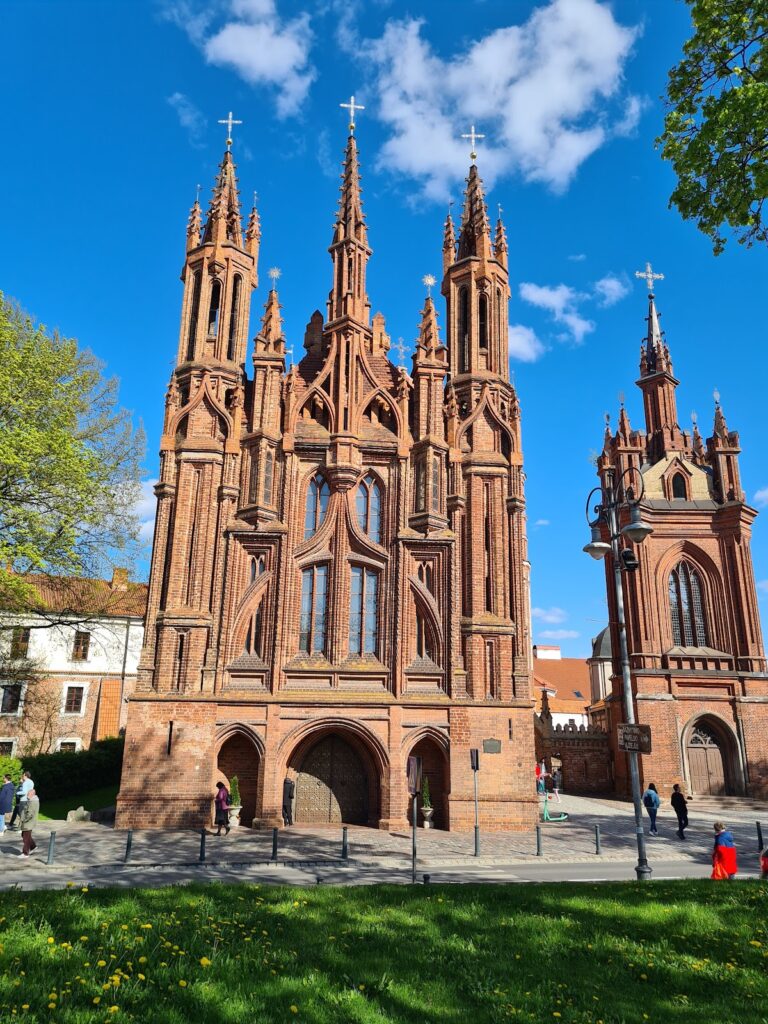
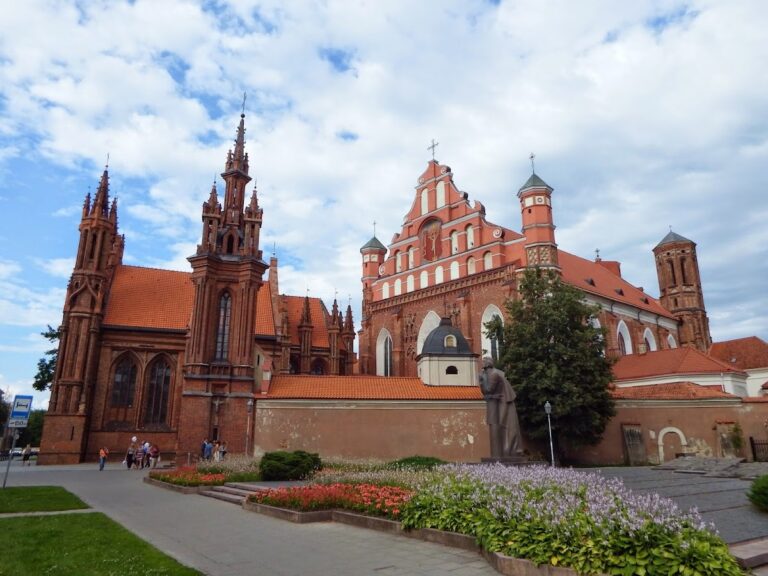
Tradition attributes the original construction to craftsmen from Kyiv, who supposedly followed the model of Saint Sophia Cathedral in Kyiv. This attribution remains uncertain. The cathedral is near the churches of Saint Anne, the Bernardine Church of Saint Francis, and Saint Michael.
Nineteenth-century exterior
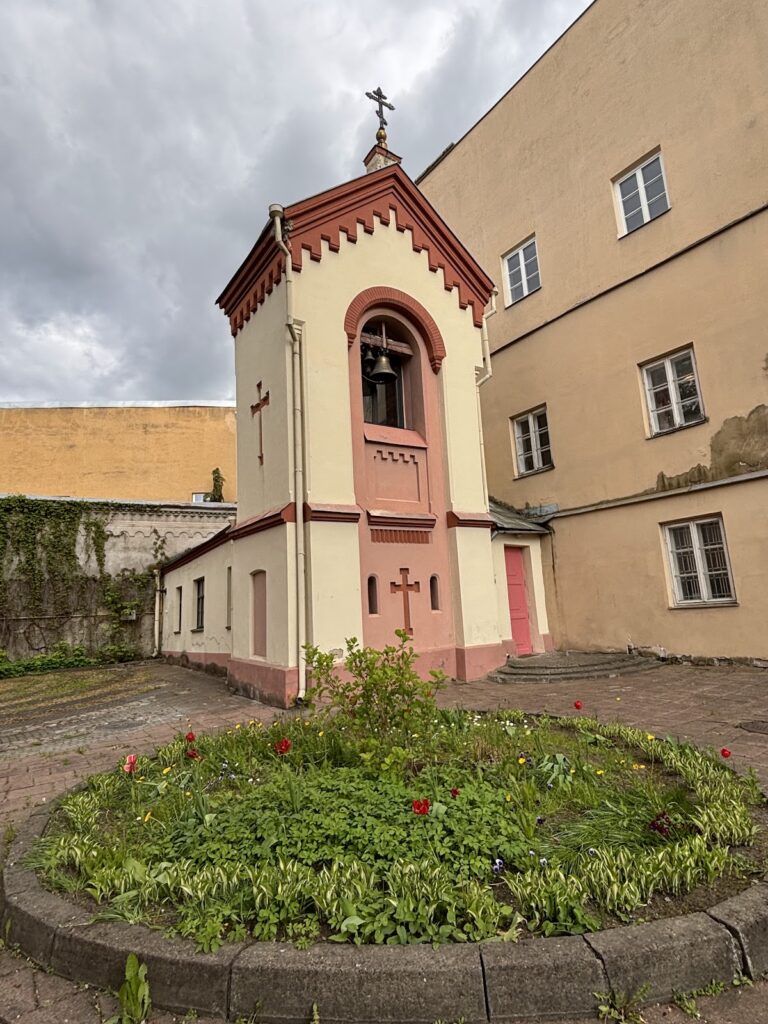
The restoration of 1865 to 1868 added three lateral towers and raised one surviving lateral tower. It also installed a metal central dome with a tent-shaped roof. Although substantial surviving fragments retain a strongly Gothic character, the rebuilt church received a restrained Romanesque treatment. The tent-shaped tower and dome roofs were unusual in Byzantine-Russian ecclesiastical architecture and gave the building visual affinities with Armenian and Georgian sacred architecture.
Iconostasis
Inside, the five-tier iconostasis contains 73 icons. An iconostasis is the screen of icons separating the sanctuary from the main body of an Eastern Christian church. Painter Ivan Trutnev made the screen and served as the church warden for two decades. Its icons include Saint Euphrosyne of Polotsk, Saint Alexander Nevsky, and other saints associated with the western Rus lands.
Associated chapels and church
Church of the Savior
The small Church of the Savior stood on the cathedral’s south side and served as the “warm” church after the fire of 1748. In 1785, it was converted into a hospital during Metropolitan Jason Smogorzewski’s restoration of the cathedral.
Chapel of Saint Macarius
A chapel on the cathedral’s right side is dedicated to Saint Macarius. It commemorates the archimandrite who conducted the marriage service of Elena Ivanovna and Alexander in 1495, was later killed by Tatars, and was canonized.
The building’s present stylistic appearance is substantially the result of the 1864 to 1868 restoration. It remained generally intact after the restoration carried out in 1998.
Nearby sites