Adria Cathedral: The Cathedral Church of Saints Peter and Paul in Italy


Site at a Glance
- Rating
- 4.5
- Popularity
- Low
- Country
- Italy
- Primary era
- Modern
- External website
- Open
- Eras represented
- Medieval, Modern
- Civilizations
- Holy Roman Empire, Italian
- Site type
- Religious
- Remains
- Cathedral
On this page20 sections
History
Adria Cathedral is a Roman Catholic church in Adria, Italy, whose present building was constructed at the beginning of the nineteenth century over a fourteenth-century church. Dedicated to Saints Peter and Paul, it developed from an early Christian episcopal center and remains the cathedral of the Diocese of Adria-Rovigo.
Early Christian and Medieval Adria
Christianity reached Adria from Ravenna between the late second and early third centuries. During the fourth century, the town became part of the Exarchate of Ravenna, the Byzantine imperial territory that governed much of northeastern Italy from Ravenna, and an episcopal see was established there.
Gallionisto is the first known bishop of Adria. In 649 he attended the Lateran Synod presided over by Pope Martin I. The synod condemned Monothelitism, a seventh-century doctrine that held that Christ had one will. Inscriptions at the Basilica of the Tomba preserve the names of Bishops Bono and Giovanni and date from the late eighth or early ninth century. Relics found beneath the high altar of the Old Cathedral in 1746 were associated with Bishop Teodino, who had attended the Council of Ravenna in 877.
In 920, Pope John X instructed Bishop Paolo to build a castle at the Bonevigo court, also called Rodige, on the condition that he rebuild the ruined Church of Blessed Peter in Adria. The castle was functioning by 950, but the cathedral was rebuilt only about a century later. Construction begun in 1050 by Pope Benedict I was completed in 1067 by his successor, Tutone, who added defensive structures to protect the sacred site.
Rebuilding and the Old Cathedral
A new church with three naves was built on higher ground over the medieval building in 1407. It was restored in 1463 and renewed and reconsecrated on 22 May 1644 by Bishop Giovanni Paolo Savio. The medieval church had altars dedicated to the Holy Cross, Saint Anthony of Padua, and the Madonna della Vita, later known as the Madonna della Salute. Its wooden crucifix, made by an unknown artist, is now preserved in the present cathedral. The bell tower was rebuilt in 1686.
By the middle of the eighteenth century, the existing cathedral was regarded as too small and insufficiently solid. A larger church was therefore planned and built over the fourteenth-century structure. The present Cathedral of Saints Peter and Paul replaced the much older cathedral dedicated to Saint John. The earlier building, also called the Old Cathedral or the Church of Saint John, continues to function as a parish church.
In 1830, Bishop Arnaldo Speroni degli Alvarotti ordered the demolition of more than half of the old cathedral. Investigations into the stability of its foundations uncovered a painted chapel or apse, often but incorrectly called a crypt. The surviving structure is probably one of three apses from a second cathedral built inside the castle during the second half of the tenth century. No other trace of that cathedral remains.
The Present Cathedral
The new church was completed in 1836 with altars, a pipe organ attributed to the Callido workshop, a choir loft, altarpieces, and liturgical objects. Bishop Giuseppe Apollonio consecrated it on 10 September 1882 and dedicated it to Saints Peter and Paul, who are also the patrons of Adria. A project to complete the facade was prepared during the Holy Year of 1900 but was not finished. The portals were completed during the Holy Year of 1925, and Bishop Anselmo Rizzi blessed the main door on 1 February that year.
The cathedral was historically the episcopal seat of the Diocese of Adria and has been the cathedral of the Diocese of Adria-Rovigo since 1986. It is recognized as an Italian national monument. The silver Hand of Saint Peter reliquary remains in liturgical use during the feast of Saints Peter and Paul on 29 June.
Collections and Institutional Memory
The cathedral library was moved from its original location above the Canons’ sacristy to the left side of the bishop’s palace. It contains more than 15,000 volumes, chiefly concerning history, theology, liturgy, and music. Armenian, Indian, and Dalmatian volumes once held in the collection have been lost.
The Chapter Archive, housed beside the cathedral in the Bishop’s Palace since 1970, contains mainly episcopal, capitular, and parish records. Its materials include records of births, baptisms, marriages, and deaths from the seventeenth century onward. The Cathedral Museum opened on 3 October 2015. Its Origins Room, Picture Gallery, and Treasury present the history of the Diocese of Adria, the cathedral’s transformations, ecclesiastical art, documents, and sacred objects.
Remains
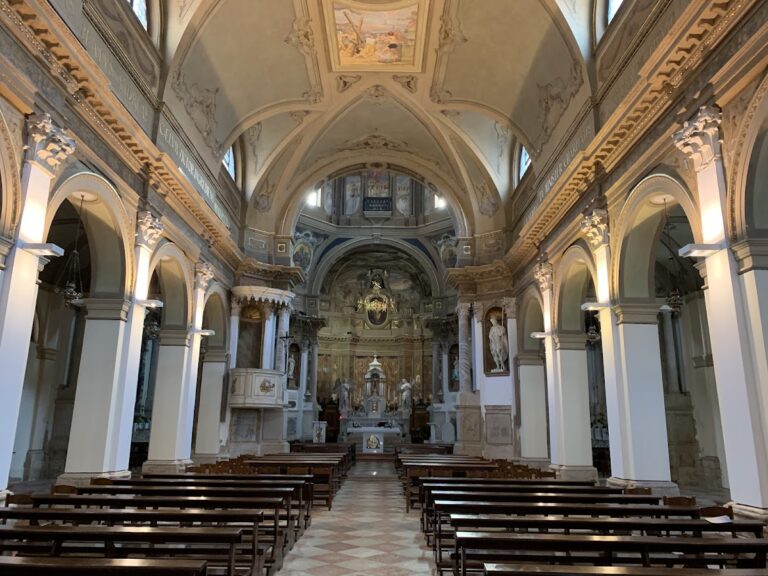
Adria Cathedral measures approximately 70 metres in length and 33 metres in width. Its plan is a Latin cross with three naves, six recessed chapels, and two larger chapels beside the transept. The broad facade remains in plain, unfinished brickwork, while a freestanding bell tower stands beside the church and the south side opens toward Piazza Campanile.
Exterior and Main Interior
Facade and Portals
The unfinished facade has three portals. Columns flank the central entrance, which is topped by a pediment and a marble statue of the Redeemer. The plain brick surface gives the exterior its incomplete appearance.
Interior Plan and Presbytery
The floor of the interior uses white, black, and Verona-red stone and was designed by engineer Luc’Antonio Lupati in 1830. A balustrade of red Verona marble encloses the presbytery, which ends in a frescoed apse. The chapter altar, made entirely of Carrara marble, was blessed in 1825. Frescoes occupy the ceiling above the choir, while paintings decorate the tribune.
The choir frescoes show episodes from the life of Saint Bellinus, the principal patron of the diocese, together with the Glory of Saints Peter and Paul. Behind the high altar is an artistically inlaid walnut choir. A stained-glass window fills the thermal window in the counterfacade. Made in 1941 by the Pritoni workshops of Bologna from a design by Antonio Maria Nardi, it depicts the Assumption of the Virgin between Saints Peter and Paul.
Organ and Later Works
The cathedral’s organ was built in the 1950s by the Fabbrica Organi Ruffatti of Padua and incorporates material from an earlier organ made by Giuseppe Malvestio in 1933. The Malvestio-Ruffatti instrument has three keyboards and stands on a choir loft beside the presbytery. It was restored in 2010.
Five tempera panels by Graziano Martini hang on the wall to the left of the altar. They depict the Mysteries of Light: the Baptism of Jesus, the Wedding at Cana, the proclamation of the Kingdom of God, the Transfiguration, and the institution of the Eucharist. Cardinal Ersilio Tonini blessed the panels on 12 October 2003 in the presence of Bishop Andrea Bruno Mazzocato.
Medieval Remains and Sacred Evidence
Surviving Apse
The apse-like structure uncovered during the foundation works of 1830 has a semicircular Romanesque choir or apse plan. Its plain base is followed by an ornamental stucco band, a central single-lancet window, and lateral niches. Later alterations left the upper part incomplete.
Six painted apostles survive on its wall. Executed in fresco in a Carolingian artistic style associated with western European art of the eighth and ninth centuries, the figures are enclosed in circular medallions and identified by Latin inscriptions. The composition is incomplete, and only the lower edge of the central medallion survives, possibly indicating a former image of Christ Pantocrator, the all-powerful ruler traditionally shown in a central apse position.
Altar and Relics
Groundwater beneath the building damaged the frescoes, so a drainage system was installed to divert the water before it reached floor level. The present concrete floor incorporates an altar table found in its original position. Four recesses in its sides were intended to hold apostles’ relics.
Two inscriptions on the third pillar on the right commemorate the cathedral’s consecration on 10 September 1882 and the transfer in 1822 of relics associated with the early Christian martyrs Agricola, Blaise, Nicholas of Myra, Sigismund, Vitalis, and Victor. The relics had been found during work at the high altar of the Old Cathedral in 1746.
Bell Tower and Surroundings
Bell Tower
The freestanding bell tower rises approximately 60 metres from its base to the statue on the spire. It contains five swinging bells arranged in D major, beginning at D3. The three largest were cast in 1891 at the Pietro Colbachini foundry in Bassano del Grappa. Another was cast in 1965 in Padua by the Colbachini foundry, while the fourth was cast in 2011 by the De Poli foundry of Vittorio Veneto, now located in Revine Lago.
Grotto of Lourdes
Behind the cathedral is a reproduction of the Grotto of Lourdes, built during the 1930s.
Museum Collections and Furnishings
Origins Room
The Origins Room contains a Coptic bas-relief of the Virgin and Child enthroned between the archangels Gabriel and Michael, the small Carolingian-style apse with its apostle figures, a baptismal vessel modeled on the standard form of early Christian baptisteries, and a limestone male head. After a new baptistery was built in 1870, the vessel was reused as a holy-water font. The room also contains a chest whose frontispiece identifies it as intended for offerings toward construction of the cathedral.
Picture Gallery
The Picture Gallery preserves altarpieces and canvases commissioned for the cathedral’s altars, together with half-length portraits of cardinals, bishops, and prelates dating from the early fourteenth to the early nineteenth century. Its works include portraits of Adria’s bishops Pellegrino Ferri, Girolamo Porcia, Bartolomeo Roverella, Federico Maria Molin, and Arnaldo Speroni degli Alvarotti. A two-sided wooden-panel crucifix known as the Crucifix of Lepanto is also preserved there.
Treasury and Sacristy
The Treasury contains sacred art and liturgical objects made from precious materials. Among them are the silver Hand of Saint Peter reliquary, which contains relics of Saints Peter and Paul, a flask-shaped reliquary with a gilded copper Madonna, Child, and angel, and a silver reliquary shaped like a monstrance, the vessel used to display the consecrated host.
A mid-seventeenth-century throne for the Blessed Sacrament has a wooden core covered by a partly gilded silver frame decorated in repoussé. Made for exposition of the sacrament during the Forty Hours’ devotion, a Catholic period of continuous Eucharistic adoration, it bears volutes, imitation shells, vegetal motifs, and two cherub heads beneath the monstrance plate. The throne remains in liturgical use. The sacristy contains finely carved cabinets attributed to Giacomo Piazzetta of the Venetian School of Charity. The cathedral also preserves a sixth-century Byzantine bas-relief, a Byzantine altar, and a Byzantine crucifix.