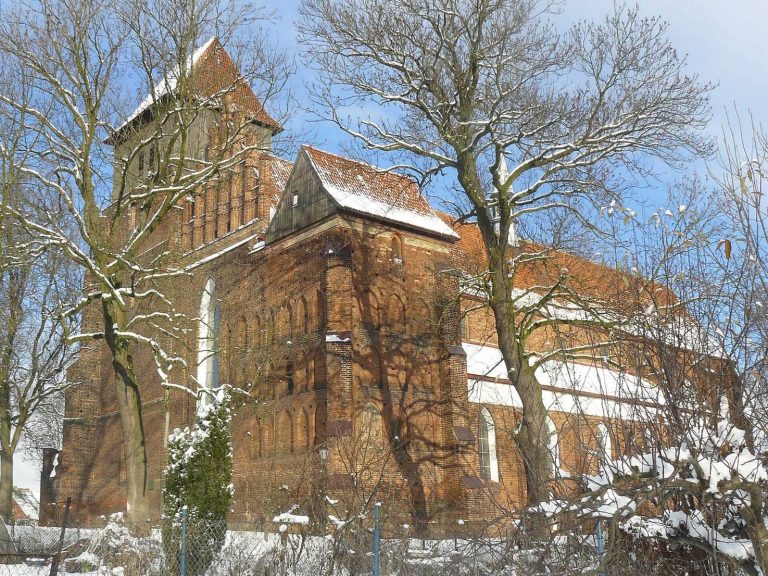
St. Nicholas Cathedral, Elbląg: A Historic Parish Church and Cathedral in Poland


Site at a Glance
- Rating
- 4.6
- Popularity
- Medium
- Country
- Poland
- Primary era
- Medieval
- External website
- Open
- Eras represented
- Medieval, Early Modern, Modern
- Civilizations
- German, Kingdom of Poland, Kingdom of Prussia, Teutonic Order
- Site type
- Religious
- Remains
- Cathedral
On this page14 sections
History
St. Nicholas Cathedral, Elbląg, is a medieval brick church in Poland whose origins date to about 1247. Originally the parish church of Elbląg’s New Town, it is dedicated to St. Nicholas of Myra, a fourth-century Christian bishop whose cult spread widely across Europe. The church is the seat of the city’s oldest parish and later became the cathedral of the Diocese of Elbląg.
Medieval foundation and expansion
The New Town developed during the tenure of Commander Siegfried von Sitten between 1332 and 1342, in competition with the older city. It was intended to remain independent of the rule of the Teutonic Order, a medieval Catholic military and religious order that controlled extensive territory in the eastern Baltic. Construction at St. Nicholas continued gradually for two centuries. The initial towerless hall church was altered into a basilica, a church whose central nave rises above its side aisles, after a tower was added and the nave was raised. Later, the side aisles were raised as well, returning the building to the form of a hall church, in which the nave and aisles are of roughly similar height.
By 1428, two additional towers of almost equal height had been built beside the main tower. Their construction helped stabilize the tower after the central nave had been raised and created a three-part western structure described as unique in the region. The church also became a repository for the relics of the Holy Cross. A fragment had been given by Emperor Frederick II Hohenstaufen to Hermann von Salza, Grand Master of the Teutonic Order, in the thirteenth century. The relics were first kept in the Teutonic castle and were transferred to St. Nicholas after the castle was captured in 1454.
Lutheran and Catholic use
In 1573 the church was taken over by the Lutheran community and became the principal Lutheran church. Catholic restoration efforts led by Szymon Rudnicki, Prince-Bishop of Warmia, resulted in its return to the Catholic parish through an agreement with the city council in 1616. Apart from Swedish occupations between 1626 and 1631 and between 1655 and 1660, it remained Catholic until 1945, even though Catholics were a minority in the city.
Several changes marked the church during this period. Manierist gables with clocks were added to the west and east sides in 1576. Between 1599 and 1603, a superstructure divided by two galleries was built between the main tower and the clock towers. Its color gave it the popular name “Green Tower.”
Fire, rebuilding, and altered form
A lightning strike during a storm in 1777 ignited the tower and then the church. The fire destroyed the towers and roof, while the collapse of the vaults ruined the high altar and much of the remaining furnishings. The city could not afford a full reconstruction. All three towers were therefore demolished, the building was lowered by more than 6.5 metres, and its interior and roof were substantially changed. The former triple-ridge roof was replaced by a single gabled roof, and baroque sail vaults, which curve upward from corner supports like filled sails, were installed. The walls and pillars were plastered, previously polychromed sculptures were painted white, and the high altar was reconstructed in 1790.
A new tower was erected on the site of the destroyed three-towered west front in 1906 and 1907. Its foundation stone was laid on 24 October 1906, and its form was intended to restore a prominent element of the church’s historic silhouette. The First World War brought another loss when all six bells were requisitioned for melting for military purposes. Replacement bells were made and installed in 1928.
Conservation and the work of Arthur Kather
Parish priest Arthur Kather directed important conservation work before and after the First World War. In 1915 he repaired and conserved the sacristy, began rearranging and preserving the altars, and oversaw the discovery and conservation of valuable late-fourteenth-century Gothic paintings. In 1923 he initiated the cleaning and conservation of the interior. He also arranged a memorial plaque for parishioners killed in the wars of 1813, 1870 to 1871, and 1914 to 1918.
Kather opposed National Socialism and conducted prohibited services for forced laborers in Elbląg and its surroundings. On the orders of Gauleiter Albert Forster, he was expelled from West Prussia in 1940.
Destruction in 1945 and postwar reconstruction
During the Red Army’s capture of Elbląg from 26 January to 10 February 1945, the cathedral was burned out on 2 February. Jan Ostrowski, a former participant in the Warsaw Uprising, was the first Polish priest to arrive in the city. Because the ruined cathedral was not expected to be rebuilt quickly, Hilary Pracz-Praczyński, a Conventual Franciscan sent by the Ministry of Public Administration in July 1945, worked to restore a former Baptist chapel for worship.
On 2 April 1946, Teodor Bensch, Apostolic Administrator of the Diocese of Warmia, assigned Ludwik Białek to the parish, and Białek continued the work on the chapel. Wacław Hipsz became parish priest and dean of Elbląg on 31 December 1947. He established the Committee for the Reconstruction of the Historic St. Nicholas Church on 7 May 1948, and clearance began on 25 July. About 7,000 cubic metres of rubble were removed by rail carts, with approximately 25 people volunteering each day, including local school students and members of the Polish Service.
The reconstruction included preparations for a concrete ceiling, which was cast and sealed with bituminous roofing felt in 1950. Clerical persecution interrupted the work. Hipsz was ordered to leave Elbląg within three days on 10 February 1952 and was transferred to Ostróda, while approval of his successor was delayed. Gracjan Rudnicki succeeded him, and Gedymin Pilecki took over the parish in May 1954.
Pilecki raised funds to continue the reconstruction, concentrating especially on the roof and the historic silhouette. A storm on 17 January 1955 removed three windows, shattered many other panes, and tore away the roof over the sacristies. Pilecki also transferred furnishings from abandoned churches to Elbląg, including organs, benches, pulpits, and altarpieces from Rozgart, Nowe, Jasna, Stalewo, and Fiszewo. On 28 May 1955 he obtained the former high altar from the Three Kings Church in Elbląg’s New Town in exchange for a wooden St. Joseph altar.
The tower’s steel structure was questioned by some monument conservators, who considered it too dominant. An expert commission convened through Pilecki ruled on 29 June 1956 that the structure was unique, protected, well preserved, and capable of lasting for another twenty years. It recommended retaining the steel tower helmet and recreating its covering according to conservation requirements. Pilecki bought 100,000 bricks in May 1957 and exchanged 60,000 of them in October for bricks salvaged from the church at Kadyny. The exchanged bricks were used to repair the damaged tower.
Reconstruction can be regarded as complete by 1965, while stained-glass windows were installed between 1969 and 1989. The church entered the heritage register under number 17/N on 21 November 1959. It became the cathedral of the Diocese of Elbląg on 25 March 1992 and remains both a parish church and the cathedral of the diocesan ordinary. In 2000 it was declared a Sanctuary of the Holy Cross, a church or shrine given a particular status because of a relic, devotion, or pilgrimage tradition.
Remains
Layout and exterior
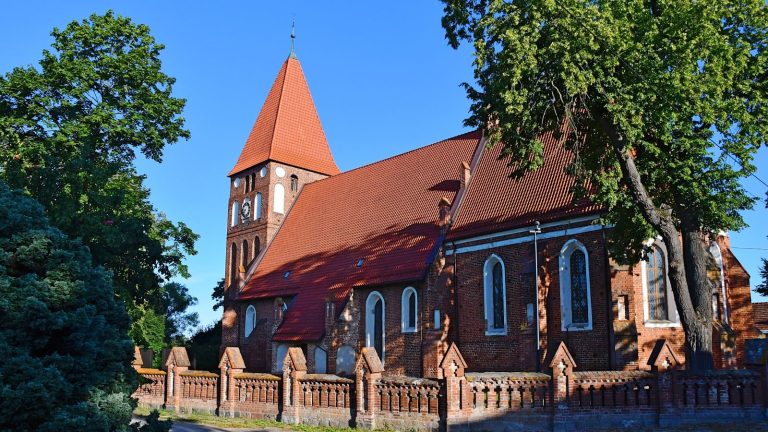
St. Nicholas Cathedral is a three-aisled brick Gothic building with a single principal tower. The initial medieval structure consisted of a rectangular chancel, the part of a church containing the high altar and normally reserved for clergy, and five bays, or structural divisions, of the nave. Its present tower is listed as 97 metres high, making the church one of Poland’s highest religious buildings and the highest church tower on the right bank of the Vistula.
Principal tower
The present tower was built in 1906 and 1907 in place of the fire-destroyed three-towered west front. It rises 95 metres and has wooden and copper cladding that recalled the earlier Green Tower. Its first floor contained a parish library of about 1,500 volumes, including many medieval books. The upper floors held the clock mechanism and six bronze bells. The retained steel tower helmet and its reconstructed covering formed part of the postwar conservation decision to preserve the structure.
Sacristy and roof
The present sacristy dates from 1402. Its original Gothic vaults were exposed to renewed damage when the roof over the sacristies was torn away in the storm of 1955. A marble floor was laid in 1850 using material imported from mines at Namur and Dinant in Belgium. The roof and ceiling were substantially altered after the fire of 1777, when the triple-ridge roof gave way to a single gabled roof and the church received baroque sail vaults.
Interior furnishings and devotional objects
Altars and sculptures
The interior contains a Gothic bronze baptismal font dated 1387 and made by Master Bernhauser, wooden figures of the apostles, and a large Gothic sculpture of St. Nicholas. Late-Gothic altars transferred from other Elbląg churches include those of the Three Kings, the maltsters, the Virgin Mary, and the raftsmen. The high altar is associated with Schofstein and reflects contacts with sculptors in Nuremberg, Würzburg, and Kraków.
A side chapel dedicated to St. Olaf contains a Passion altar transferred from the demolished church at Kadyny. The outer sides of its wings bear the coats of arms of its donors, Wilhelm II and Auguste Viktoria. The Holy Cross reliquary, a container made to preserve and display a religious relic, dates from about 1400. It was damaged in 1945 and restored in 1971. An inventory made in 1992 counted 1,054 fire-drill marks on the cathedral building.
Organs
The first organ was installed in 1397, and by 1404 the church had two instruments, described in 1453 as a large and a small organ. The organs were repeatedly rebuilt over the following centuries before being destroyed in the fire of 1777. A provisional instrument was then constructed, followed by a 35-stop organ commissioned from Arendt in Gdańsk. Built between 1818 and 1821 and consecrated on 21 October 1821, it was financed by the church and local community, which collected 993 thalers, while the Protestant merchant Gottfried Schiplick donated 2,000 thalers.
Bruno Göbel of Königsberg built another organ in 1926 with 53 stops, three manuals, and a pedal. It was destroyed in the cathedral fire of 2 February 1945. In 1955, Pilecki commissioned Zygmunt Pietrzak’s firm in Włocławek to reconstruct an instrument from remains obtained from the church at Nowe. The rebuilt organ has pneumatic action, two manuals, a pedal, and 26 stops. Its manual compass is C to f3 and its pedal compass C to d1. The instrument was renovated and enlarged in 2011.
Bronze bells
The tower contains three bronze bells cast in Bochum in 1929 and transferred in 1950 from the damaged and later demolished St. Anne’s Church in Elbląg. The largest weighs two tonnes, sounds the note C, and bears inscriptions translated as “Be joyful in hope” and “Cast in place of the bronze bells surrendered during the World War of 1914 to 1918.” The middle bell weighs 1,350 kilograms, sounds D-sharp, and bears the words “Patient in tribulation.” The smallest weighs 950 kilograms, sounds F, and bears “Persist in prayer,” together with an inscription dedicating it to the evangelical St. Anne’s parish community in Elbląg.