Patti Cathedral: A Norman-Founded Episcopal Church in Italy


Site at a Glance
- Rating
- 4.6
- Popularity
- Low
- Country
- Italy
- Primary era
- Early Modern
- External website
- Open
- Eras represented
- Medieval, Early Modern
- Civilizations
- Kingdom of Sicily, Norman, Spanish
- Site type
- Religious
- Remains
- Cathedral
On this page16 sections
History
Patti Cathedral is a Roman Catholic church in Patti, Italy, dedicated to Saint Bartholomew the Apostle and serving as the episcopal seat of the Diocese of Patti. The Norman count Roger I of Altavilla founded the Benedictine Monastery of the Most Holy Savior beside the Norman castle, probably in 1082 or 1083, and commissioned its first church, whose construction is dated to 6 March 1094. The cathedral is the principal, largest, and oldest church in Patti, standing beside the episcopal palace and seminary.
Norman foundation and the diocese
The monastery emerged during the Norman re-Christianization of Sicily. Pope Urban II approved the foundation and granted its abbot, Ambrose, the tithes collected in the territory of Patti. A tithe was a customary church payment, generally based on income or produce. On 24 September 1131, Hugh, archbishop of Messina, raised the monasteries of Patti and Lipari to episcopal status. In October of that year, he entrusted their spiritual and temporal administration to Abbot John, who received episcopal dignity. The Holy See formally recognized the Diocese of Patti in 1157.
The bishop of Patti also served as abbot of the Monastery of the Most Holy Savior. This combined office gave him spiritual authority as well as extensive feudal rights. Until the end of the nineteenth century, the office carried the titles of grand castellan of Patti, baron of Gioiosa Guardia, prince or dynast of the Most Holy Savior, and count of Librizzi.
Royal associations and medieval changes
Adelasia del Vasto, Roger I’s third wife and the mother of Roger II, withdrew to Patti after Roger’s death and the failure of her later marriage to Baldwin I of Jerusalem. Roger II became the first king of Sicily. Adelasia died at Patti in 1118 and was buried in the monastery. Her tomb was later moved to the cathedral’s Chapel of Saint Febronia.
The cathedral also figured in the journey of Frederick II of Hohenstaufen, the medieval emperor whose body was carried from southern Italy to Palermo for burial. In 1251, the procession stopped at Patti and included the Saracen Guard and six companies of armed cavalry guards.
In 1399, Pope Boniface IX, with the consent of King Martin I of Sicily, divided the episcopate because its territory was extensive and its maritime distances were difficult to administer. The separate dioceses of Lipari and Patti were created. Unlike the dioceses of Lipari and Santa Lucia del Mela, Patti was not suppressed or incorporated into the Archdiocese of Messina.
Earthquakes and rebuilding
The first church had a single nave and a bell tower, but earthquakes repeatedly forced reconstruction. Patti and its wider region were affected by the Naso earthquake of 25 August 1613, the Calabria earthquake of 27 March 1638, the southern Calabria earthquake of 1783, the Oliveri earthquake of 25 August 1786, the southern Calabria earthquake of 1894, and the Messina earthquake of 1908.
The earthquake of 11 January 1693 caused extensive damage in Patti. At the cathedral, the upper level of the bell tower, three trefoil-like apses, the vault, and the side chapels collapsed. The canons escaped because the earthquake had made the clock run half an hour fast, prompting them to leave before the collapses. Reconstruction after the disaster gave the church its present Latin-cross plan, with a central nave, transept, and apse, and introduced Late Baroque or Sicilian Baroque features.
The Gulf of Patti earthquake of 1978 caused further damage. Consolidation work was followed by a comprehensive restoration. The cathedral’s 1758 organ, attributed to Annibale Lo Bianco, was also restored and remains functional. Its institutional history is preserved in the Arca Magna, the capitular archive kept by the canons, which contains documents concerning events dating from the Norman period. Memorials and commissions within the church recall bishops including Pietro Galletti, Giacomo Bonanno, Carlo Mineo, Salvatore Pisano, Nicolò Gatto, and Ignazio Zambito, as well as archpriests such as Vito Porrazzo, Vincenzo Smriglio, and Pierangelo Scaravilli.
Remains
The cathedral faces west toward Via Cattedrale. Its surviving fabric combines medieval pointed-arch decoration with lava and white marble, later Baroque additions, and the Latin-cross interior created after the 1693 earthquake. The main front, a southern entrance, the bell tower, the counterfaçade, the nave, transept chapels, and presbytery preserve different stages of the building’s development.
Exterior and entrance features
Western façade
The central portal is Gothic, with three columns on each side separated by slender colonnettes. Their capitals carry zoomorphic figures, while the brick portal supports a pointed arch formed by several orders of splayed moulding. Surviving marble decoration is supplemented by restrained modern mouldings that replace missing portions while retaining the older ornamental arrangement.
Blind biforate-window frames flank the portal. A second level contains another series of blind biforate frames with round arches, and the outer single-light windows contain blind oculi. The central upper niche is lined with lava and holds an oculus fitted with a modern window showing the face of Christ. Cornices divide the front into three levels; intermediate pilasters occupy the upper level, which ends in a triangular pediment. Lava blocks and bright white marble inserts create the façade’s contrasting colour scheme, with decorative lava stone drawn from Sicilian and Aeolian sources.
Southern portal
The southern entrance has a portico and a Baroque portal dated 1742. Ionic columns with Corinthian capitals frame its round arch and support a heavy, richly moulded entablature. Scrolls and shells crown the composition, while the open tympanum carries the Bourbon coat of arms. The pedestals are decorated with carved tracery, putti, and plant forms.
Bell tower and counterfaçade
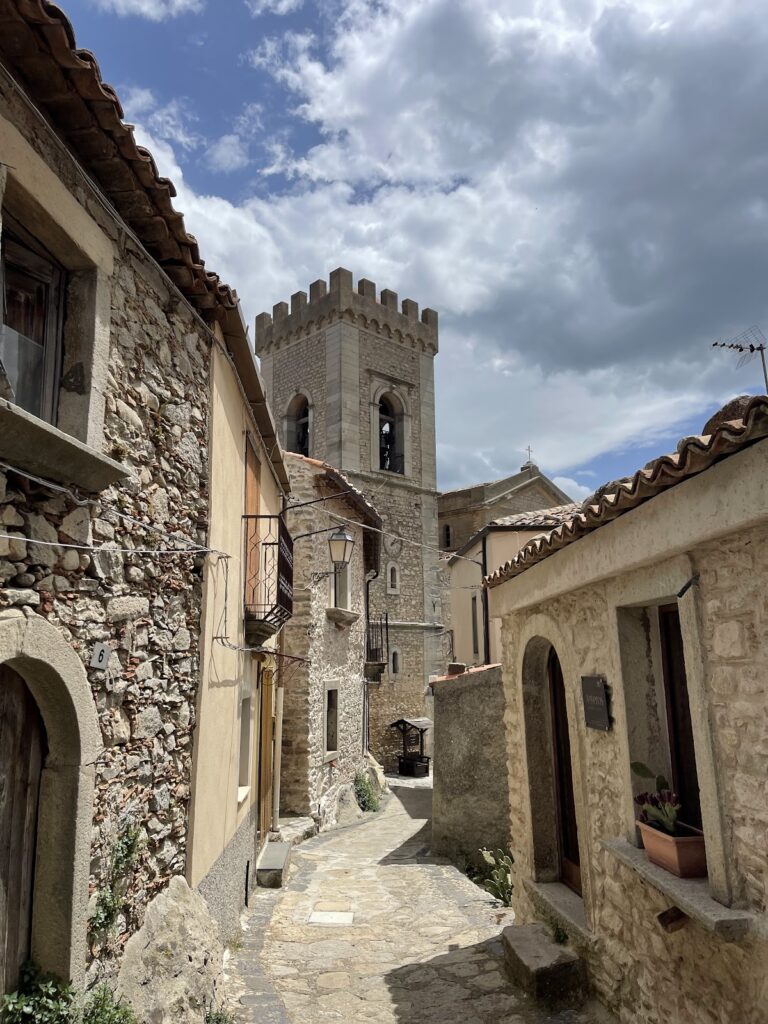
The bell tower belongs to a late-sixteenth-century rebuilding phase. It is described as a reconstruction of 1578 and is also associated with Bishop Gilberto Hisfar and the date 1588. The tower rises to a stated height of 30 metres.
The counterfaçade has exposed masonry and two niches containing remains of early sculptures. In the upper lunette, an imperial eagle appears with a coat of arms. Festooned stucco frames two oval frescoes depicting saints.
Nave and western interior
Southern nave bays
The interior follows a Latin-cross plan, in which a long central axis is crossed by a shorter transept. Along the southern wall of the nave, the first bay contains a marble inscription to Nicola Gatto. The second has an opening and marble inscriptions associated with Pietro Galletti, Carlo Mineo, and Salvatore Pisano. In the third bay, an altar holds an Adoration of the Shepherds attributed to the Flemish painter Guglielmo Borremans and dated 1725. Two cockerel motifs refer to its commissioner, Bishop Pietro Galletti.
The fourth southern bay contains the side entrance and access to rooms corresponding to the first three nave bays. The fifth holds the altar of the Most Holy Crucifix, with a sixteenth-century wooden crucifix inside a richly decorated eighteenth-century reliquary, a container for preserving or displaying a relic. The sixth bay contains the 1758 organ attributed to Annibale Lo Bianco.
Northern nave bays
The first northern bay contains marble inscriptions and plaques. The second has an opening and a marble inscription associated with Ignazio Zambito. The third contains an altar dedicated to the Virgin, with a Madonna and Child attributed to Antonello da Saliba and dated 1531.
The fourth bay contains the Chapel of the Sacred Heart of Jesus. The fifth has another altar dedicated to the Virgin, with an 1848 painting by the Patti painter Francesco Nachera. The work shows Saint Bartholomew offering the Virgin the knife and his flayed skin, the instruments of his martyrdom. Saint Benedict of Nursia stands behind him holding his Rule, recalling the Benedictine monastery founded by Roger I. The sixth bay contains an opening.
Transept chapels
Chapel of Saint Febronia
The southern transept, or former southern apse, gives access to rooms corresponding to the fifth and sixth nave bays. Its Chapel of Saint Febronia, the patron saint of Patti, contains a polychrome-marble altar whose superstructure imitates the pediment of a Roman temple. Columns, superimposed broken-arch pediments, and a central coat of arms form the composition. A marble-framed niche holds a statue of the saint.
On the left stands the Renaissance tomb of Queen Adelasia del Vasto. Its sarcophagus, dated 1557, shows the queen reclining. The monument originally stood in a chapel of the monastery before being transferred to the cathedral. Paintings by an anonymous artist of the Caravaggio school and works attributed to the Palermo painter Pietro Novelli occupy the chapel’s left wall. An opening beside the altar leads to the sacristy, and an artistic wall bracket remains in place without its former object.
Chapel of the Most Holy Sacrament
The northern transept contains the entrance colonnade to the baptismal chapel. Its marble font has an octagonal wooden canopy decorated with friezes and gilded reliefs. The adjoining wall bears a painting of Saint Joseph with the Christ Child, an inscription, and a Resurrection of Christ.
The Chapel of the Most Holy Sacrament has a polychrome-marble altar with a Roman-temple-style pediment, columns, superimposed broken-arch pediments, and a central coat of arms. Its inner structure is a two-level ciborium, a canopied architectural structure over an altar or sacred object, shaped like a temple and topped by a dome. Marble high-relief medallions framed by pilasters depict Salvatore Pisano on the right wall and Giacomo Bonanno on the left. On the opposite wall, a baldachin-like frieze with putti rises above a painting of the Virgin, a marble bust, and the inscription of Nicola Gatto.
Presbytery
The high altar has a niche between pilasters with Corinthian capitals and a crown-like baldachin frieze. It contains a sixteenth-century marble Virgin and Child attributed to the Carrara sculptor Antonio Vanella. The statue bears the inscription “hoc opus fecit M. Ant. Vanelli Paomi.” Frescoes of Saints Peter and Paul occupy the side panels of the presbytery. At the centre stands the episcopal throne, while an eighteenth-century Baroque wooden choir lines the side walls. A marble ambo, a raised stand for proclaiming scripture, and a central chandelier donated by the Bourbons complete the presbytery furnishings.
Nearby sites