Orihuela Cathedral: Seat of the Diocese of Orihuela-Alicante


Site at a Glance
- Rating
- 4.6
- Popularity
- Low
- Country
- Spain
- Primary era
- Medieval
- External website
- Open
- Eras represented
- Medieval, Early Modern
- Civilizations
- Crown of Aragon, Crown of Castile, Spanish
- Site type
- Religious
- Remains
- Cathedral
On this page25 sections
History
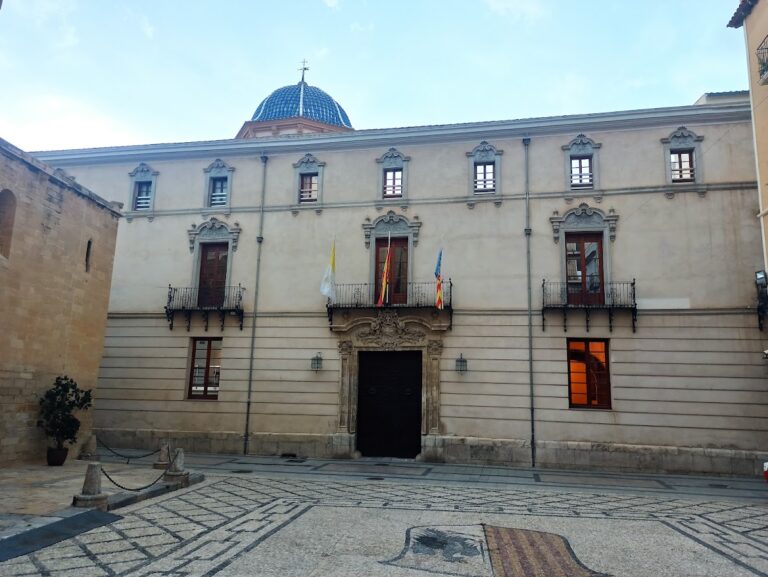
Orihuela Cathedral, formally the Cathedral of the Savior and Saint Mary, is a Spanish Gothic cathedral in Orihuela, Spain, built from the late thirteenth century onward over Visigothic and Hispano-Arabic remains, including the site of a former mosque in Madinat Uryula. It is the seat of the Diocese of Orihuela-Alicante and combines Valencian Gothic, Renaissance, Baroque, and Neoclassical phases.
Foundation and ecclesiastical development
In 1281, Alfonso X of Castile ordered that the church of the Savior and Saint Mary become Orihuela’s principal and largest church. It was given precedence over the churches of Saints Justa and Rufina and Saint James, and its parish priest received the rank of archpriest.
Orihuela passed from Castile to the Crown of Aragon in 1304 after the Treaty of Torrellas, but the church continued to depend ecclesiastically on the Diocese of Cartagena. This difference between the town’s civil allegiance and its ecclesiastical administration eventually encouraged efforts to establish a separate diocese.
Antipope Benedict XIII raised the church to collegiate status in 1413. Pope Martin V confirmed the decision in 1419. A collegiate church was served by a college of clergy but was not necessarily governed by a bishop. In 1510, Pope Julius II elevated the collegiate church to cathedral status and created the Diocese of Orihuela, while canonically joining it with Cartagena under one bishop at the recommendation of Ferdinand the Catholic. Popes Leo X and Clement VII later annulled this arrangement at the request of Charles V.
In 1564, Pope Pius IV definitively separated Orihuela from Cartagena and established its own bishopric at the request of Philip II, following the decision of the Cortes of Monzón in 1563. The Cortes of Monzón was a representative assembly of the Crown of Aragon. Gregorio Gallo de Andrade became the first bishop of the new diocese. Bishop José Esteve consecrated the cathedral in 1597. Since 1959, the diocese has shared its cathedral seat with the Co-Cathedral of Saint Nicholas of Bari in Alicante.
Construction and transformation
The building grew through four principal phases. The tower and western nave area belong to the period from the late thirteenth to the mid-fourteenth century. The crossing, sanctuary, ambulatory, and former chapter house followed from the mid-fifteenth to the early sixteenth century. The north portal and adjoining chapels were added during the second half of the sixteenth century, while the Communion Chapel and sacristy belong chiefly to the eighteenth century.
At the beginning of the sixteenth century, the crossing was reformed according to designs by Pere Compte, a Valencian architect active around the transition from the fifteenth to the sixteenth century. The cathedral was expanded northward, and Renaissance chapels were constructed as part of the same sixteenth-century reform program. The eighteenth century brought the construction or enlargement of the Communion Chapel, sacristy, chapter-house antechamber, and chapter hall. The Baroque Rosary Chapel was made in 1633, and the Neoclassical Communion Chapel was built in 1745-1747 to a design by Cristóbal Sánchez.
The cathedral’s furnishings also changed over time. A Baroque high altarpiece stood in the seventeenth century, and a possible replacement was commissioned from Nicolás de Bussy late in that century, although it is uncertain whether the commission was completed. In the eighteenth century, Jacinto Perales produced a new carved and sculpted altarpiece.
Nineteenth-century alteration and twentieth-century restoration
During the nineteenth century, Bishop Herrero altered the High Chapel by covering its Gothic pointed arches and vault and giving the interior a Neoclassical appearance. He added paintings by Vicente López Portaña, including the Resurrection of Christ and the Prayer in the Garden. These alterations were destroyed during the war. In 1942, the High Chapel was restored with the aim of recovering its Gothic character. The Gothic arcades were uncovered, while the cathedral chapter’s iron and bronze benches were removed and preserved in the Diocesan Museum. The city chapter’s eighteenth-century iron and bronze benches remain outside the chapel.
In the same year, a Renaissance cloister was transferred from the former Merced convent to the cathedral cemetery, or former burial ground. Its medieval origin is dated to 1377, while its Renaissance reconstruction around 1560 is attributed to Hernando Veliz. The relocation project by the architect Serrano Peral also provided adjoining premises for the Diocesan Museum of Sacred Art and the Cathedral Archive.
Saint Vincent Ferrer preached in the High Chapel during his visit to Orihuela in January 1411. The cathedral was declared an Asset of Cultural Interest in Spain on 3 June 1931 and forms part of the country’s historical heritage.
Remains
Orihuela Cathedral has a compact exterior formed largely by smooth ashlar surfaces with few openings. Its flat terrace roofs enclose a body of three naves, with the central nave slightly higher than the side aisles, an ambulatory behind the sanctuary, and chapels between the buttresses. The surviving fabric brings together Valencian Gothic, Renaissance, Baroque, and Neoclassical elements.
Tower and portals
Bell tower
The square-plan bell tower is the oldest part of the cathedral. Begun in the late thirteenth century, it was increased in height and width during the fourteenth century. Built of ashlar, it rises approximately 28 metres and has four levels covered by simple rib vaults, separated on the exterior by continuous mouldings.
The tower contains a former prison with inscriptions made by prisoners, old eighteenth-century clock machinery, a room for the liturgical bells, a room associated with wax, the sixteenth-century hour bell, and an eighteenth-century clock bell. A late-medieval Gothic stone spiral staircase connects the levels. Episcopal coats of arms appear in the prison chamber and at the first section of the stairway. The clock sphere is mounted on an eighteenth-century balcony. Five bells and two clock gongs remain in the tower, while its top displays the four-barred arms of the Crown of Aragon.
Door of the Chains
The fourteenth-century Door of the Chains is the cathedral’s oldest portal. It is Gothic with probable Mudéjar influence, meaning that it incorporates forms or techniques associated with Islamic traditions in Christian Spain. Its multilobed arch has figurative capitals and imposts, but no tympanum or central mullion. The portal’s name derives from chains that formerly surrounded the nearby square and the Lonjeta, where the medieval council met.
Loreto Door
The Loreto Door dates from the mid-fifteenth century and uses an archaizing Gothic style. Its original mullion disappeared in the sixteenth century and was replaced by a Renaissance basket-handle arch. Sculpted singing and instrumental angels fill the archivolts. The portal leads toward the Loreto Chapel, which belongs to the cathedral but stands outside the main building.
Door of the Annunciation
The north Door of the Annunciation was completed in 1588 by Juan Inglés. This Renaissance portal is arranged like a triumphal arch, with paired columns carrying Corinthian capitals and two niches. The spandrels contain an Annunciation scene in which the Archangel Gabriel tells Mary that she will become the mother of Jesus.
Nave, crossing, sanctuary, and ambulatory
Naves and chapels
From the entrance to the crossing, the interior has a higher central nave and two lower side aisles. Light enters through the façade rose window and upper windows above the lateral aisles. The pilasters have attached paired columns, and simple rib vaults cover the nave. Their keystones bear the four bars of Aragon and the arms of Peter IV of Aragon.
The northern side chapels replaced earlier Gothic chapels and have Renaissance barrel vaults decorated with coffering. Elsewhere, the original Gothic chapels between the buttresses survive.
Crossing and High Chapel
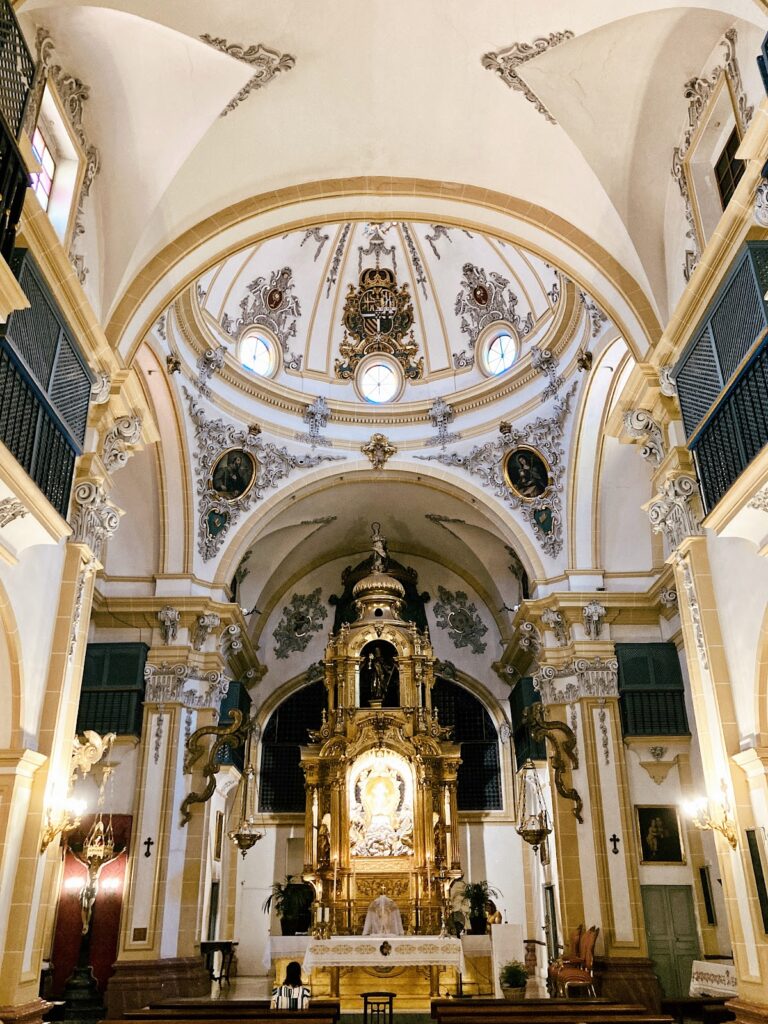
The crossing was formed during the early-sixteenth-century expansion by removing two pillars in front of the High Chapel and adding two transverse arches on pillars, together with another arch resting on the buttresses. A crossing is the point where the nave, transept, and sanctuary meet. Here the alteration created a taller space across all three naves, giving the interior the impression of a single nave.
The crossing vault has six sections and twisted ribs that imitate palm trees. Seven carved, painted, and gilded wooden bosses were added in the eighteenth century. An eighteenth-century Baroque wrought-iron Via Sacra links the High Chapel and choir.
The rectangular sanctuary is defined by the closing walls of the side chapels and the former chapter hall. The exterior of that former hall has a Flamboyant Gothic window. Between the crossing and ambulatory, the irregularly hexagonal High Chapel has a star vault from the second half of the fifteenth century. A star vault is a rib vault whose structural pattern forms a star-like network.
The High Chapel’s surrounding Gothic ironwork is supplemented by a principal Renaissance screen designed by Jerónimo Quijano and made by the French metalworkers Savanán of Cartagena. The screen takes the form of a three-section, four-level Plateresque altarpiece with an attic. Its central medallion depicts the Annunciation, and the attic contains the Crucifixion.
Ambulatory
The ambulatory was constructed during the sixteenth-century expansion. An ambulatory, or passage running behind the main sanctuary, allows movement around the High Chapel. Its Gothic vaulting covers irregular trapezoidal and pentagonal bays between the High Chapel, the side chapels, and the sanctuary.
Near the sacristy antechamber is a bell wheel containing several Gothic bells, together with an eighteenth-century Baroque wrought-iron screen separating the church from the sacristy entrance.
Chapels
Saint Barbara and Our Lady of Solitude
The Chapel of Saint Barbara was remodeled in the sixteenth century and has a coffered arch vault. It contains a large Baroque image of Saint Barbara, an eighteenth-century white-marble baptismal font, and a sixteenth-century Italian-influenced painting of the Virgin of the Populo.
The Chapel of Our Lady of Solitude was also remodeled in the sixteenth century and has a coffered vault. Its principal image was made by José Sánchez Lozano.
Immaculate Conception and Christ of Calvary
The Gothic Chapel of the Immaculate Conception has a rib vault and a strongly vertical Gothic window. Its image of the Immaculate Conception was made by José Sánchez Lozano.
The Gothic Chapel of Christ of Calvary contains an image by the Valencian sculptor Enrique Galarza Moreno, the present bishops’ crypt, and a rose window that illuminates the chapel and part of the ambulatory. The entrance to the Main Sacristy is beside it.
Communion Chapel
The large Communion Chapel was commissioned by Bishop Gómez de Terán in the eighteenth-century Neoclassical style. Neoclassicism revived restrained forms and proportions associated with classical antiquity. The chapel is oval and opens from the ambulatory through a Gothic-style screen. It has three altars: a high altar dedicated to the Eucharist, and lateral altars dedicated to Our Lady of the Pillar and the Souls in Purgatory. The latter has a large-format painting by Eduardo Vicente, while a bust of Our Lady of Sorrows by Francisco Salzillo stands at the rear.
The high altar has an eighteenth-century Neoclassical tabernacle containing a sixteenth-century silver cross from the workshop of Miguel de Vera. A tabernacle is a structure used to reserve the consecrated Eucharist. Above it, the vault rises to a hemispherical dome on a drum.
Rosary Chapel
The Baroque Rosary Chapel, dating from the seventeenth and eighteenth centuries, has a richly decorated retable made during those centuries by Bartolomé Perales and his son. Its central section contains the seventeenth-century image of the Virgin of the Rosary, while the side sections show reliefs of the Mysteries of the Rosary.
The attic contains a large fourteenth-century Gothic crucifix with the Virgin and Saint John, flanked by Saints Peter and Paul and outer sculptures of the apostles. The chapel also contains the former burial area of the Rosary confraternity and has the status of a Perpetual Privileged Altar.
Saint Catherine and Loreto
The Gothic Chapel of Saint Catherine provides access to the chapter room. Its large Gothic altarpiece depicts Saint Catherine and her martyrdom. The Desprades family commissioned it for their former cathedral chapel, now the Chapel of the Sacred Heart, and the family arms appear on sections of its surrounding frame.
The Gothic Chapel of Our Father Jesus of Loreto contains an eighteenth-century full-length image of Jesus the Nazarene by Francisco Salzillo. The figure is shown falling.
Sacred Heart, Saint Joseph, and Saint Peter
The Gothic Chapel of the Sacred Heart of Jesus was formerly the chapel of the Desprades family, whose patronage later passed to the family of the Duke of Pinohermoso. Its Renaissance screen from the first half of the sixteenth century is crowned by a triangular pediment bearing the Desprades arms.
The Gothic Chapel of Saint Joseph contains an image of Saint Joseph with a pedestal attributed to José Vergara. The Chapel of Saint Peter has an eighteenth-century painting of the saint by the Murcian painter José Campos. It also contains Eduardo Vicente’s Christ Healing the Lepers and, on the opposite side of the Door of the Chains, another painting by Vicente depicting the Baptism of Christ.
Choir, screens, and sacristies
Choir
The choir is connected to the High Chapel by the eighteenth-century Via Sacra. Valencian sculptor Juan Bautista Borja made it between 1716 and 1719 on commission from Bishop Castilblanc. Carved from walnut left in its natural colour, it combines abundant Baroque-classicizing carving with predominantly straight lines.
Forty-five stalls accommodate canons, privileged clergy, and presbyters, with the episcopal chair at the centre of the second level. Reliefs on the stall backs depict biblical episodes, including the capture of Jerusalem. Above the episcopal chair is a group representing Christ the Savior of the World. The choir also contains an eighteenth-century lectern and a Gothic music stand dated 1492.
A Renaissance screen encloses the choir. Its outer face bears the arms of Charles V, while its inner face bears those of the Crown of Aragon. Jerónimo Quijano designed the screen, which was made by Savanán of Cartagena.
Sacristies and chapter house
The sacristy antechamber contains an eighteenth-century Baroque red-marble fountain, paintings including Saint Christopher and the Immaculate Conception, and a large carved wooden door leading to the Main Sacristy. The hexagonal Main Sacristy was built in 1723. Its furnishings include a chest of drawers made in 1734 by José Ganga Ripoll, with gilded bronze handles by the silversmith Bernardo Gil. Pedro Juan Codoñer made the carved boss supporting the sacristy lamp in 1728.
A reliquary cabinet made by Jacinto Perales in 1735 contains relics associated with Saints Severa, Florinda, Peter, Victor, Zephyrinus, Vincent Ferrer, and the True Cross. A reliquary is a container for sacred relics. The reliquaries were made by goldsmiths including Miguel de Vera and Hércules Gargano.
The cathedral retains Gothic, Renaissance, Plateresque, and Baroque screens, including the screens of the High Chapel and Communion Chapel, the Renaissance screen of the Sacred Heart Chapel, the Renaissance choir screen, the Plateresque High Chapel and chapter-house screens, and the Baroque screen in the sacristy antechamber.
The eighteenth-century chapter house has a Plateresque portal and a sixteenth-century wrought-iron screen. It now houses the Museum of Sacred Art. The Minor Sacristy is also an eighteenth-century work, furnished with contemporary carved Baroque furniture, and serves the Communion Chapel.
Organ, art, and cathedral collections
The Baroque organ was made in Valencia in 1733 by Nicolás de Salanova and Martín de Userralade. It has more than 72 stops, a positive division, and a large battle-trumpet section, with all its pipes made of tin. The instrument was transformed into a Romantic-style organ late in the eighteenth century. Its gilded, carved, and sculpted case is polychrome, bears the four-barred arms of the Crown of Aragon, and has painted decoration on its lower section.
The cathedral and museum contain paintings by Diego Velázquez, Vicente López Portaña, Matthias Stomer, José de Ribera, Valdés Leal, Paolo de San Leocadio, Luis de Morales, Juan de Juanes, Bernardo López Piquer, Luis López Piquer, Pedro de Orrente, Nicolás de Villacis, Alonso Sánchez Coello, and Jerónimo Jacinto Espinosa. The collection also includes a seventeenth-century Russian icon.
Sculpture holdings include works by Francisco Salzillo and José Vergara, the sixteenth-century Holy Thursday Monument chest, and surviving sections of cathedral retables made between the sixteenth and eighteenth centuries. Silverwork comes from workshops and artists including Hércules Gargano, Miguel de Vera, Ruvira, Martínez, Domínguez, and Zapatti. Among the objects are the Silver Feather of Saint John of Ribera, the large eighteenth-century Holy Thursday Monument chest by Luis Perales, and an eighteenth-century processional monstrance by Domínguez. A monstrance is a vessel used to display the consecrated Eucharistic host.
The textile collection contains liturgical vestments made from the fifteenth century to the present in Orihuela, Madrid, Valencia, and foreign workshops. Notable examples include a Renaissance chasuble, the chasuble of Bishop Gallo, and the vestment set associated with Cardinal Bonaparte. The museum also displays eighteenth-century cathedral chapter benches, a helmet associated with the army of Charles V, more than 50 choir books, a fifteenth-century incunable, and the fifteenth-century Bible of Pope Calixtus III.
Nearby sites