Sankt-Sebastian-Kirche: Cathedral of the Diocese of Magdeburg


Site at a Glance
- Rating
- 4.7
- Popularity
- Low
- Country
- Germany
- Primary era
- Medieval
- External website
- Open
- Eras represented
- Medieval, Early Modern, Modern
- Civilizations
- Holy Roman Empire
- Site type
- Religious
- Remains
- Cathedral
On this page16 sections
History
Sankt-Sebastian-Kirche is the Roman Catholic cathedral of the Diocese of Magdeburg in Magdeburg, Germany. Founded around 1015 as a collegiate foundation, it combines Romanesque origins with later Gothic rebuilding and remains a protected cultural monument of Saxony-Anhalt on the Romanesque Road.
Foundation and the cult of Saint Sebastian
Archbishop Gero laid the foundation stone around 1015, and after his death in 1022 he was buried in the church. The foundation was served by canons, members of a religious institution who lived and worshipped together without following a monastic rule. The church initially had three patrons: Saint Sebastian, John the Evangelist, and Fabian. After the foundation obtained a head relic of Saint Sebastian, his dedication became the dominant one.
The relic acquired a role in the religious and political history of the archdiocese. When the army of Henry IV approached, it was carried along the border of the Archdiocese of Magdeburg. In later years, the relic was taken each year on 20 January in a procession from the cathedral to Sankt-Sebastian-Kirche.
Romanesque church and Gothic rebuilding
Several extensions altered the original Romanesque church before fires destroyed it in 1188 and again in 1207. During the first half of the fourteenth century, the building was reconstructed in the Gothic style. The older choir, probably dating from Gero’s period, was demolished and replaced by a larger one. At the beginning of the fifteenth century, the nave was remodelled as a Late Gothic hall church while the earlier Romanesque ground plan was retained. Archbishop Ernst reconsecrated the church on 17 May 1489.
The church also became involved in the military history of Magdeburg. During the siege of 1550 by Maurice of Saxony, cannon were placed on its towers for defensive purposes. The Reformation, the sixteenth-century movement that created Protestant churches and changed the administration of many German religious institutions, then transformed the church’s religious use. The canons renounced the Catholic faith in 1558, and the building became Protestant. In 1573 the collegiate foundation was converted into a Protestant foundation. On the first Sunday of Advent that year, cathedral preacher Siegfried Sack conducted the first Protestant service there, and Georg Rollenhagen served as preacher from 1573 to 1609.
Destruction and changing uses
During the storming of Magdeburg on 10 May 1631, an episode of the Thirty Years’ War, the major European conflict of 1618–1648, the church burned down. It was still described as a ruin in 1642. The choir was rebuilt in 1663, but the first service after the destruction did not take place until 1692.
A cloister north of the church later fell into ruin and was used as a cemetery. The street name Friedhof continued to recall that use until after the Second World War. Respected citizens were also buried inside the church. From 1756, religious services ceased, and the building became a warehouse. The tombstone of Archbishop Gero disappeared from the choir toward the end of the eighteenth century.
During the French occupation, Jérôme Bonaparte dissolved the collegiate foundation on 1 December 1810. French troops used the church as a field forge and stored beer, spirits, and salt inside it. Magdeburg bought the building from Prussia in 1823 for 1,300 thalers and used it as a wool warehouse. Members of the German Catholic movement held religious services in the choir between 1845 and 1854.
Return to Catholic use
In 1865, the Liebfrauen Foundation bought the church from Magdeburg for 25,000 thalers and offered it to the Catholic Marien parish in exchange for the Liebfrauenkirche. The parish rejected the offer because Sankt-Sebastian-Kirche was in poor structural condition. Under a settlement reached in 1873, the Liebfrauen Foundation transferred the church to the Catholic congregation without payment and contributed to its restoration. The building was renovated and received new stone vaults.
In May 1878, the Catholic Marien parish moved from the Liebfrauenkirche to Sankt-Sebastian-Kirche, adopted Saint Sebastian as its patron, and transferred the Catholic provost church there. The first Roman Catholic Mass in the building since the Reformation was celebrated in 1878. Another extensive renovation followed in 1928.
War damage and cathedral status
An air raid on Magdeburg on 16 January 1945 damaged the church during the Second World War. Repairs to the nave were completed by 1946. Because other central-city churches had suffered more severe destruction, Sankt-Sebastian-Kirche was initially shared by different denominations. Its approximately 44-metre-high towers were restored later.
From 1949, the church served as the episcopal church of the auxiliary bishop of the Archdiocese of Paderborn. An auxiliary bishop assists a diocesan bishop without being the ordinary head of the diocese. Major building and restoration campaigns took place from 1953 to 1959 and from 1982 to 1991. These works included underfloor heating and a new episcopal crypt.
Magdeburg became an independent Catholic diocese again in 1994. Sankt-Sebastian-Kirche then became its cathedral and the seat of the cathedral chapter, the body of clergy associated with a cathedral’s administration and liturgical life. The cathedral served under Bishop Leo Nowak until his retirement in 2005 and subsequently under Bishop Gerhard Feige.
Recent ecclesiastical development
Building work completed in 2005 redesigned the interior and added a covered cloister, a new sacristy, and a chapter cemetery. A new people’s altar was installed with a tooth relic of Saint Sebastian, derived from the saint’s skull relic preserved at the Benedictine Schotten Abbey in Vienna. In 2007, cathedral canon Ulrich Lieb consecrated a room beside the west portal for the silent remembrance of deceased children. The church marked the thousandth anniversary of its foundation in 2015.
The Cathedral Parish of St. Sebastian was established on 2 May 2010 from the Magdeburg-Mitte community association, founded in 2006. The former Propstei St. Sebastian and the parishes of St. Norbert, St. Adalbert, and St. John the Baptist were dissolved and incorporated as subsidiary congregations. Parish leadership passed to Cathedral Provost Reinhold Pfafferodt on 1 August 2010. Daniel Rudloff has served as cathedral parish priest since 1 September 2020. The St. Marienstift Chapel also belongs to the parish.
Remains
Building fabric and spatial arrangement
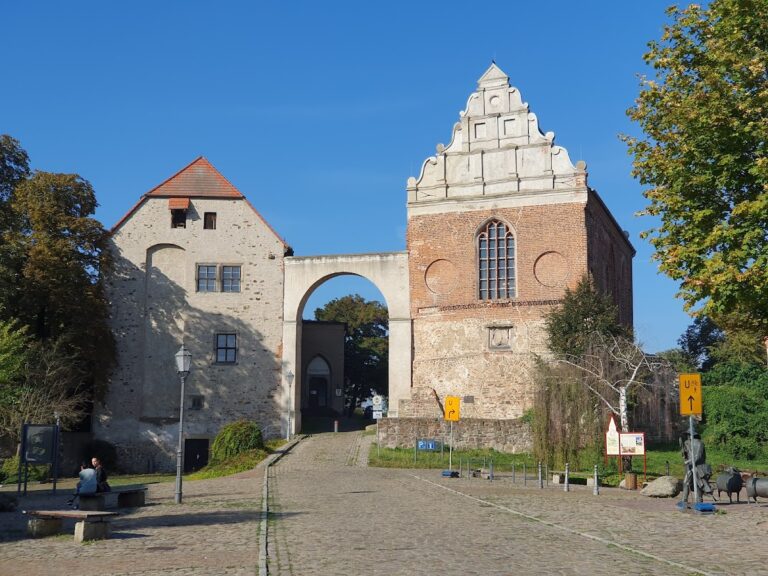
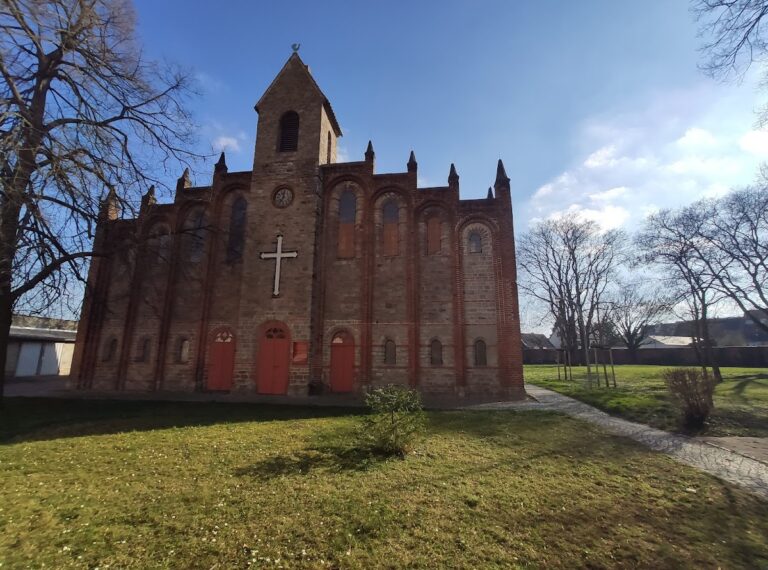
Sankt-Sebastian-Kirche is a brick church whose surviving fabric brings together Romanesque and Gothic elements. The Gothic rebuilding preserved the earlier Romanesque ground plan. The larger Gothic choir replaced the earlier sanctuary in the fourteenth century, while the nave became a Late Gothic hall church in the early fifteenth century. A hall church has a central nave and side aisles of approximately similar height.
Choir and altar area
The choir rebuilt in 1663 has a vaulted wooden ceiling, while the nineteenth-century restoration supplied new stone vaults. The interior contains a central nave and an altar area partly redesigned in the early twenty-first century. The high altar has a retable, and the choir contains a Gothic winged altarpiece made between 1510 and 1520.
Towers, portals, and cloisters
Two towers rise to approximately 44 metres. The south tower contains a four-part steel bell set made by the Bochumer Verein in 1955. The bells are tuned to a°–c′–d′–f′; the largest weighs 2.8 tonnes and measures 1.98 metres across. On the west side, the Angels’ Portal includes ironwork. The former cloister lay north of the church, while the later complex includes a covered cloister, a new sacristy, and a chapter cemetery.
Memorial room and textiles
A room beside the west portal is dedicated to the silent remembrance of deceased children. The church also preserves eight tapestries made by Christine Leweke in the 1950s and 1960s. Each measures 100 by 150 centimetres.
Organs
Earlier main organs
The original main organ was built by Ernst Röver of Hausneindorf in 1916, or according to other information in 1918–1919. It had three manuals, or hand-operated keyboards, and 45 stops, each controlling a set of organ pipes, and stood on the west gallery. It remained usable after the Second World War.
A. Schuster and Son built a replacement on the west gallery in 1959. It had three manuals, a pedal keyboard operated by the feet, and 47 stops. Its exposed-pipe facade was designed by the Halle artist Fritz Leweke. Five stops from the earlier organ were incorporated into the pedal, and the previous wind chests for the Hauptwerk, Oberwerk, and pedal were reused. The instrument used electro-pneumatic action and registration, and its design reflected the Organ Reform Movement, which sought to revive principles associated with earlier organ-building traditions.
The 1959 organ had no case and was vulnerable to falling plaster and bird droppings. Erwin Lägel restored it to full working order in the late 1980s after the Hauptwerk became unplayable, but its condition later deteriorated. It sounded for the last time on 30 August 2001 and was sold to the Heilig-Geist parish in Dębica, where it continued in use after thorough restoration.
Eule main organ
After the west gallery was remodelled, the Eule company built a new main organ there in 2005. Instrument no. 637 has 56 stops on three manuals and pedal. Its tonal design is principally rooted in central German Classical and Romantic styles, with several French symphonic stops. The console follows the design of F. Ladegast and has curved stop jambs.
The organ has mechanical and Barker-lever couplings, a Heuss decimal combination system with 10,000 combinations stored electronically on a USB medium, forward and reverse sequencer controls, and a register crescendo roller with 60 levels and four freely programmable settings. It also has register lock, reed and mixture cancellation, a Barker lever for the third manual, and tremulants adjustable in speed and intensity. Its Rückpositiv, a smaller organ division behind the organist, includes the stop Vox strigis. When it is pulled, a side hatch opens and a life-size owl replica emerges as an allusion to the builder’s name, Eule.
Choir and chest organs
The choir organ was begun by A. Schuster and Son in 1992 on the west wall of the north transept. It initially had 11 stops and reached 13 stops in 1999. The successor company, Welde, completed it in 2001. It moved to the north wall of the high choir in 2004, when an exposed 16-foot stop was added to the outside of the rear case wall, bringing the instrument to 20 stops on two manuals and pedal. It has mechanical action and registration, a facade designed by Fritz Leweke, and a Zimbelstern. In 2017, Vogtland Organ Building Thomas Wolf cleaned and revoiced it and installed a new Neidhardt temperament, a keyboard tuning system associated with the eighteenth-century German theorist Neidhardt.
Since 2018, the church has also contained a five-stop chest organ by Johannes Kircher of Heidelberg. A chest organ is a compact portable or semi-portable pipe organ. This instrument can be transposed between 415, 440, and 465 hertz.
Nearby sites