Phoenice: Ancient Greek and Roman City in Albania


Site at a Glance
- Rating
- 4.5
- Popularity
- Very Low
- Country
- Albania
- Primary era
- Classical
- External website
- Open
- Eras represented
- Classical, Medieval
- Civilizations
- Ancient Greek, Byzantine, Roman
- Site type
- City
On this page15 sections
History
Phoenice is an ancient Greek and Roman city in Albania, centered on a hill near Finiq and founded by Greek colonists associated with Corinth and Corcyra in the second half of the fifth century BC. The Chaonians, one of the three principal Greek tribal communities of Epirus, also played a central role in its foundation and development. The city became the political center of Chaonia and grew into the wealthiest and most powerful city in Epirus.
Greek foundation and Epirote government
Phoenice’s position strengthened after Ambracia detached itself from the Epirote political system. From 224 BC, Phoenice served as the capital of Epirus. After the Epirote monarchy was abolished around 233 BC, the city became the center of the Epirote League, a federal organization of the communities of Epirus.
The theater was also a political meeting place for the “Public of the Epirotes around Phoenice.” Decisions concerning peace, war, and other public matters were made there. Three annually elected officials represented the Molossians, Chaonians, and Thesprotians: the hipparchos, an official associated with command of cavalry; the secretary of the assembly; and a guarantor. Dodona served as the cult center associated with Phoenice.
War and Roman expansion
In 231 BC, Queen Teuta’s Illyrian army captured Phoenice after its garrison of 800 Gallic mercenaries surrendered. An army sent by the Epirote League was defeated in the Battle of Phoenice. The Illyrians later withdrew because of an internal rebellion, and the city and its free-born captives were returned to the Epirotes for ransom. The killing of Roman merchants during the occupation contributed to the outbreak of the First Illyrian War.
In 205 BC, Phoenice hosted a peace treaty between the Kingdom of Macedon and the Roman Republic, bringing the First Macedonian War to an end. During the Third Macedonian War, the Chaonians and Thesprotians supported Rome, while the Molossians supported Macedon. The pro-Roman forces were based at Phoenice under Charops.
After Rome conquered Epirus in 167 BC, Phoenice was spared the destruction inflicted on many communities that had supported Macedon. Roman occupation was initially limited, but the city later underwent renovation and its settlement spread beyond the earlier Greek and Hellenistic core. Ancient writers including Polybius, Strabo, Livy, and Ptolemy described Phoenice as a strongly fortified and strategically placed city near the coast and north of Butrint. The city also lay on the route to Nicopolis described in the Itinerarium Antonini and the Tabula Peutingeriana.
Late Antique Christian center
During the fifth and sixth centuries AD, Phoenice was an important settlement in Epirus Vetus, a Late Roman and Byzantine province in the western Balkans, and became the seat of a Christian bishopric. Valerian was associated with the city at the Councils of Ephesus in 431 and Chalcedon in 451, major Christian assemblies concerned with doctrine and church governance. Later bishops included Philip in 516, Peregrinus in 552, and Eustathius in 568.
According to the sixth-century historian Procopius of Caesarea, Emperor Justinian I, who ruled from 527 to 565, moved the city from the plain to the hilltop because the lower area was becoming marshy and fortified the elevated settlement. Other accounts place Justinian’s fortifications on a hill beside Phoenice. The city remained a Christian center during Late Antiquity, with a basilica, baptistery, and other religious buildings. After the sixth century, the urban center shifted toward nearby Mesopotamon, although settlement at Phoenice continued through the Middle Ages and ended only after the Ottoman conquest in the second half of the fifteenth century. Eustathius later transferred the episcopal see to the monastery of Mesopotamon, and subsequently to Delvina and the monastery of Kamena near Kakodhiq.
Rediscovery and archaeological investigation
Nineteenth-century travelers, including the British consul William Martin Leake, recognized the importance of the ancient site. Formal excavation began in 1924 under the Italian Archaeological Mission led by Luigi Maria Ugolini. Investigations from 1924 to 1928 involved French and Italian archaeologists and were partly shaped by Fascist Italy’s political and nationalist objectives. Ugolini attempted to connect prehistoric finds with the Illyrians and associated some materials with the Iron Age culture of southern Italy.
After 1928, excavation concentrated mainly on the nearby sites of Kalivo and Çuka e Aitoit, where work continued until 1943. Research at Phoenice resumed after the Second World War, including excavations by Albanian and Soviet archaeologists from 1958. Following the political split between Albania and the Soviet Union in 1961, Albanian authorities continued the work. Albanian archaeologists Bace and Bushati published findings in 1989, although a complete report of this phase was not issued.
Major investigations took place in 1980–1981 and 1989–1991. An Italian-Albanian mission led by the University of Bologna in cooperation with the Albanian Archaeological Institute resumed archaeological work from 2000, concentrating on the House of the Two Peristyles, the thesauros-basilica area, the theater, the necropolis, and the surrounding territory.
Remains
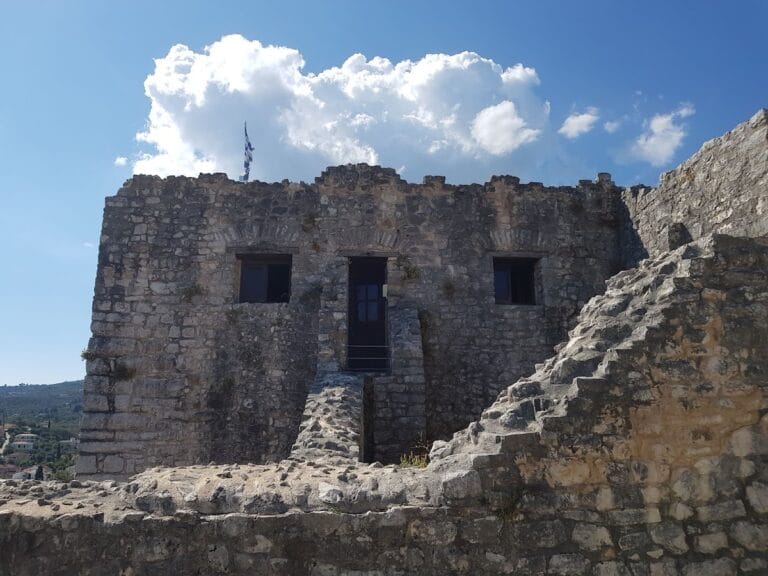
Hilltop city and fortifications
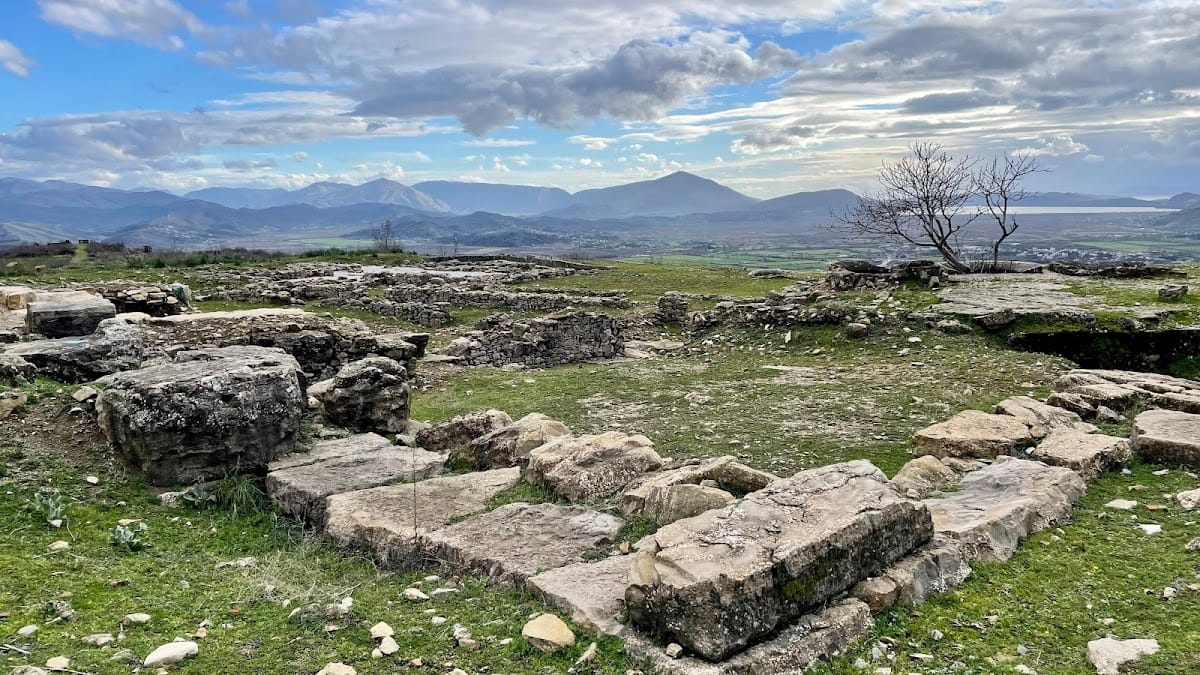
Phoenice was built around a hill that rises to approximately 283 meters above sea level, in the center of a broad plain associated in antiquity with the Caliassa and Bistrica rivers and Lake Butrint. The Greek and Hellenistic settlement occupied the summit and extended onto the southern slopes, while Roman-period buildings spread across the plain below.
The acropolis, also called the agora, occupied the highest level of the hill. An acropolis was the elevated fortified and civic center of an ancient city, while an agora was its public communal space. At Phoenice, the two terms describe the city’s central social and architectural complex. It retained this central role during the city’s later decline and contained major monuments including the thesauros and a large basilica.
The defenses developed through three principal phases. The first began with the city’s foundation around the fifth century BC and continued until the middle of the fourth century BC. A second phase began in the mid-fourth century BC during a period of major development. The third accompanied rapid expansion and the first local coinage, issued around the third century BC with an inscription naming Phoenice. The earliest walls were built from massive blocks and reached approximately 3.6 meters in thickness.
The southern slopes were reshaped into terraces as part of Hellenistic monumental urban planning. During the third century BC, the settlement expanded across the central and western sides of the hill. Roman occupation brought buildings onto parts of the acropolis and extended the urban area more widely across the plain.
Theater
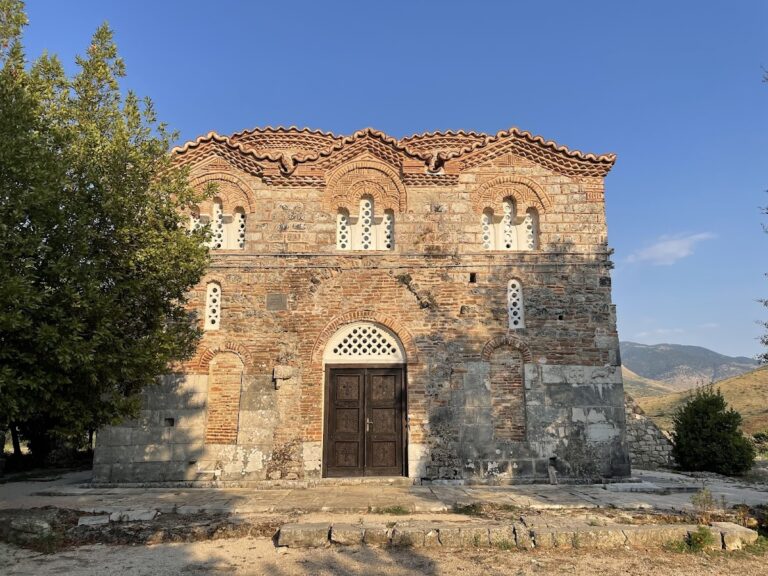
The theater was constructed into the hillside, with its opening toward the monastery of the Forty Saints. It had an estimated capacity of about 17,000 people and a stage façade approximately 30 meters wide. Three structural phases have been identified. The earliest belongs to the beginning of the fourth century BC, the second to the third century BC, and later work renovated the building in the second century BC before a reconstruction under Roman rule in the second century AD.
The orchestra, the circular performance area, measured 19.80 meters in diameter. The cavea, or seating area, extended approximately 129.5 meters from its center to the top of the seats. Carefully arranged passageways divided the seating steps. Very large pedestals on the stage preserve impressions of their former bases and supported exceptionally large statues of ancient deities or emperors.
Civic and religious buildings
Thesauros and basilica
A Hellenistic thesauros, meaning a treasury building for communal or religious wealth, stood in the acropolis area. Luigi Maria Ugolini identified it during the first excavations in 1926. It housed the city’s treasury and the treasury of the Epirote public. The remains lie near traces of a very large basilica. Excavations in the central area also revealed two Roman cisterns, including a large cistern dated to the second century AD.
Christian churches and baptistery
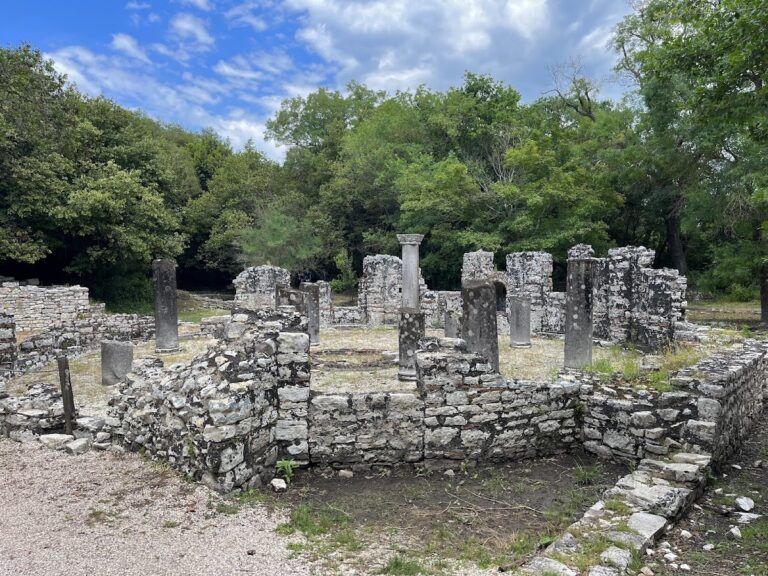
Phoenice contained a Christian basilica, a baptistery, and other religious buildings influenced by the architectural style of the large basilicas at Nicopolis. A Christian church stood a few meters from the basilica. At Palea Avli, ruins of Late Antique Christian temples preserve varied mosaics.
The episcopal church dedicated to the Virgin Mary as “Zoodochos Pigi” appears to have been built over an earlier basilica. A later church with the same dedication was rebuilt in the center of the settlement on the mountain slopes.
Domestic buildings, burials, and finds
House of the Two Peristyles
The House of the Two Peristyles is a characteristic third-century BC residence with an almost square plan covering approximately 700 square meters. Its arrangement centered on a large rectangular courtyard with a peristyle, a colonnaded court, around which several smaller rooms were placed.
Necropolis and tombs
A large necropolis occupied the southern base of the hill and was used during both the Hellenistic and Roman periods. Excavations in 1980–1981 uncovered additional Hellenistic tombs, including one probably dating from the end of the fourth century BC and containing rich grave goods.
Pottery, coins, and surrounding structures
The necropolis and settlement produced abundant pottery and approximately 358 coin types, including 314 Hellenistic examples. Coins bearing an inscription identifying Phoenice reveal commercial exchanges with prosperous cities between the fourth and first centuries BC. Other excavated remains include Hellenistic domestic buildings, Roman houses, and structures dating from the fourth century BC to the fourth century AD. Three buildings outside the principal defensive enceinte, or main fortified boundary, may have formed a prytaneion, a civic building associated with public administration, although this interpretation remains tentative.
A Hellenistic tomb beside the road linking Phoenice with its hinterland was damaged in June 2012. Heavy construction equipment cut a trench several meters deep through the hillside, scattering the tomb’s stones.