Wanstead Park: A Historic Landscape and Former Country Estate in the United Kingdom

Site at a Glance
- Rating
- 4.9
- Popularity
- Very Low
- Country
- United Kingdom
- Primary era
- Early Modern
- Eras represented
- Early Modern, Modern
- Civilizations
- British, English
- Site type
- Civic
- Remains
- Park
On this page10 sections
History
Wanstead Park is a historic park in the United Kingdom, shaped by the development of Wanstead Manor, its royal hunting estate, and the eighteenth-century Palladian country house that once stood nearby. The wider Wanstead area was occupied from about the fifth century BC, and excavations in 1985 demonstrated this early activity. The place-name probably has Anglo-Saxon roots, combining words for a hill and a settlement.
Medieval Manor and Royal Hunting Estate
Tradition says that Abbot Aelfric transferred the manor to the monks of Westminster Abbey, although this story is not securely documented. The Domesday Book, the survey of landholding and resources completed in 1086 for William the Conqueror, records Wanstead Manor as held by Ralph son of Brian for the Bishop of London. At that time the manor was heavily wooded and formed part of the Forest of Essex, a royal forest governed by special Crown rules concerning woodland, hunting, and land use.
Wanstead Hall was probably modest until the fourteenth century, but by 1499 it had become substantial enough to serve as a royal hunting lodge. Henry VII purchased the estate for its park, secluded position near Greenwich Palace, hunting grounds, and use as a place where payments could be received outside the formal royal palaces. The future Henry VIII lived there during part of his father’s later reign, and both kings hunted in the surrounding woods.
Tudor and Stuart Ownership
Shortly before 1512, during Henry VIII’s reign, the park was enclosed, probably after some woodland had been cleared. Around the same time, Aldersbrook Manor was separated from Wanstead and became an independent manor. Wanstead itself remained royal for several more years.
Richard Rich, 1st Baron Rich, served as the Crown’s governor at Wanstead in 1543. Edward VI granted him ownership of the manor house and park in 1549. Rich’s son sold the estate in 1577 to Robert Dudley, 1st Earl of Leicester, who had also acquired Stonhall Manor in Ilford. The two estates were later sold together several times.
Henry Mildmay held Wanstead by 1619. After he supported the Parliamentarians during the English Civil War, a conflict between supporters of Parliament and the monarchy, the estate was forfeited to the Crown. Charles II granted it to his brother James, Duke of York, who returned it in 1662 to Sir Robert Brooke, Mildmay’s son-in-law.
The Child Family and Wanstead House
Josiah Child, governor of the East India Company, bought the manor in 1673 or 1674 and undertook extensive improvements. Among them was a series of ponds, many of which still survive with relatively little alteration. After Child died in 1699, his son inherited the estate and leased Wanstead and Stonhall to his half-brother Richard. Richard later became Sir Richard Child, 3rd Baronet, and inherited both the title and the estates.
In 1715, Sir Richard Child commissioned the Scottish architect Colen Campbell to design a new great house in the Palladian style. Palladianism drew on the classical proportions and designs associated with the Italian architect Andrea Palladio and was used in eighteenth-century Britain for imposing country houses. The new house replaced the earlier manor house and was completed in 1722. Child became Viscount Castlemaine in 1718 and 1st Earl of Tylney in 1731, and in 1734 received royal permission to pass the latter title to his heirs.
The Tylney-Long Estate and Repton’s Landscape
After the first Earl of Tylney died in 1750, his 38-year-old son John succeeded him. John continued his father’s planting schemes but adapted them toward the informal landscape style then becoming fashionable. When the second Earl died without male heirs in 1784, the estates passed to Sir James Long, the eldest son of his sister Emma. He adopted the surname Tylney-Long for himself and his descendants.
Following the death of James Tylney-Long, 7th Baronet, in 1794, the estate passed to his one-year-old son, also named James Tylney-Long. The younger James died in 1805 at the age of eleven, leaving the estates to his eldest sister, Catherine Tylney-Long, who became England’s wealthiest heiress. She married William Wellesley-Pole in 1812. After changing his surname by royal licence to Pole-Tylney-Long-Wellesley, he commissioned Humphry Repton in 1813 to extend the park’s planting. Repton was an influential English landscape designer, and some of his informal arrangements remain.
Demolition and Protection
Wellesley accumulated heavy debts and pledged the trust containing Wanstead House and its contents as security for £250,000. In June 1822, trustees auctioned the contents of the house over thirty-two days to meet the estate’s obligations and protect Catherine’s son’s future inheritance. When no tenant could be found for the house, the trustees authorised its demolition in 1825. The building materials brought only £10,000, although construction had cost about £360,000 in 1722. The house could not be separated from the park for sale because of the terms of Sir James Tylney-Long’s will.
Before 1828, Wellesley felled many trees while seeking saleable assets, damaging avenues, vistas, and groups of trees established under Sir Josiah Child and the Earls of Tylney. His son obtained a court injunction in 1828 to stop the felling of another 2,000 trees, and the injunction was upheld in 1834. Catherine died in 1825, shortly after the house was demolished, having been deserted by her husband in 1823. Wellesley retained a life interest in the remaining 5.7-square-kilometre estate until 1840. His son later inherited it and entrusted it to Henry Wellesley, 1st Earl Cowley.
In 1880, Henry Wellesley sold 0.74 square kilometres of Wanstead Park to the City of London Corporation for protection and preservation as part of Epping Forest. Epping Forest is a historic woodland and former royal forest, and its administration explains the corporation’s role in preserving the park. The municipal park officially opened in 1882. Further land was sold to Wanstead Sports Grounds Ltd in 1920. Wanstead Park is now administered as part of Epping Forest, and a management plan begun in 1992 sought to restore elements of the formal character associated with the grounds of the great house. The park is listed at Grade II* on the Register of Historic Parks and Gardens, a category for sites of more than special interest that is higher than Grade II.
Remains
Park Layout and Former House Site
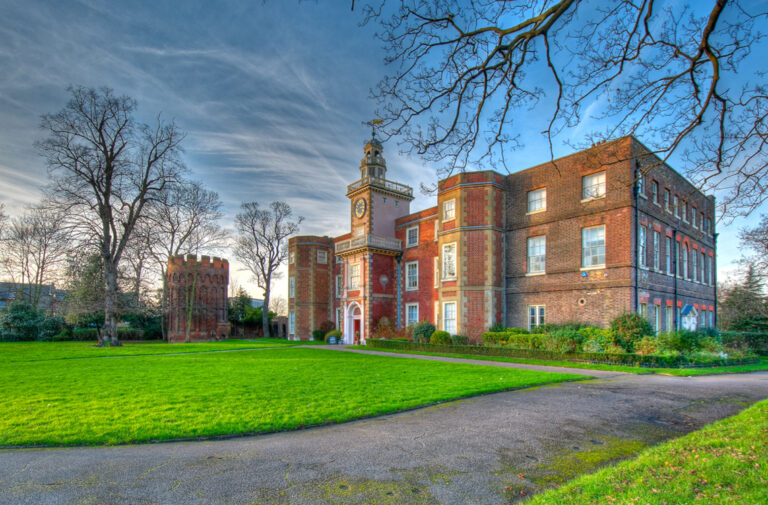
Wanstead Park covers about 57 hectares, or 140 acres, within part of the former deer park of Wanstead Manor. A deer park was an enclosed estate managed for keeping and hunting deer. The present park preserves part of the grounds of Wanstead House, although its western boundary lies about 330 yards east of the former house site. The surviving landscape combines open grassland, broadleaved woodland, woodland glades, formal avenues, ponds, and later informal planting.
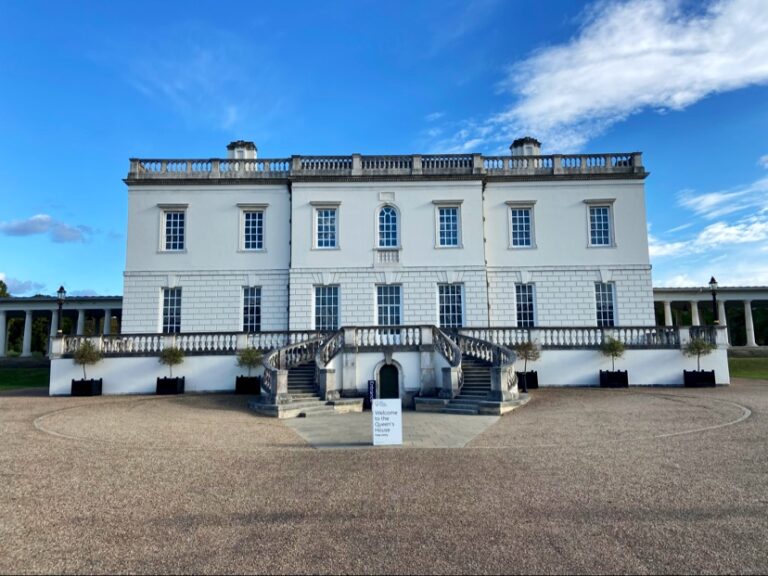
The Palladian house occupied an area measuring 79 by 21 metres. Its facade included a portico with six Corinthian columns. A Corinthian column is a classical column with an ornate capital traditionally decorated with acanthus leaves. This portico was described as the first example of its type in England. The building itself was demolished in 1825, while parts of the surrounding designed landscape survive within the park.
Gardens, Rides, and Water
George London laid out the grounds as a landscape garden with formal avenues of trees. London was a leading English garden designer of the late seventeenth and early eighteenth centuries. Later, Humphry Repton introduced more informal planting, and portions of these arrangements remain. The Glade is a broad grassy ride through woodland. It follows a direct easterly line from the former house site for about 500 yards to the Ornamental Pond.
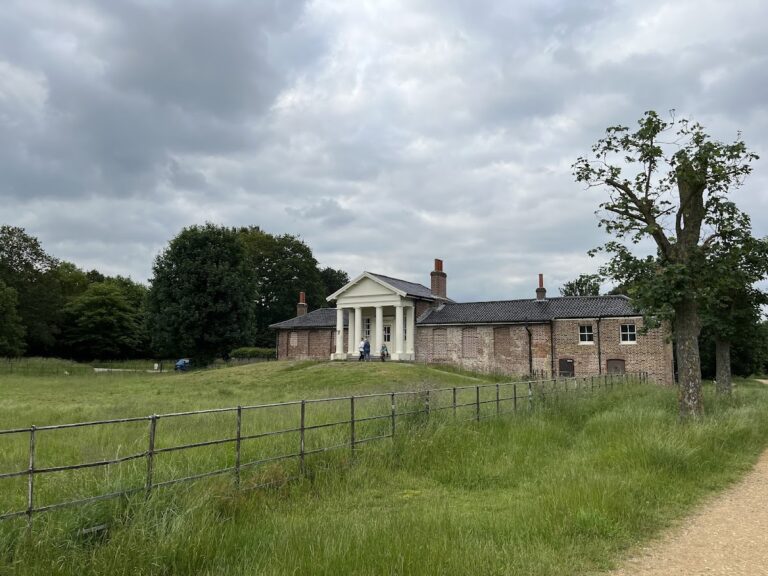
Josiah Child’s improvements included a connected series of ponds that have survived with relatively little alteration. The park’s waters include the Ornamental Pond, Perch Pond, and Heron Pond. The Temple is a surviving park structure used for displays about Wanstead Park’s history. These displays include finds from the eighteenth-century grotto and material associated with the “Lost Roman Villa.”
Woodland and Living Features
Chalet Wood forms part of the park’s woodland, which is interspersed with grassland and glades. Bluebells grow in the woods, while common gorse grows beside one of the lakes. Common rhododendron is also present and is regarded as invasive in Britain.
The notable trees include a European oak estimated to be 346 years old, which was dying and losing branches in 2020, and another European oak estimated at 330 to 340 years old. A wych elm is estimated at 280 to 300 years old, while a European yew is estimated at 465 to 480 years old. The park also contains a European aspen, and many beech trees are more than 200 years old.
Recorded animal life includes eastern gray squirrels, red foxes, Canada geese, mute swans, and parakeets, which are especially evident in summer. Additional paths have opened further parts of the park. Heavy human activity has caused widespread soil degradation and litter, while the lakes often dry out during summer, reducing aquatic life.
Nearby sites