Colpach Castle: A Medieval Stronghold and Cultural Centre in Luxembourg


Site at a Glance
- Rating
- 3
- Popularity
- Very Low
- Country
- Luxembourg
- Primary era
- Early Modern
- External website
- Open
- Eras represented
- Medieval, Early Modern, Modern
- Civilizations
- Habsburg, Holy Roman Empire
- Site type
- Domestic
- Remains
- Manor House
On this page12 sections
History
Colpach Castle is a historic fortified residence in Luxembourg, at Colpach-Bas in the municipality of Ell near the Belgian border. It began as a small medieval water fortification at the beginning of the fourteenth century and was first recorded in 1303. The site lies approximately one kilometre from the confluence of the Koulbich and Attert, and its later history reflects successive changes from a stronghold to a manor, cultural gathering place, and medical facility.
From stronghold to manor
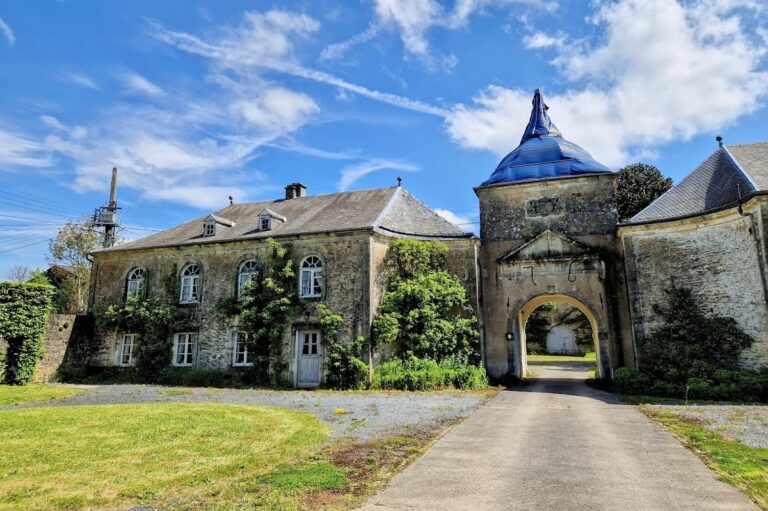
The castle belonged to the Pforzheim family from 1628 until 1817. During the eighteenth century, the family altered the character of the property by filling in the moat and converting the former fortified residence into a modest manor house. The entrance gate bears the date 1747, associated with this transformation.
In the nineteenth century, Baron Henri-Édouard de Marches administered Colpach as a farming centre while living at Guirsch Castle near Arlon. Around 1870, he created gardens around the manor. After his death, his widow, Cécile Papier, married the Hungarian painter Mihály Munkácsy in 1874. Munkácsy had first been brought to Luxembourg by the de Marches-Papier household in 1871. The couple used Colpach as their summer residence and Paris as their winter residence. After 1900, however, the castle was increasingly deserted by Cécile Papier, who died in 1915.
A nineteenth-century cultural circle
During the later nineteenth century, Colpach became a meeting place for Luxembourg’s upper society and for foreign artists, musicians, intellectuals, and other prominent visitors. Those associated with the circle included the art dealer Charles Sedelmeyer; painters László Paál, Wenzel de Brozik, Mihály Munkácsy, and Théo van Rysselberghe; sculptor Stanislas Lami; architect Otto Bartning; violinist Jenő Hubay; Cardinal Haynald; and writers and intellectuals such as André Gide, Jacques Rivière, Marie Delcourt, and Walther Rathenau.
The Hungarian composer and pianist Franz Liszt stayed at Colpach from 5 to 20 July 1886. During that stay, he gave his final recital at the Casino Bourgeois in Luxembourg on 19 July.
The Mayrisch period
Émile Mayrisch, a leading figure in ARBED, a major Luxembourg-based steelmaking group, bought the castle and its surrounding area on 27 January 1917. Between 1917 and 1920, he and his wife, Aline Mayrisch, reshaped Colpach as a centre for meetings among European politicians, economists, writers, and artists.
The resulting Colpach circle included Paul Desjardins, André Gide, Ernst Robert Curtius, Marshal Lyautey, Pierre Viénot, Jean Schlumberger, Wladimir d’Ormesson, André Siegfried, Walther Rathenau, Jacques Rivière, Otto Bartning, and Théo van Rysselberghe. In 1926, Mayrisch and several participants helped establish the Franco-German Committee for Information and Documentation. Based at Colpach Castle, the committee sought to encourage cultural exchange and European rapprochement.
Aline Mayrisch bequeathed the castle to the Luxembourg Red Cross in 1947. The Luxembourg Red Cross, the national organization responsible for humanitarian and health-related activities in Luxembourg, subsequently used the property as a convalescent home, a supervised centre for recovery after illness, injury, or medical treatment. It now operates as a medical facility for post-oncological and physical rehabilitation through the Fondation Emile Mayrisch. During the COVID-19 pandemic in Luxembourg, the castle was converted into a Red Cross rehabilitation centre, admitting approximately 100 patients in June 2020.
Émile and Aline Mayrisch are buried in the castle park. The estate has been protected as a national monument since 2002. Colp’Art, directed by Patricia De Zwaef, organizes cultural activities at the site, including sculpture exhibitions.
Remains
Colpach Castle combines the surviving former water fortification and manor house with a nineteenth-century park and the estate’s ancillary buildings, riding arena, gardens, meadows, and woodland. The moat that once protected the medieval stronghold was filled during the eighteenth-century conversion. Later alterations adapted the building for residential and institutional use while retaining an elegant, simple architectural character.
The castle and its alterations
Medieval fortification and manor house
The original building was a small water castle, meaning a fortified residence protected in part by a surrounding moat. Its entrance gate carries the date 1747, linking the surviving entrance to the conversion of the earlier stronghold into a modest manor house. The moat was filled in as part of that eighteenth-century work.
Munkácsy additions
During the period when Mihály Munkácsy and Cécile Papier used Colpach as a summer residence, the castle was adapted for seasonal domestic life. The additions included a veranda and a tower.
Mayrisch-era enlargement
Between 1917 and 1920, Sosthène Weis enlarged and modified the castle for the Mayrisch period. The work preserved the building’s elegant and simple architectural character. The castle currently contains a 60-bed medical facility for post-oncological and physical rehabilitation.
Park, gardens, and sculpture
Nineteenth-century landscape
The park created around 1870 includes a lake with an island, curved pathways, ornamental bushes, and trees. These landscape features remain visible within the estate’s gardens, parks, meadows, and woodland.
Sculptural works
Émile Mayrisch installed important art collections at Colpach. Sculptures associated with the park include works by Antoine Bourdelle, Charles Despiau, Albert Kratzenberg, Alicia Penalba, and Maillol. Works by Maillol, Despiau, Kolb, and Bourdelle remain there.