Forte del Santissimo Salvatore: A Spanish-Era Coastal Fortress in Messina


Site at a Glance
- Rating
- 4.6
- Popularity
- Very Low
- Country
- Italy
- Primary era
- Early Modern
- Eras represented
- Medieval, Early Modern, Modern
- Civilizations
- Italian, Kingdom of Sicily, Norman, Spanish
- Site type
- Military
- Remains
- Fort
On this page13 sections
History
Forte del Santissimo Salvatore is a sixteenth-century coastal fortress in Messina, Italy, built under Spanish rule to protect the entrance to the city’s natural harbor. Construction took place in the mid-sixteenth century, and the fort was completed in 1546 as part of a wider defensive response to Ottoman military pressure in the Mediterranean.
Ancient and Medieval Foundations
The San Raineri peninsula had been inhabited since antiquity. Greek pottery dating to the eighth century BC was found there, providing evidence of activity long before the present fortress. Around 1081, a tower dedicated to Saint Anne was built on the peninsula. Saint Anne is traditionally regarded in Christianity as the mother of the Virgin Mary and grandmother of Jesus.
The fort takes its name from the medieval monastery and church of the Holy Saviour. The monastery was the seat of the Archimandritate of the Holy Saviour, an ecclesiastical institution headed by an archimandrite, a senior clerical title associated with Eastern Christian monastic leadership. Saint Anne’s Tower saw fighting during the War of the Sicilian Vespers in 1282, a revolt in Sicily against Angevin rule.
Sixteenth-Century Construction
During the 1540s, the monastery and other medieval buildings were demolished as Messina’s port defenses were strengthened. The monastery was rebuilt in the area now occupied by the Regional Museum, while the church and Saint Anne’s Tower were incorporated into the new fort.
The modernization of Messina’s fortifications followed concern over the expanding Ottoman Empire. Emperor Charles V, whose Mediterranean and Italian territories faced growing Ottoman military pressure, ordered the wider defensive program after visiting Messina in 1535. Around 1534, Pietro Antonio Tomasello, a royal military engineer, prepared an initial design with a circular bastion at the tip of the peninsula. In 1540, Don Ferrante Gonzaga, Viceroy of Sicily, commissioned a larger design from Antonio Ferramolino, who succeeded Tomasello in that office. Ferramolino, a military engineer from Bergamo, designed the fortress that was completed in 1546.
Conflict, Damage, and Transformation
In 1549, an explosion in the fort’s gunpowder magazine destroyed the church. The resulting damage, along with later earthquakes, led to alterations and repairs. A major earthquake in 1783 damaged the fortress, which was repaired soon afterward.
Messinese rebels captured the fort during the 1674 uprising against Spanish rule. After the revolt was suppressed in 1678, the Real Cittadella was built nearby in the center of the San Raineri peninsula. During the Sicilian Revolution of 1848, the fort and the nearby Cittadella remained under Bourbon control and were used to bombard Messina after rebels had taken the city. Piedmontese forces captured the fort during Giuseppe Garibaldi’s Expedition of the Thousand in 1861, the campaign in Sicily and southern Italy that contributed to the formation of the Kingdom of Italy.
The earthquake of 1908 severely damaged Forte del Santissimo Salvatore. In 1909, the walls facing the port of Messina were demolished. Some restoration has since been carried out, but the complex remains only partially intact because of the earthquake damage and demolition.
Modern Military Use
In 1934, the Stele of the Madonna della Lettera was inaugurated on the fort. The Madonna della Lettera, whose title means “Madonna of the Letter,” is the patronal Madonna of Messina and is associated with the city’s religious tradition concerning a letter linked to the Virgin Mary. Pope Pius XI activated the monument’s electric illumination remotely from Rome using a device made by Guglielmo Marconi, the Italian inventor and pioneer of wireless telegraphy. Angelo Paino, then Archbishop of Messina, commissioned the monument.
The fort remains state military property and is located near the Italian Coast Guard base. It continues to function as a military base and arsenal, and since 2004 it has also served as the headquarters of the Messina Naval Support Unit of the Coast Guard. The surviving complex belongs to Italy’s military estate.
Remains
Forte del Santissimo Salvatore is a low, elongated coastal fortress whose polygonal plan follows the curved, sickle-shaped outline of the San Raineri peninsula. Built of limestone and brick, it occupies the peninsula’s tip and is positioned to control the entrance to the harbor of Messina. Its surviving structures combine the sixteenth-century defensive design with medieval fabric and later commemorative construction.
Peninsula Tip and Medieval Tower
Forte Campana
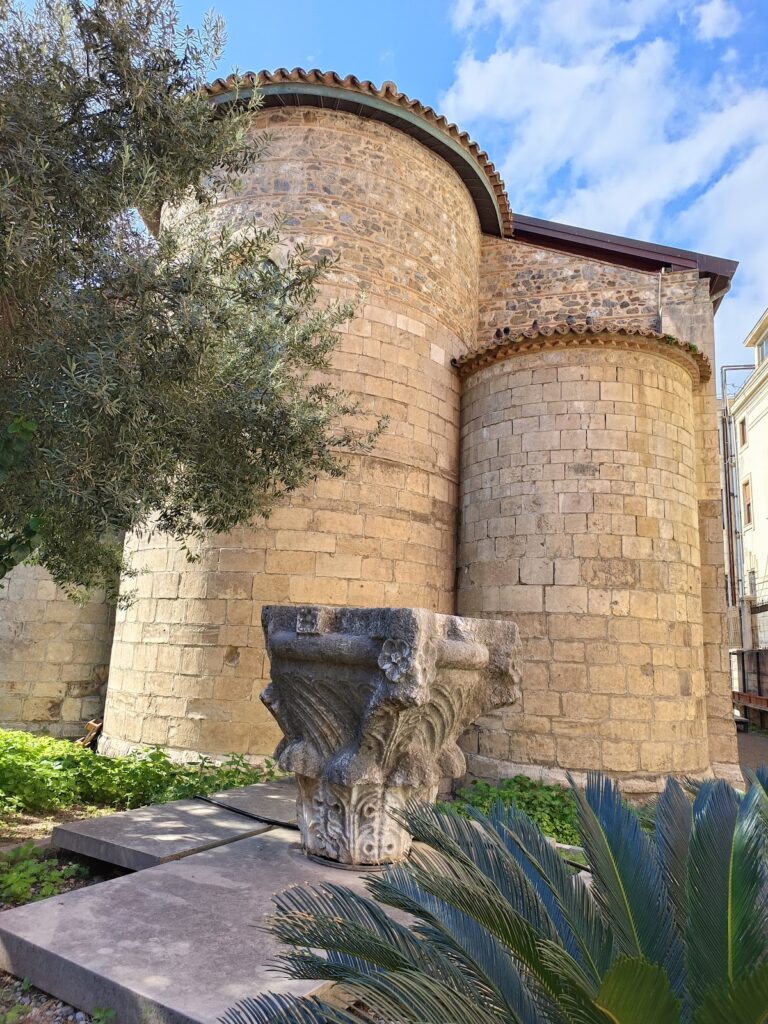
The outer end of the peninsula is occupied by Forte Campana, a semicircular or semi-cylindrical bastion. A bastion is a projecting fortification that allows defenders to fire along the faces of adjoining walls. Forte Campana is the surviving remnant of the circular bastion proposed in Tomasello’s initial design.
Saint Anne’s Tower
The medieval Saint Anne’s Tower was incorporated into Forte Campana. Its base remains recognizable within the fort, and other portions of the tower can still be seen. The tower’s position also explains the location of the later Stele of the Madonna della Lettera, which stands above the semicircular bastion on the site of the medieval structure.
Stele of the Madonna della Lettera
The stele, an upright commemorative or religious monument, was erected in 1934. It is 35 metres high, made of reinforced concrete, and faced with stone from Trapani. A seven-metre-high bronze statue of the Madonna blessing surmounts the monument. The stele has become one of Messina’s symbols.
Landward Defenses
Bastions and Main Gate
The landward front originally comprised two bastions connected by a curtain wall containing the main gate. A curtain wall is a defensive wall linking projecting fortifications. One of the landward bastions remains intact, while the other was demolished after damage caused by the 1908 earthquake.
Connecting Curtain Walls
Two curtain walls connected the landward front with the semicircular bastion. Each included artillery batteries, positions arranged for guns, and a small bastion. The wall facing the Strait of Messina survives, while the wall facing the harbor was demolished after the 1908 earthquake. These surviving and altered elements preserve the fortress’s original defensive organization along the peninsula.
Nearby sites